Choosing how to manufacture a plastic part comes down to one question more than any other: how many do you actually need? Get that answer right and the rest of the decision – cost, speed, quality – tends to fall into place. Get it wrong and you either sink money into a mould you never recover, or you pay far too much per part for a process that was only ever meant for prototypes.
Here is the short version. If you need a handful of parts, a working prototype, or your design is still changing, 3D printing is almost always the smarter choice – there is no tooling to pay for and you can hold a finished part within a few days. Once your design is locked and you are ordering in the thousands, injection molding takes over, because the cost of the mould is shared across every part and the price per piece keeps dropping. The interesting decisions live in the middle, and that is what the rest of this guide unpacks.
3D printing vs injection molding at a glance
| Factor | 3D Printing | Injection Molding |
| Upfront tooling cost | None | High – a mould must be made first |
| Cost per part | Flat – similar at 10 or 1,000 units | Falls sharply as volume rises |
| Best volume range | 1 to ~1,000 parts | ~1,000+ (excels at 10,000+) |
| First part in hand | Around 1–3 days | Around 4–8 weeks (mould making) |
| Design changes | Free – just edit the file | Costly – may need a reworked or new mould |
| Material options | Resins, nylon, PETG, metal AM and more | Commodity and engineering-grade plastics |
| Strength & consistency | Good; MJF nears molded-part strength | Excellent and highly repeatable |
| Geometry freedom | Very high – internal & complex features | Limited by draft angles and undercuts |
| Ideal use | Prototypes, iteration, low volume, complex one-offs | Validated designs made at scale |
How the two processes actually work
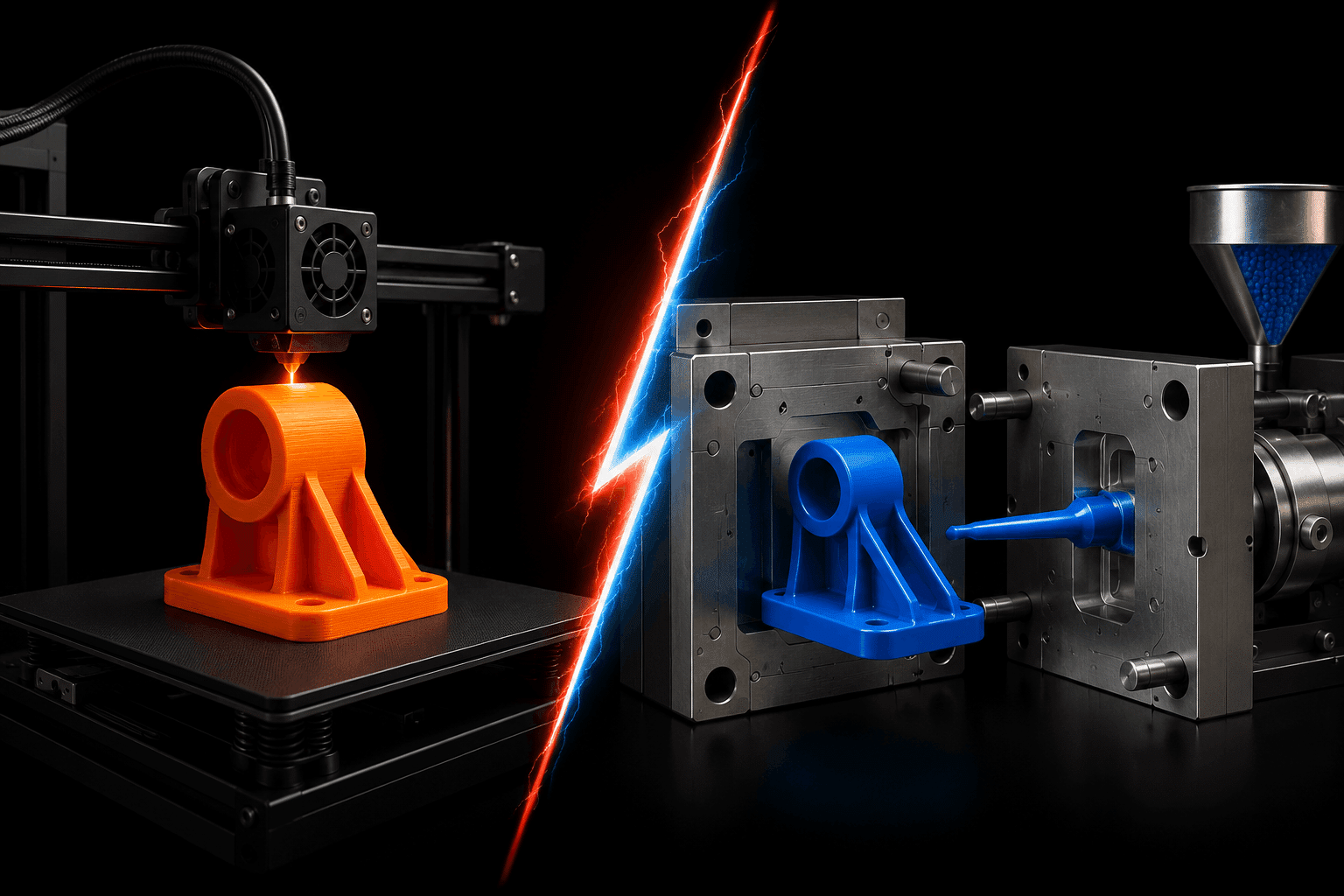
The two methods sit at opposite ends of manufacturing logic. 3D printing is additive – a machine builds your part layer by layer, straight from a CAD file, with nothing made in advance. Because there is no setup beyond the file itself, the first part and the hundredth part cost roughly the same to produce.
Injection molding is the opposite. A steel or aluminium mould is machined first, then molten plastic is injected into it under pressure, cooled, and ejected – over and over, in seconds per cycle. The mould is expensive and slow to make, but once it exists, each part is astonishingly cheap and identical to the last. The whole economic case for molding rests on producing enough parts to justify that upfront tool.
The cost comparison – the part that decides it
Most teams agonise over materials and finish when the real swing factor is tooling. 3D printing carries no tooling cost at all, so the line on a cost chart starts low and stays fairly flat. Injection molding starts high – you pay for the mould before a single sellable part exists – but the per-part cost then falls as that fixed cost is divided across more and more units.
Why 3D printing stays flat
With printing, you are essentially paying for machine time and material on every part, with no fixed cost to amortise. That is what makes it unbeatable for low volumes and prototypes. For a full breakdown of what drives the number in India, see our complete 3D printing cost guide for India.
Why injection molding gets cheaper at scale
Tooling is the lever. Internationally, a simple aluminium mould can start in the low thousands of dollars and last for a few thousand to perhaps ten thousand parts, while a hardened multi-cavity steel tool can run past USD 100,000 but produce hundreds of thousands – even millions – of parts. Spread across a large run, that cost becomes negligible: per-part pricing can drop to well under a dollar at high volumes. For India-specific tooling and per-unit figures, our injection molding cost guide for India (2026) has the local numbers.
Where the two lines cross
Published cost studies put the break-even point anywhere between roughly 1,000 and 13,000 parts, depending on part size, complexity and how expensive the mould is. One widely cited test by Formlabs produced 1,000 parts for around USD 600 by printing versus roughly USD 3,920 with outsourced molding – about 85% cheaper to print at that volume – with molding only pulling ahead well into the thousands. The lesson is not the exact number; it is that the crossover shifts with your specific part, so the volume bands below are a starting point rather than a rule.
| Order volume | Lower-cost method | Why |
| Under ~200 parts | 3D printing | No tooling to pay off; full design freedom |
| ~200 – 1,000 parts | Depends | Part size, complexity and mould cost decide it |
| ~1,000 – 10,000 parts | Usually molding | Tooling cost starts spreading across enough parts |
| 10,000+ parts | Injection molding | Per-part cost drops to a fraction of printing |
Lead time and speed to market
Speed often matters as much as cost. A 3D-printed part can be in your hands in roughly one to three days because there is no tooling step – you go straight from file to finished part. Injection molding typically needs around four to eight weeks just to design and cut the mould before the first part appears. If you are racing to a launch, testing a design, or iterating quickly, that gap is decisive. If you have a stable design and a long production horizon, the mould lead time is a one-time cost worth absorbing.
Design flexibility and iteration
This is where printing quietly saves projects. Need to move a mounting boss or thicken a wall? With printing you edit the CAD file and reprint – no extra cost. With molding, almost any geometry change means reworking the tool, and a significant change can mean cutting a new one. That is why so many teams prototype and refine with printing, lock the design, and only then commit to a mould. A clean, manufacturing-ready model makes either path smoother, which is where good 3D CAD design earns its keep.
Material and strength considerations
Both processes cover a wide material range, but they behave differently. Injection molding delivers excellent, highly repeatable mechanical properties – every part comes out essentially the same, which matters for regulated or load-bearing components. Modern printing has closed much of the gap: processes such as Multi Jet Fusion can reach close to the tensile strength of a molded part, which is often more than enough for functional prototypes, jigs, fixtures and low-volume end-use parts.
For very small runs where you still want cast-like quality, vacuum casting can bridge the two – our explainer on the vacuum casting process covers when that makes sense.
When to choose 3D printing
- You need prototypes or design validation before committing to tooling.
- Your total volume is under roughly 1,000 parts.
- The design is still changing or you expect revisions.
- The geometry is complex, with internal channels or features a mould cannot easily release.
- You need parts in days, not weeks.
When to choose injection molding
- Your design is finalised and unlikely to change.
- You are ordering in the thousands, with more runs to follow.
- You need every part to be identical, with consistent strength.
- Per-part cost matters more than upfront investment.
Still weighing low versus high volume? Our guide on low-volume vs high-volume injection molding breaks down where each makes sense.
The smartest route is often both
For most new products, the winning strategy is not choosing one process forever – it is sequencing them. Prototype and refine with 3D printing while the design is fluid, validate the part in real use, then transition to injection molding once your volume justifies the tooling. You de-risk the design before spending on a mould, and you reach scale efficiently. Picking the right manufacturing partner for that handover matters too; our guide on how to choose an injection molding partner in India walks through what to look for.
What to expect in India
India’s 3D printing sector is growing quickly – valued at around USD 860 million in 2025 and projected to reach roughly USD 5.2 billion by 2034, a compound growth rate of about 21% a year, according to IMARC Group. Much of that demand is driven by rapid prototyping in automotive, aerospace and electronics. For you, this maturing ecosystem means competitive pricing on both processes and shorter local lead times than importing parts. Whether you are building drone components, automotive parts or IoT enclosures, both routes are well served domestically.
Frequently asked questions
Is 3D printing cheaper than injection molding?
For small quantities, yes – usually significantly so, because there is no mould to pay for. As volume climbs into the thousands, injection molding becomes cheaper per part and eventually far cheaper. The break-even point depends on your part and tooling cost, but commonly falls somewhere between 1,000 and 13,000 parts.
At what quantity does injection molding become worth it?
As a rule of thumb, once you are confident you will produce more than about 1,000 identical parts – and especially beyond 10,000 – the tooling investment starts paying for itself. Below that, printing usually wins on both cost and speed.
Can 3D printing be used for production parts, not just prototypes?
Yes. For low to mid volumes, complex geometries, or parts where modern printed materials meet the strength requirement, 3D printing is a legitimate production method – not only a prototyping tool.
How much faster is 3D printing than injection molding?
Considerably, for the first parts. Printing can deliver a finished part in one to three days, while molding typically needs four to eight weeks to make the tool before production begins.
Not sure which fits your part?
Every part is different, and the right call depends on your volume, budget, timeline and how finalised your design is. Send us your CAD file and we will give you a free design-for-manufacture review and an honest recommendation – printing, molding, or a staged approach – along with a quote. Get in touch with Precious3D to get started.