For years, 3D printing in India basically meant plastic. Prototypes, jigs, display models, the odd enclosure — all useful, but the moment someone needed a part that could take real load, heat or stress, the conversation went straight back to CNC machining or casting. That has quietly changed. Metal 3D printing has grown up, and in 2026 it is a genuinely practical option for Indian businesses, not just aerospace labs with deep pockets.
If you are weighing it up for your own product, this guide covers what it actually costs in India, which metals you can print, and where it makes sense — and, just as importantly, where it doesn’t. If you are new to additive manufacturing altogether, our 3D printing services page is a good starting point.
What is metal 3D printing, really?
Metal 3D printing — also called metal additive manufacturing (AM) — builds a part layer by layer from fine metal powder instead of carving it out of a solid block. The most common process is DMLS (Direct Metal Laser Sintering), where a high-power laser fuses metal powder inside a sealed, inert-gas chamber. Its close cousin SLM (Selective Laser Melting) works almost identically. You will also hear about Binder Jetting (cheaper, better for volume), EBM (electron beam melting) and DED (directed energy deposition).
The big draw is geometry. You can build internal cooling channels, lattice structures and weight-optimised shapes that are simply impossible to machine or cast. The trade-off is cost — and that is the part most people get wrong.
How much does metal 3D printing cost in India? (2026)
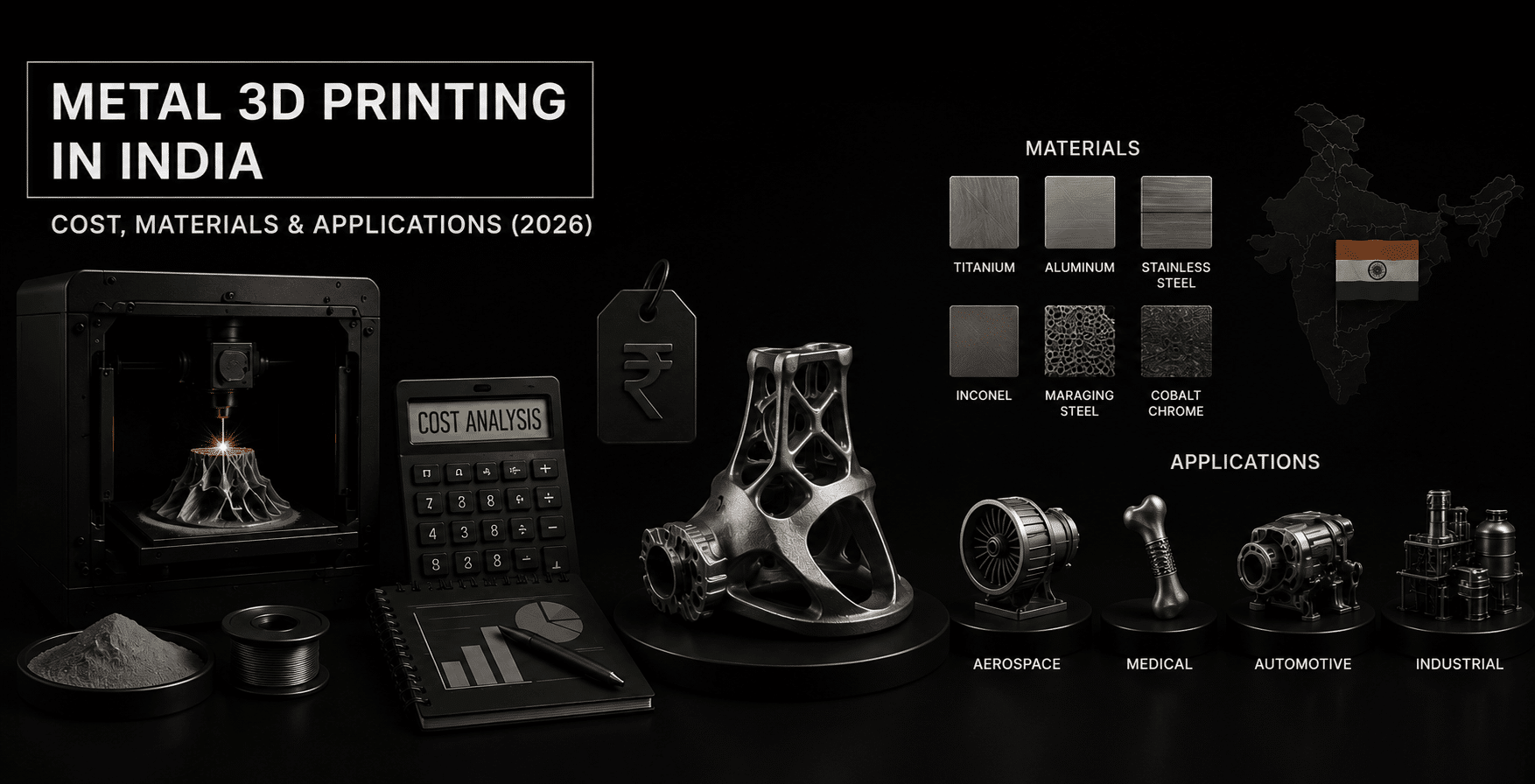
Let’s get to the number everyone wants. Metal AM sits at the premium end of the spectrum. As a rough benchmark, DMLS printing in India runs roughly ₹50 to ₹150 per gram depending on the alloy, with a small functional part typically starting around ₹5,000. Compare that with FDM plastic at ₹3–8 per gram and you can see why metal is reserved for parts that earn it.
| Process / Material | Typical Price (India, 2026) | Best suited for |
| Metal DMLS — Stainless Steel (316L / 17-4 PH) | ₹50–90 / gram | Functional parts, brackets, tooling |
| Metal DMLS — Titanium (Ti6Al4V) | ₹100–150 / gram | Aerospace, medical implants, lightweight parts |
| Metal DMLS — Aluminium (AlSi10Mg) | ₹60–100 / gram | Heat sinks, automotive, light housings |
| Metal Binder Jetting | Lower per-part at volume | Mid-to-high volume, complex geometry |
| FDM Plastic (PLA / ABS) — for reference | ₹3–8 / gram | Prototypes, jigs, display models |
A few things move the final price more than the per-gram rate suggests:
- Part volume and weight — you pay for every gram, plus the support structures.
- Post-processing — heat treatment, support removal by wire EDM and CNC finishing of mating surfaces are usually mandatory, not optional.
- Alloy choice — titanium and Inconel cost far more than stainless steel.
- Quantity — batching several parts onto one build plate brings the per-part cost down.
For a fuller breakdown across every technology, our complete Cost of 3D Printing in India guide lays the numbers out side by side.
Metals you can actually print
The material list has expanded a lot. The workhorses in India right now:
- Stainless Steel (316L, 17-4 PH) — strong, corrosion-resistant and the most economical way into metal AM. 17-4 PH reaches high tensile strength after heat treatment.
- Titanium (Ti6Al4V) — an exceptional strength-to-weight ratio and biocompatible, which is why it dominates aerospace and medical implants.
- Aluminium (AlSi10Mg) — light with good thermal conductivity; popular for automotive parts and heat sinks.
- Inconel (625, 718) — nickel superalloys that hold up under extreme heat, used in turbines and energy applications.
- Cobalt Chrome & Tool Steel — dental, medical and hard-wearing tooling.
Picking the right alloy is honestly half the battle. If you are not sure, our CAD design and engineering team can advise based on the load, environment and budget your part has to live with.
Where metal 3D printing makes sense
This is where it earns its keep:
- Aerospace & defence — lightweight, topology-optimised brackets and ducts.
- Automotive — performance and motorsport parts, prototype components and conformal-cooled tooling. See our automotive manufacturing work.
- Medical & dental — patient-specific titanium implants and surgical guides.
- Tooling & moulds — mould inserts with internal cooling channels that cut cycle times, a neat bridge to our injection molding services.
- Electronics & IoT — rugged metal housings and heat sinks for demanding IoT and electronic devices.
- Drones — strong, featherweight structural parts where every gram matters, exactly what drone manufacturers need.
India’s metal AM ecosystem has matured too. Homegrown machine builders like Intech Additive Solutions and Amace Solutions now sit alongside global names such as EOS and 3D Systems, which has steadily pushed costs down and capacity up across the country.
When you should NOT use metal 3D printing
Honest answer: if you need simple geometry in high volume, traditional machining or casting will almost always be cheaper. Metal AM wins on complexity, customisation and low-to-mid volumes — not on churning out 10,000 identical brackets. If you are torn between approaches, our 3D printing vs injection molding comparison is a useful next read.
The bottom line
Metal 3D printing in India in 2026 is no longer experimental — it is a credible production route when your part demands real metal performance and a geometry nothing else can deliver. The key is matching the process and alloy to the job, and staying clear-eyed about volume.
If you have a part in mind, the fastest way to a real number is to send us the CAD file. Talk to our team and we’ll tell you honestly whether metal AM is right for it — and what it will cost.