Tag

3d printing

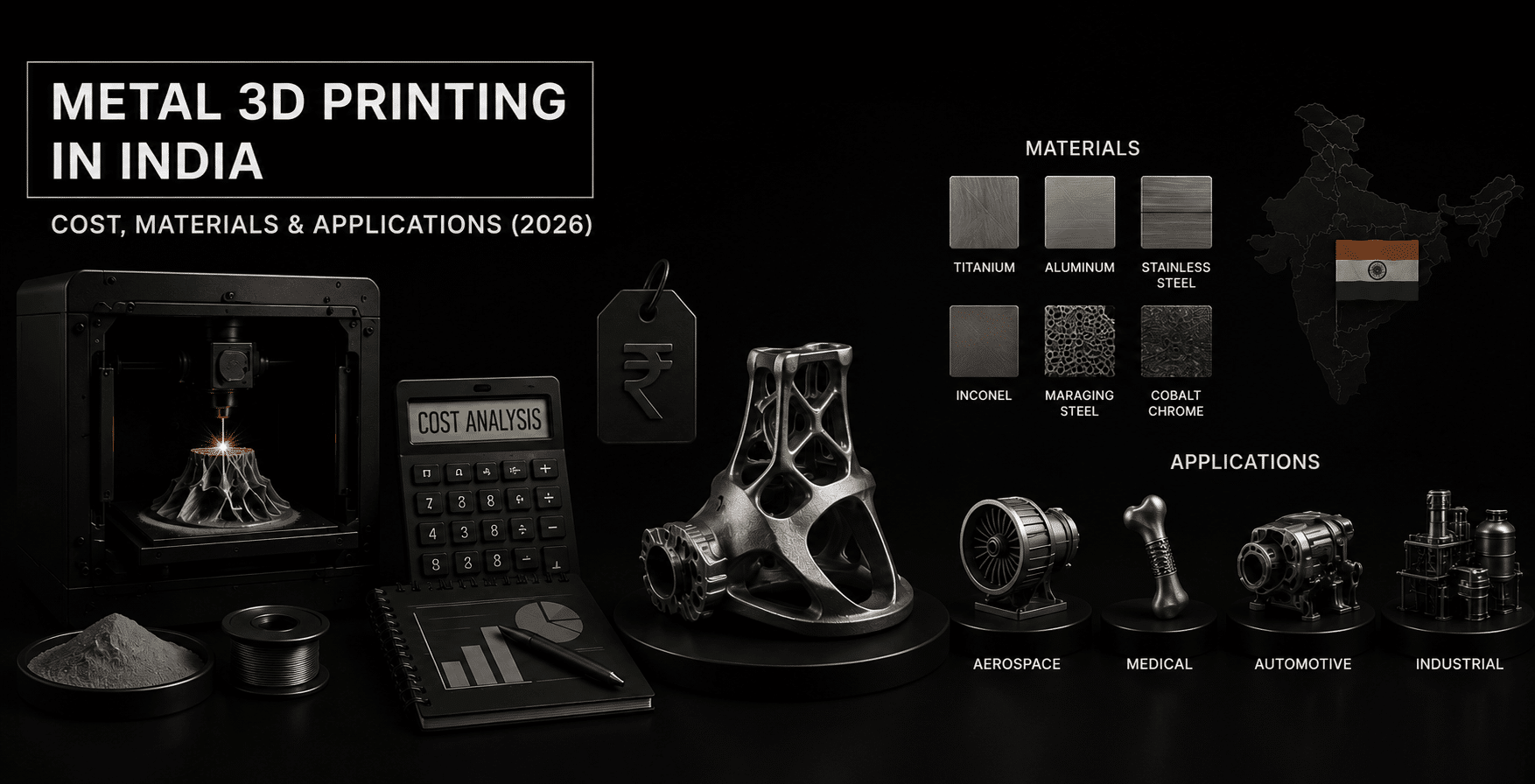
Metal 3D Printing in India: Cost, Materials & Applications (2026)

Metal 3D Printing in India Cost, Materials & Applications (2026)

For years, 3D printing in India basically meant plastic. Prototypes, jigs, display models, the odd enclosure — all useful, but the moment someone needed a part that could take real load, heat or stress, the conversation went straight back to CNC machining or casting. That has quietly changed. Metal 3D printing has grown up, and in 2026 it is a genuinely practical option for Indian businesses, not just aerospace labs with deep pockets.

If you are weighing it up for your own product, this guide covers what it actually costs in India, which metals you can print, and where it makes sense — and, just as importantly, where it doesn’t. If you are new to additive manufacturing altogether, our 3D printing services page is a good starting point.

What is metal 3D printing, really?

Metal 3D printing — also called metal additive manufacturing (AM) — builds a part layer by layer from fine metal powder instead of carving it out of a solid block. The most common process is DMLS (Direct Metal Laser Sintering), where a high-power laser fuses metal powder inside a sealed, inert-gas chamber. Its close cousin SLM (Selective Laser Melting) works almost identically. You will also hear about Binder Jetting (cheaper, better for volume), EBM (electron beam melting) and DED (directed energy deposition).

The big draw is geometry. You can build internal cooling channels, lattice structures and weight-optimised shapes that are simply impossible to machine or cast. The trade-off is cost — and that is the part most people get wrong.

How much does metal 3D printing cost in India? (2026)

Let’s get to the number everyone wants. Metal AM sits at the premium end of the spectrum. As a rough benchmark, DMLS printing in India runs roughly ₹50 to ₹150 per gram depending on the alloy, with a small functional part typically starting around ₹5,000. Compare that with FDM plastic at ₹3–8 per gram and you can see why metal is reserved for parts that earn it.

Process / MaterialTypical Price (India, 2026)Best suited for
Metal DMLS — Stainless Steel (316L / 17-4 PH)₹50–90 / gramFunctional parts, brackets, tooling
Metal DMLS — Titanium (Ti6Al4V)₹100–150 / gramAerospace, medical implants, lightweight parts
Metal DMLS — Aluminium (AlSi10Mg)₹60–100 / gramHeat sinks, automotive, light housings
Metal Binder JettingLower per-part at volumeMid-to-high volume, complex geometry
FDM Plastic (PLA / ABS) — for reference₹3–8 / gramPrototypes, jigs, display models

A few things move the final price more than the per-gram rate suggests:

  • Part volume and weight — you pay for every gram, plus the support structures.
  • Post-processing — heat treatment, support removal by wire EDM and CNC finishing of mating surfaces are usually mandatory, not optional.
  • Alloy choice — titanium and Inconel cost far more than stainless steel.
  • Quantity — batching several parts onto one build plate brings the per-part cost down.

For a fuller breakdown across every technology, our complete Cost of 3D Printing in India guide lays the numbers out side by side.

Metals you can actually print

The material list has expanded a lot. The workhorses in India right now:

  • Stainless Steel (316L, 17-4 PH) — strong, corrosion-resistant and the most economical way into metal AM. 17-4 PH reaches high tensile strength after heat treatment.
  • Titanium (Ti6Al4V) — an exceptional strength-to-weight ratio and biocompatible, which is why it dominates aerospace and medical implants.
  • Aluminium (AlSi10Mg) — light with good thermal conductivity; popular for automotive parts and heat sinks.
  • Inconel (625, 718) — nickel superalloys that hold up under extreme heat, used in turbines and energy applications.
  • Cobalt Chrome & Tool Steel — dental, medical and hard-wearing tooling.

Picking the right alloy is honestly half the battle. If you are not sure, our CAD design and engineering team can advise based on the load, environment and budget your part has to live with.

Where metal 3D printing makes sense

This is where it earns its keep:

  • Aerospace & defence — lightweight, topology-optimised brackets and ducts.
  • Automotive — performance and motorsport parts, prototype components and conformal-cooled tooling. See our automotive manufacturing work.
  • Medical & dental — patient-specific titanium implants and surgical guides.
  • Tooling & moulds — mould inserts with internal cooling channels that cut cycle times, a neat bridge to our injection molding services.
  • Electronics & IoT — rugged metal housings and heat sinks for demanding IoT and electronic devices.
  • Drones — strong, featherweight structural parts where every gram matters, exactly what drone manufacturers need.

India’s metal AM ecosystem has matured too. Homegrown machine builders like Intech Additive Solutions and Amace Solutions now sit alongside global names such as EOS and 3D Systems, which has steadily pushed costs down and capacity up across the country.

When you should NOT use metal 3D printing

Honest answer: if you need simple geometry in high volume, traditional machining or casting will almost always be cheaper. Metal AM wins on complexity, customisation and low-to-mid volumes — not on churning out 10,000 identical brackets. If you are torn between approaches, our 3D printing vs injection molding comparison is a useful next read.

The bottom line

Metal 3D printing in India in 2026 is no longer experimental — it is a credible production route when your part demands real metal performance and a geometry nothing else can deliver. The key is matching the process and alloy to the job, and staying clear-eyed about volume.

If you have a part in mind, the fastest way to a real number is to send us the CAD file. Talk to our team and we’ll tell you honestly whether metal AM is right for it — and what it will cost.

Traditional Manufacturing Vs 3d Printing – A Cost Analysis

Traditional manufacturing vs 3d printing

Traditional manufacturing vs 3d printing

3d printing is a computer-driven additive manufacturing technology used for producing the final product from a digital model by laying down successive layers of materials. It saves on energy by 40 to 60 percent as it eliminates shipping and other logistics activities. Also, it enables users to produce objects with lesser material. 3d printing service cost has cut up to 70% savings due to prototyping costs. Whereas, traditional manufacturing involves high cost of manufacturing and shipping. Below is the traditional manufacturing vs 3d printing cost analysis.

Comparison of technologies

Traditional manufacturing vs 3d printing

Traditional manufacturing

3d printing technology

3d printing

The traditional manufacturing includes the process of injection moulding, machining, forming, and joining which increases the cost of the product. Also, the traditional method involves putting a big sum of money in the process of manufacturing and shipping which further adds up to the final cost. Whereas 3d printing uses processes like Selective Laser Sintering (SLS), Binder Jetting, Stereolithography (SLA), Poly-Jet, Fused Deposition Modelling/Fused Filament Fabrication (FDM/FFF) which is mostly digitally dependent and hence results in producing objects of lesser cost. Even though the initial setup costs are higher, 3d printing has become cheaper than cheap labour in third world countries. Additionally, the costs of 3d printing are still decreasing, with the potential of 3d printers in homes in the near future. Furthermore, the costs of customized products are the same for mass production products.

Traditional manufacturing vs 3d printing- Cost-effectiveness

Traditional manufacturing like injection moulding requires mass production to even out the overhead cost of tooling, labour for assembly, and production. Whereas, with additive manufacturing, the cost of manufacturing of one item stays the same no matter what the quantity is, making it cheaper when the quantity is small.

More customizable, more adaptable

Because the cost is the same for each added unit, it is possible to make an unlimited amount of changes to the product. It can be used for prototyping: you’d use 3d printing to make a prototype and update the prototype until satisfaction. This is a crucial step before getting the product to mass production. It can also be used during the rest of the manufacturing process, to create unique pieces that can be more responsive to your needs, progress in conception and consumers feedback.

No added cost for complexity:

Creating complex mechanical constructions via traditional manufacturing requires precision and skills, especially for the assembly of complex parts, which means that price increases with complexity. It is not the case with 3d printing, which creates an entire piece in one process, instead of creating each component before assembling. Therefore, there is no added cost for complexity.

Traditional manufacturing vs 3d printing- Advantages

Rapid Prototyping

Products can more quickly go from just a design to an actual prototype.

Manufacturing Speed

Just like the previous advantage, the manufacturing speed for a large number of final products is equally fast.

Reduced Costs

When 3d printers were first invented, there were a very limited amount of printers being produced. But now, there are printing companies forming all over the world, creating more 3d printers. The cheapest 3d printer is currently called the PEACHY PRINTER. It is made by Rylan Grayston from Rinnovated Designs in Canada. His printer is primarily used for small craft models.

Warehousing

With traditional manufacturing technologies, it is much faster and cheaper to manufacture additional products that you probably know that you will eventually need. However, with 3d printing, only products that are sold need to be manufactured, thus warehousing of excess inventory is significantly less needed.

3d Printers can produce just about anything

If you have a craving for chocolate or if you are in need of an organ transplant, you’re in luck. 3d printing companies originally sold plastic ink cartridges. But now, they have ink made out of sugar, chocolate, sand, ceramic, metal materials, and even living cells to manufacture an infinite amount of creations.

3d printers are the future of manufacturing businesses

Some jobs can be easily cut because of the  3d printers. 3d printers are not only more productive but are also more environmentally friendly. When you build something, you usually have scraps leftover.  A 3d printer knows the mould and design and builds only what is needed. That makes 3d printers more economical and earth-friendly. 3d printers also have the advantage of becoming a productive manufacturing tool. With the purchase of a commercial 3d printer, higher production volumes can be achieved and larger products can be designed.

Read more:

3d Printer Speed: Time Taken To Print A 3d Model

3d Printed Jewelry- Transforming The Jewelry Designs

3d Printing Technology – A Revolution

3d printing technology

What is 3d printing technology?

3d printing service or additive manufacturing is a method of making three dimensional solid objects from a digital file. The creation of a 3d printed object is achieved using additive processes. In an additive process, an object is created by laying down successive layers of material until the object is created. Each of these layers can be seen as a thinly sliced horizontal cross-section of the eventual object.

3d printing technology

3d printing technology

Steps involved in the 3d printing technology

The various steps involved in 3d printing are as follows:-

CAD File Development

In order to produce a 3d object you first have to have its virtual design.

CAD File Conversions

The CAD file is converted into the specific file formats after it is developed. The file formats are specified based on the technology of printing being employed by that particular 3d printer.

STL File Manipulation

Now that the STL format file is ready for you, all your computer now needs is a 3d printer which can print using the stereolithography technique.

Preparing the Printer

Now that everything about the digital file is ready, one needs to make sure the 3d printer is ready. This means installing properly the polymers, binders and other material which are necessary to perform a print operation.

The Building Up

Once the process has started, it is now all about patience. These printers aren’t as faster as the 2d printers. Based on the complexity of the object to be printed, the span of printing varies. Simply all that one has to do is wait and perform random checks to make sure everything is being done flawlessly.

Post Processing Stuff

Once the entire process is done and the object is ready, the object is to be handled carefully. Any actions in haste could prove to be costly.

Working of 3d printing technology

One starts by designing a 3d object on an ordinary home PC, connect it to a 3d printer, press ‘print’ and then sit back and watch. The process is a bit like making a loaf of sliced bread but in reverse. Imagine baking each individual slice of bread and then gluing them together into a whole loaf (as opposed to making a whole loaf and then slicing it, like a baker does). That’s basically what a 3d printer does.

The 3d printing process turns a whole object into thousands of tiny little slices, then makes it from the bottom-up, slice by slice. Those tiny layers stick together to form a solid object. Each layer can be very complex, meaning 3d printers can create moving parts like hinges and wheels as part of the same object. One could print a whole bike – handlebars, saddle, frame, wheels, brakes, pedals, and chain – ready assembled, without using any tools. It’s just a question of leaving gaps in the right places.

3d printing technology vs Traditional manufacturing

Saves Time

By utilizing additive manufacturing, one can get to market quicker by avoiding wasting valuable time waiting for retooling. If reworking the design is necessary, adjustments can simply be made to the CAD file and programmed into the 3d printer.

Conserve Money

Because retooling is unnecessary, one avoids having to pay for the costly changes to an assembly line that retooling can require. This means that one can order a single 3d prototype at a fraction of what it would cost using traditional manufacturing.

Reduce Waste

Unlike traditional manufacturing methods which can result in lots of waste that may not be correctly recycled, the only material that is consumed via additive manufacturing is the actual material used for the end-product.

Product Innovation

With additive manufacturing, one gains the ability to make parts that simply can’t be produced by traditional means. Parts can be printed with multiple integrated components, made to perfectly fit together with other 3d printed projects, and include gradients of color. Advances in 3d printable materials mean that the industry can now print in countless new materials. The result is that beautiful, complex, and durable end products can be produced through industrial additive manufacturing.

Future of 3d printing technology

Ultimately, when we look at the potential of 3d printing technology, it’s clear that mass manufacturing will not be completely eradicated. Its efficiency and scale have clear benefits for specific product categories. Nonetheless, 3d printing has the potential to create a whole new powerful product category. It eliminates the need for complex supply chains and excessive waste while decentralizing production, wealth and knowledge.

In the long run, 3d printing can help create a “decentralized, rural-based, self-reliant economy,” where production and consumption are once again reunited.

Read more:

3d printing in automotive industry

3d printing in the medical field