Category

3d designing

Cost of 3D Printing in India: Complete Pricing Guide

3D Printing in India

How Much Does 3D Printing Cost in India? A Complete Expert Breakdown for 2026

Clear pricing guide for materials, printers, design, finishing and delivery. Practical numbers you can use today.

Most people ask one practical question before they start: How much will 3D printing cost in India. This guide gives you direct answers. You will find material rates, the effect of different printers, design charges, finishing costs and real examples you can copy. Use this to plan a budget and avoid surprises.

Quick stat: India’s 3D printing market was about USD 707 million in 2024 and is growing above 20% CAGR through the decade

What decides your 3D printing cost

Your final price comes from five things:

  • Material weight and type
  • Printing time
  • Printer type
  • Design work
  • Post processing and delivery
3d printing technology

Material pricing per gram in India

Material cost is the biggest factor. You pay more for strength, detail or specialty materials.

Material

Price per gram

Best for

PLA
5 - 15 Rs
Simple models and prototypes
ABS
10 - 20 Rs
Functional parts and enclosures
PETG
10 - 20 Rs
Outdoor items and food safe parts
Resin (SLA)
20 - 50 Rs
Highly detailed models and miniatures
Nylon PA12
45 - 80 Rs
Durable functional parts
Carbon fiber and metal powders
100 - 500+ Rs
High strength uses in automotive and aerospace

Example: A 100 gram PLA print usually lands between 1000 and 1500 rupees. The same part in resin often costs 2000 to 4000 rupees.

PLA 3D printing

Layer lines visible on surface
Cheaper cost
Good for quick sampling

Resin 3D printing

Smooth surface finish
High and intricate detailing can be captured
Premium look and feel

Printer types and hourly cost

Printer choice changes both finish and price. Choose the printer that fits the part need not the price tag alone.How print time affects cost

Printer typeAverage cost per hour INRTypical use
FDM desktop200 to 500Low cost prototypes and sturdy parts
SLA or DLP500 to 1500Smooth finishes and small details
SLS or MJF1500 to 4000Small batch production and functional parts
Metal printing5000 to 10000Medical and aerospace parts


Design charges if you need a model

If you have an STL file you save money. If not you need a designer to create a print ready file.

ComplexityPrice INR
Simple objects500 to 1000
Medium parts with logos and small features1500 to 3000
Complex mechanical assemblies5000 to 10000

Post processing and finishing

Finishing changes the look and increases cost. Consider which finishes you actually need.

Delivery and shipping within India

Delivery cost depends on weight, distance and urgency.

TaskApprox price INR
Support removal100 to 500
Sanding and smoothing200 to 1500
Spray painting500 to 2000
Resin curing and UV100 to 300
TypeRange INR
Standard courier100 to 300
Express or fragile delivery300 to 1000

Real cost examples for 2026 

Custom name keychain

Material PLA, 12 grams, basic file

Cost 150 to 250 rupees

Branded phone stand

Material PLA, 80 grams, minor edits, FDM print, sanded

Cost 1200 to 2000 rupees

Gaming miniature

Material resin, 40 grams, SLA print, painted

Cost 2500 to 4500 rupees

Industrial electronics enclosure

Material ABS, 120 grams, custom CAD, industrial FDM, polished

Cost 5000 to 8000 rupees

Lead times in India

Prototype: 2 to 5 working days including design

Bulk after approval: 7 to 15 days

Large or complex batches: 20 to 30 days

Trends you should know from 2025

  • Material prices stayed stable through 2024 and into 2025 which helps budgeting.
  • Resin demand rose which lengthened lead times during busy months.
  • Nylon PA12 and MJF gained wider use for low volume manufacturing.
  • Metal printing stays premium because of maintenance and powder handling cost.

Expert notes

“You lower cost when you reduce surface area rather than volume. Many first time users miss this.” – R. Mehta, Additive Manufacturing Consultant

“Choose the right material for the job. Most teams over spend on resin where PLA does the job.” – Ankit Vora, Precious3D Engineering Lead

How do 3D printing companies calculate cost in India?

Is 3D printing cheaper than CNC?

Do colors change the price?

How long does a typical print take?

Can I print flexible parts?

Do I need to prepare the 3D model before printing?

3d Printing In Automotive Industry

3d printing in automotive industry

Remarkable advances in additive manufacturing (AM) technologies, commonly known as 3d printing, over the past decade have helped to transform the prospective ways in which products are designed, developed, manufactured, and distributed. For the automotive industry, these advances have opened doors for newer designs; cleaner, lighter, and safer products; shorter lead times and lower costs. While automotive original equipment manufacturers (OEMs) and suppliers primarily use AM for rapid prototyping, the technical trajectory of AM makes a strong case for its use in product innovation and high-volume direct manufacturing in the future.  3d printing in automotive industry has revived it.

New developments in AM processes, along with related innovations in fields such as advanced materials, will benefit production within the automotive industry as well as alter traditional manufacturing and supply chain pathways. The very famous Shelby Cobra and Local Motors 3d printed car are two examples of the result of the advancement of 3d printing in automotive industry, which has paved a way to experience a notable transition that in the automotive industry.

How is 3d printing in automotive industry paving the way for new car designs?

This printing technology allows for rapid prototyping instead of relying on the traditional method of making a mold and manufacturing a part or hand-tooling a part. There are many advantages of using 3d printing instead of traditional manufacturing, not the least of which are lower costs and faster speeds. The method allows for on-demand tooling, and the parts are lighter and the fabrication process is much more environmentally friendly, requiring a fraction of the energy cost that is required in traditional manufacturing.

In the current landscape, cars are built on long assembly lines that consume staggering amounts of energy, which means even cars built to live an eco-friendly existence roll off the assembly line with a huge carbon footprint. Choosing 3D printing over traditional manufacturing in the automotive industry mainly includes two positive impacts: the exclusion of leftover waste and minimum generation of heat energy, which contributes to an eco-friendly method of processing.

Biggest contribution of 3d printing in Automotive Industry

3d printed Shelby Cobra

3d printing in automotive industry

3d printed Shelby Cobra

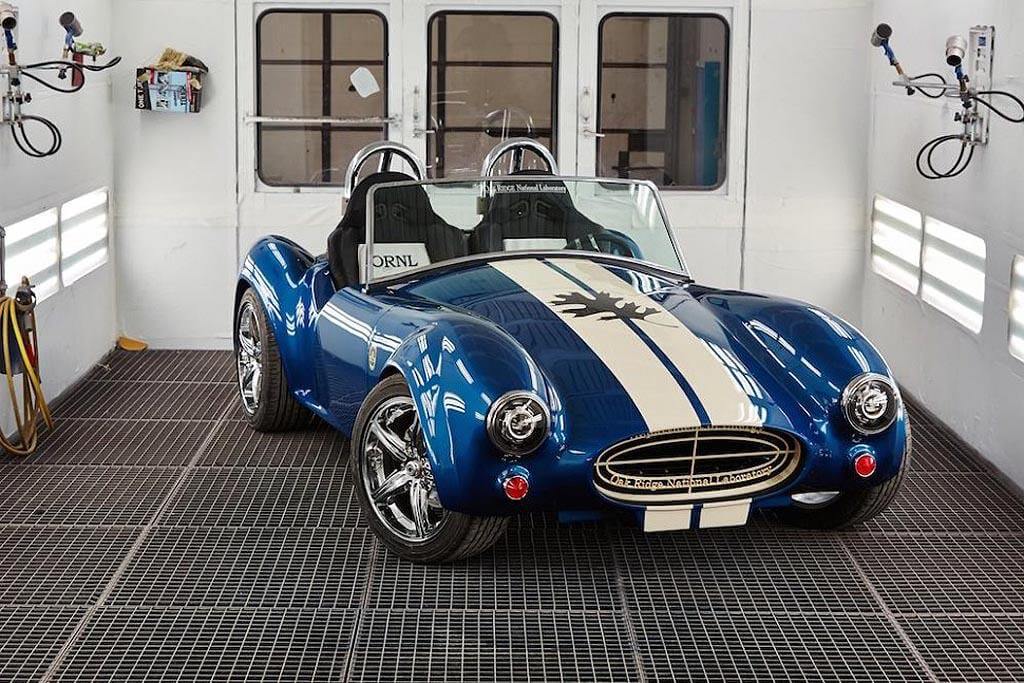
Next-generation manufacturing takes on a 50-year-old icon as ORNL researchers transform this classic sports car into a 3d-printed laboratory on wheels. 3d printing enables the seamless integration of advanced technologies with design flexibility and modularity. It provides a platform for rapid development and evaluation. The 3d printed car incorporates “plug and plays” components such as new engine, battery, and fuel cell technologies; hybrid system designs; and power electronics and wireless charging systems, allowing researchers to easily and quickly test out innovative ideas in a driving laboratory.

Olli by local motors

3d printing in automotive industry

Olli-3d printed car by local motors

Local Motors has created history by 3d printing its first Olli, self-driving shuttle in the company’s Knoxville micro-factory. Local Motors has long been innovating the future of vehicle 3d printing. And, Olli is believed to be the only 3d printed transit vehicle on Earth.


3d Printed Architectural Models- Redefining The Architecture

3d printed architectural models

The advent of  3d printing has changed tremendously the way of manufacturing a component. The wide range of materials a printer can accommodate opens up new potential for environmental-friendly furniture and decor. Choosing additive manufacturing over traditional manufacturing proves to be a boon for the mother Earth as it produces much less wastage. In this era of pollution all around, this is a smart choice to make. 3d printing has led to the major transformation in the architectural field. The 3d printed architectural models have redefined the architecture.

Intricate designs depending upon a person’s interest can be designed in design software and scanned for printing purpose and when fed into the machine it gives the customer the designed product. Adding on to this the customer can also choose his own materials for the product.This makes the designer save time in searching for shops which have the product in the design which he thought of.

The technology of 3d printing provides the means to prototype designs that cannot be made through traditional manufacturing, which has opened the door to virtually limitless possibilities for the interior design industry. From light fixtures that take on the appearance of lace to bicycle-gear-shaped chandeliers, lighting designers have embraced 3d printing to create functional art for the home. Smaller decorative furnishings like creative containers, stools, and planters are less expensive, easier to print yourself, and adds visual interest to any interior. The main usage and point of attraction are objects can be produced as a whole or separate parts that make up the whole object to be produced. These separate parts can be joined together to incredible tolerances such that it is difficult to predict whether the whole object is produced from the machine or separate parts are produced and joined.This shows the accuracy of manufacturing components.

The best 3d Printed Architectural Models

3d printed concrete castle

3d printed architectural models

3d printed castle

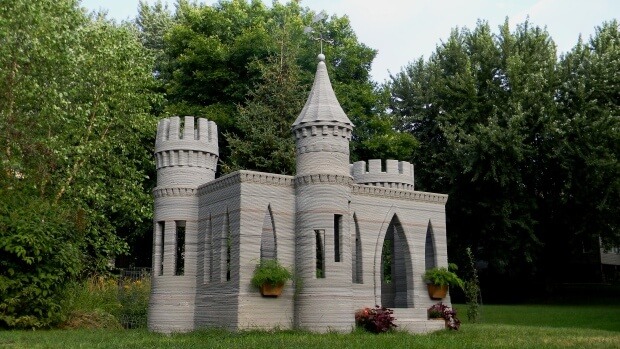
The first example of the best 3d printed architectural models is the 3d printed concrete castle made by a Minnesota based engineer named Andrey Rudenko. He with his two years of research and hard work in the field of technology came up with the idea and processing of a 3d printed concrete castle which is life-sized and capable of habitation. The walls of the small fortress, as well as three tops of the towers, have been fabricated separately and finally assembled into a single unit of free-standing structure. Looking at the castle no one can even doubt it not being a single unit that is the level of accuracy additive method of manufacturing has gained over the years. Not just this, time is consumed on a large scale.

3d printed hotel suite

3d printed architectural models

Construction phase of the 3d printed hotel suite

3d printed architectural models

Lewis Grand Hotel

The second example of the best 3d print architectural models is the 3d printed hotel suite. A Grand suite hotel at the Philippines was built just in 5 days using 3d printing. Hotel owner Lewis Yakich has unveiled the world’s first 3d printed hotel suite—and it even comes with a spacious 3d-printed concrete jacuzzi. The 130-square-meter (1,500 square feet) structure was built for The Lewis Grand hotel in Angeles, Philippines, and took approximately 100 hours of print time to complete.

Yakich collaborated with Andrey Rudenko (the Minnesotan inventor of a 3d concrete printer and builder of the world’s first 3d printed concrete castle).

Their collaboration helped them to:

  • Prepare and ship the 3d printer components over from Minnesota to the Philippines
  • Assemble the machine
  • Create the right concrete mix from local materials, including sand and volcanic ash.

The recently completed two-bedroom villa measures 10.5 meters by 12.5 meters and includes a living room and a jacuzzi room. Plumbing, wiring, and rebars are also installed in the structure

Sounds Impossible? Well, that is the true essence of this method, making impossible things possible.

Read more:

3d Printed Shoes By Adidas: Future Craft 4d

3d Printing In The Medical Field