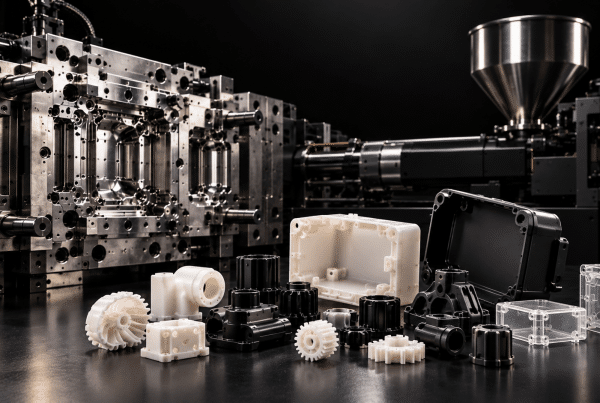
You have a part that is ready for injection molding. You send it to a few molders, and the replies come back: “Minimum order 10,000 pieces.” “We don’t take jobs under 5,000.” One doesn’t reply at all. If you only need 300 parts for a pilot batch, or 1,000 for a first production run, that is frustrating.
The good news is that a minimum order quantity (MOQ) is not a law of physics. It is a business decision based on cost, and with the right mold and the right molder, small batches are entirely possible. This guide explains why molders set MOQs, how the cost per part changes with quantity, how to get a genuinely low MOQ, and when you should skip injection molding altogether. We work with small batches every week at Precious3D’s mold and tool making shop in Chennai, so the advice here comes from real quotes, not theory.
Quick answer
- Large, high-volume molders commonly ask for 1,000 to 10,000+ parts per order, because their machines are booked for long runs.
- Low-volume and prototype molders commonly accept 50 to 500 parts. Precious3D regularly molds batches of a few hundred parts.
- The real limit is cost, not the machine. The mold is a one-off cost, so the fewer parts you make, the more each part carries.
- Below roughly 50–300 parts, 3D printing or vacuum casting is often cheaper and faster than paying for a mold.
- To lower your MOQ, ask for an aluminum or prototype mold, a family mold or a mold insert that fits a shared mold base.
What “MOQ” Really Means in Injection Molding
When a molder quotes an MOQ, it can mean one of three different things. Ask which one they mean, because the answer changes how you plan your orders:
- Minimum per order: the smallest quantity they will mold in a single run. This is the number most people mean.
- Minimum annual volume: some molders only take projects with a certain yearly demand, even if each order is small.
- Minimum order value: instead of a part count, some suppliers set a minimum invoice per run. For small parts, this works out to a high part count; for large parts, a low one.
None of these is fixed. They depend on the molder’s machines, how busy they are and what kind of customers they usually serve.
Why Molders Set Minimum Order Quantities
Every production run has fixed costs that do not change whether you make 100 parts or 10,000:
- Mold setup. Mounting the mold in the machine, connecting cooling lines and heating everything to temperature can take a few hours.
- Material purging. The machine barrel has to be cleared of the previous material and color, which wastes resin.
- Process tuning and first-article checks. The first shots are adjusted and measured before good parts are accepted.
- Machine scheduling. A molder running long jobs on large presses loses money by stopping a 50,000-part job to make your 200 parts.
On a long run, these costs disappear into the price of thousands of parts. On a short run, they are a big share of the bill. That is why a high-volume factory sets a high MOQ, while a molder that specializes in short runs plans its shop around frequent changeovers and can accept much smaller orders.
How Cost per Part Changes With Quantity
The easiest way to understand MOQ is to see the numbers. Below is an illustrative example for a small ABS housing made in a single-cavity aluminum mold. The prices are examples to show the pattern, not a quote: mold $3,000, setup $150 per run, and $0.80 per part for material and machine time.
Swipe sideways to see the full table →
| Quantity | Mold + setup | Parts | Total | Cost per part |
|---|---|---|---|---|
| 100 | $3,150 | $80 | $3,230 | $32.30 |
| 500 | $3,150 | $400 | $3,550 | $7.10 |
| 1,000 | $3,150 | $800 | $3,950 | $3.95 |
| 5,000 | $3,150 | $4,000 | $7,150 | $1.43 |
| 20,000 | $3,150 | $16,000 | $19,150 | $0.96 |
Two things stand out. First, the cost per part falls steeply up to about 1,000 parts and then flattens out. Second, at 100 parts you are mostly paying for the mold. Making 100 molded parts is entirely possible; it just means each part costs much more than at higher volumes.
This is why the right question is not “what is your MOQ?” but “at what quantity does molding beat the alternatives?” For a full breakdown of mold prices, per-part costs and the charges that are easy to miss, read our injection molding cost guide.
Plan for the whole product life, not the first order. If you need 300 parts now and expect 5,000 next year, the mold pays for itself over both orders. Quote the mold once, and plan reorders from the same tool.
Six Ways to Get a Lower MOQ
1. Use an aluminum or prototype mold
Aluminum molds are faster to machine and cheaper than hardened steel. They wear faster, but they typically last thousands to tens of thousands of shots, which is plenty for pilot runs and early production. A lower mold cost directly lowers the quantity at which molding makes sense.
2. Use a single-cavity mold
Multi-cavity molds make more parts per shot, but they cost more to build. For small batches, a single cavity keeps the mold cost down. You can add a multi-cavity production mold later, once demand is proven.
3. Combine parts in a family mold
If your product has several small parts in the same material and color, such as a top and bottom housing and a button, a family mold can produce them together in one shot. You pay for one mold instead of three, and every run gives you a complete set. Family molds work best when the parts are similar in size and wall thickness, so check this with your molder at the design review stage.
4. Ask about inserts in a shared mold base
Many molders keep standard mold bases, sometimes called MUD (Master Unit Die) frames, and machine only the cavity inserts for your part. You pay for the inserts rather than a complete mold, which can reduce tooling cost significantly for small, simple parts.
5. Simplify the design
Undercuts, side actions, threads and textured finishes all add cost to the mold. Small design changes, such as adding draft or replacing an undercut with a snap-fit that releases in the direction of the mold opening, can make the mold simpler and cheaper. A good molder will suggest these during the DFM (design for manufacturing) review.
6. Choose a molder that specializes in short runs
This is the simplest fix. A molder that serves startups, product designers and small OEMs plans its shop around frequent mold changes, so a 300-part order is normal work. Our guide on choosing the right injection molding partner explains what to look for, and our comparison of low-volume vs high-volume injection molding shows how the two kinds of shops differ.
When to Skip Injection Molding Altogether
For very small quantities, paying for a mold rarely makes sense. Here is a simple guide:
Swipe sideways to see the full table →
| Quantity | Usually the best process | Why |
|---|---|---|
| 1–50 parts | 3D printing | No tooling cost; parts in days; design changes are free |
| 20–200 parts | Vacuum casting | Low-cost silicone molds; parts that look and feel molded |
| 200–5,000 parts | Aluminum or prototype mold | Real molded parts at a moderate tooling cost |
| 5,000+ parts | Steel production mold | Lowest cost per part over long production life |
These ranges overlap, and the exact break-even point depends on your part’s size and complexity. Using the example above, if the same housing costs $12 to 3D print, molding becomes cheaper at around 280 parts. A larger or more detailed part would move that point higher.
For a deeper comparison, read 3D printing vs injection molding and our guide to low-volume manufacturing: 3D printing vs vacuum casting vs soft tooling. If vacuum casting looks like the right fit, our vacuum casting cost guide covers pricing and lead times.
Reorders: Does Every Run Have a Minimum?
Once your mold is paid for, reorders are much cheaper, because you only pay for setup and parts. But each run still carries a setup cost, so very small reorders cost more per part than larger ones. A few practical tips:
- Order in sensible batches. Ordering 1,000 parts twice a year usually costs less than 200 parts every month.
- Ask about blanket orders. Some molders will mold a larger batch and ship it to you in stages, so you get the lower price without storing all the stock.
- Agree on mold storage. Find out how long the molder will store your mold free of charge, and who pays for maintenance between runs.
- Confirm mold ownership in writing. You should own the mold once it is paid for, and be able to move it to another supplier if you need to.
Small-Batch Molding for Overseas Buyers
Short runs are one of the main reasons US, UK and European companies come to India. Domestic molders in those countries often have high MOQs or very high tooling costs for small jobs, while Indian low-volume molders can offer both a low mold cost and small batches.
For small batches, air freight is usually the practical choice. Parts typically arrive in about a week, and for a few hundred small parts the freight cost per part is modest. Remember to include import duty in your comparison. Our guide to outsourcing injection molding to India explains shipping, duties and IP protection, and our China vs India injection molding comparison shows how 2026 tariffs affect landed cost. US companies can also see our low-volume manufacturing service for the USA, and UK companies our low-volume molding service for the UK.
What to Send for a Small-Batch Quote
To get an accurate small-batch quote quickly, send:
- ☐ 3D CAD file (STEP or IGES) for each part
- ☐ Material and color (or the performance you need, such as heat or UV resistance)
- ☐ First order quantity and expected annual volume; both affect which mold makes sense
- ☐ Critical dimensions and tolerances
- ☐ Surface finish or texture
- ☐ Delivery date and destination country
Not sure which material to choose? Our guides to ABS injection molding, polycarbonate injection molding and nylon injection molding explain where each one fits. For housings and covers, see our custom injection molded enclosures.
Frequently Asked Questions
What is the minimum order quantity for injection molding?
It depends on the molder. Large production molders often ask for 1,000 to 10,000 or more parts per order. Low-volume and prototype molders commonly accept 50 to 500 parts. Technically, you can mold any quantity; the limit is whether the mold cost makes sense for the number of parts you need.
Can I injection mold 100 parts?
Yes, with a low-volume molder and a simple aluminum or prototype mold. Each part will cost much more than at higher volumes, because most of the price is the mold. For 100 parts, compare the quote with 3D printing and vacuum casting before you decide.
Why do some molders refuse small orders?
Every run has fixed costs for setup, purging and quality checks, and large molders keep their machines booked with long runs. Stopping a big job for a small one costs them money. Molders that specialize in short runs plan for frequent changeovers, so small orders work for them.
Is there a minimum for reorders once I own the mold?
Usually there is a practical minimum, because each run carries a setup cost. Reorders are still much cheaper than the first order, since the mold is already paid for. Ordering in fewer, larger batches keeps the cost per part down.
How long does an aluminum mold last?
Typically thousands to tens of thousands of shots, depending on the material, part design and how the mold is maintained. Abrasive materials such as glass-filled nylon wear molds faster. If you expect high volumes later, plan to move to a steel production mold.
Final Thoughts
A high MOQ does not mean injection molding is out of reach for your project. It usually means you have asked the wrong kind of molder. With an aluminum or prototype mold, a simpler design and a supplier that specializes in short runs, a few hundred molded parts is a normal job. And if your quantity is very small, 3D printing or vacuum casting will get you real parts faster and for less.
The best next step is to get a quote at two or three quantities, for example 300, 1,000 and 5,000 parts. That shows you exactly where the cost curve flattens for your part.
Have a small batch? Send us your CAD
Tell us your first order and expected annual volume. We will review your part for moldability and quote at several quantities, so you can see where molding makes sense.
Request a Free Quote