

Quick answer
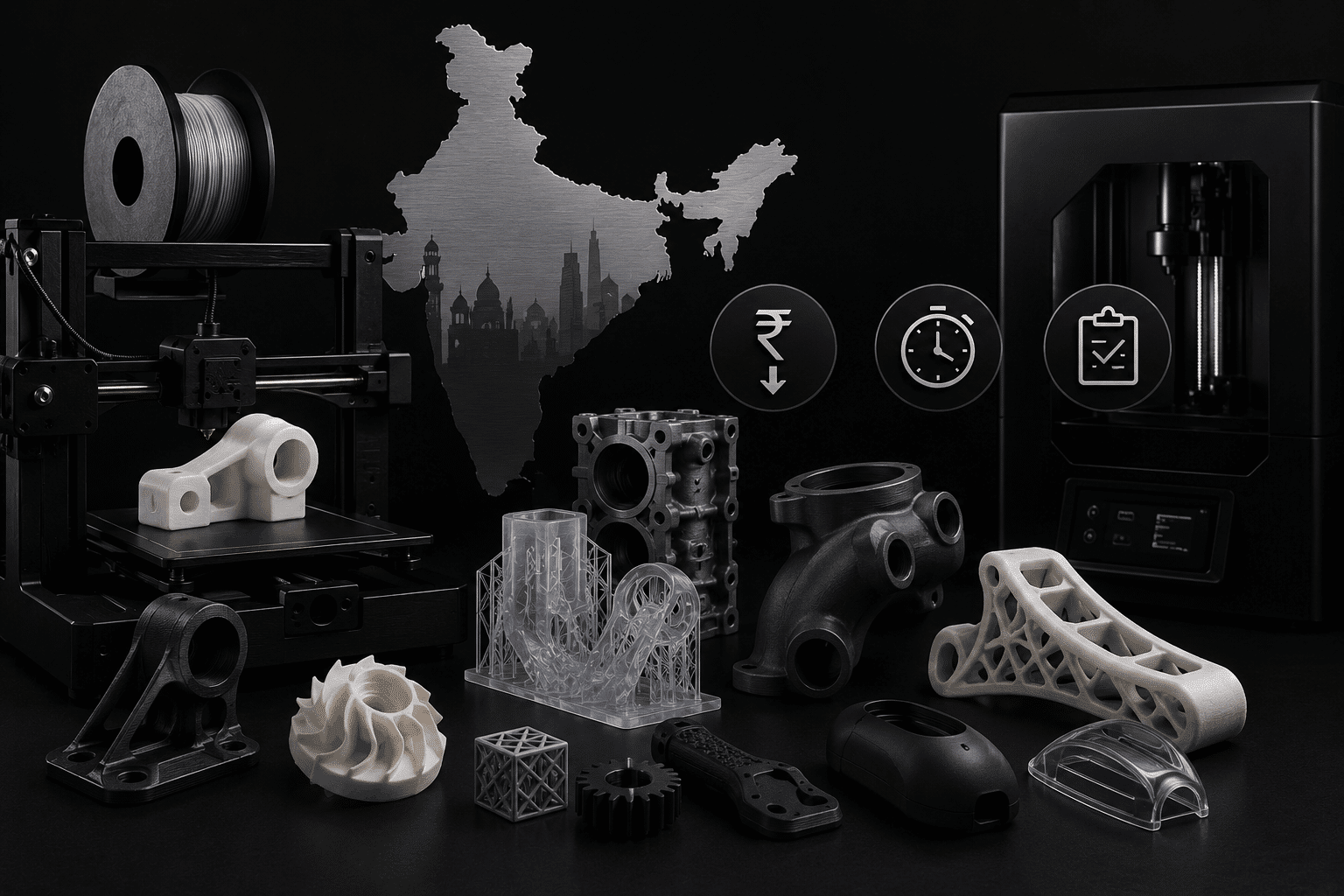
Rapid prototyping in India turns a CAD file into a physical, testable part in 1–4 working days for most 3D printed prototypes. Indicative 2026 costs start around ₹3–8 per gram for FDM, ₹8–15 for SLA, ₹10–20 for SLS and ₹50–150 for metal (DMLS). CNC machining takes 3–7 days and vacuum casting 1–2 weeks for small batches of identical copies.
Every good product starts as a prototype. The faster you can hold that first physical part in your hands — test it, break it, improve it — the faster you get to market, and the less you spend fixing mistakes later. That is the whole promise of rapid prototyping: turn a CAD file into a real, testable part in days, not months.
India has become a genuinely strong place to do this. Costs are competitive, turnaround is quick, and the range of processes available has expanded a lot. But “rapid prototyping” covers several different methods, and the right one depends on your part, your budget and your timeline. Here is how to think it through.
Key takeaways
- 3D printing is the fastest and cheapest route for most early prototypes — often 1–4 days.
- CNC machining is best when you need tight tolerances in metal or engineering plastics.
- Vacuum casting is the most cost-effective way to get 10–50 identical copies.
- The biggest delay is usually waiting for a final CAD file, not the printing itself.
- Choose a partner with several processes under one roof and a clear path to injection molding.
What Rapid Prototyping Actually Covers
Rapid prototyping is not one technology — it is an approach. The goal is speed, and several processes deliver it:
- 3D printing (FDM, SLA, SLS) — the fastest, most flexible route for most prototypes. See our 3D printing services.
- CNC machining — for precise metal and engineering-plastic parts with tight tolerances.
- Vacuum casting — for producing small batches of identical copies from a single master. Learn how the vacuum casting process works.
- Metal additive manufacturing — when the prototype itself needs real metal performance. Read our metal 3D printing guide.
A good partner will not push you toward whichever machine they happen to own — they will match the method to what your part actually needs. If you are still deciding between print processes, our FDM vs SLA vs SLS guide breaks them down.
How the Rapid Prototyping Process Works
From file to finished part, most projects follow the same five steps:
- Share your design — send a STEP or STL file. No CAD file yet? Our 3D CAD design team can create one from a sketch or sample.
- Design review (DFM) — engineers check wall thickness, tolerances and features that could fail or add cost.
- Process and material selection — matched to what the prototype must prove: look, fit or function.
- Production and finishing — printing, machining or casting, followed by sanding, painting or inserts if needed.
- Inspection and delivery — dimensional checks, then dispatch anywhere in India.
How Much Does Rapid Prototyping Cost in India?
Cost depends far more on your part than on a fixed “rate” — volume, geometry, material, finish and quantity all move the number. That said, here is a realistic 2026 picture to budget against:
| Method | Lead time | Indicative cost (India) | Best for |
|---|---|---|---|
| FDM 3D printing | 1–3 days | ₹3–8 / gram | Cheap, fast, larger prototypes |
| SLA 3D printing | 1–3 days | ₹8–15 / gram | High-detail, smooth display models |
| SLS 3D printing | 2–4 days | ₹10–20 / gram | Strong, functional plastic parts |
| Metal 3D printing (DMLS) | 5–10 days | ₹50–150 / gram | Parts needing real metal performance |
| CNC machining | 3–7 days | Quote-based (geometry/material) | Precise metal & engineering plastics |
| Vacuum casting | 7–15 days | Cost-effective for 10–50 copies | Small batches of identical parts |
← Swipe to see the full table on mobile
Prices exclude GST, design and shipping. A few honest pointers to keep costs down:
- Choose the right process. Do not pay for SLS detail when FDM will do — most first-timers overspend here.
- Reduce surface area, not just volume. Hollowing parts and thoughtful design cut material cost more than people expect.
- Batch your parts. Filling a build plate or machining setup spreads the fixed cost across more pieces.
Our complete Cost of 3D Printing in India guide has the full breakdown by material if you want to go deeper.
Which Rapid Prototyping Method Should You Choose?
Start with what the prototype needs to prove:
| If you need… | Choose | Why |
|---|---|---|
| A quick shape or size check | FDM 3D printing | Lowest cost, fastest turnaround |
| A smooth, detailed display model | SLA 3D printing | Best surface finish and fine detail |
| A strong part for functional testing | SLS 3D printing | Tough nylon, no support marks, near-production strength |
| Tight tolerances in metal | CNC machining | Highest precision on metal and engineering plastics |
| A metal part with complex geometry | Metal 3D printing (DMLS) | Shapes CNC cannot reach, real metal properties |
| 10–50 identical copies | Vacuum casting | Low per-part cost without steel tooling |
← Swipe to see the full table on mobile
Building a product enclosure? See our custom enclosure 3D printing service. We also prototype for IoT and electronics companies, drone manufacturers and the automotive sector.
Lead Time: How Fast Is “Rapid”?
This is where India shines. For most 3D printed prototypes you are looking at 1–4 working days from approved file to finished part — sometimes same-day for small, simple pieces. CNC parts typically take 3–7 days depending on complexity. Vacuum casting takes a little longer, usually 1–2 weeks, because a master and silicone mould have to be made before copies are cast.
What slows things down? Complex geometry, large size, special materials, heavy post-processing (painting, polishing, inserts) and — honestly — slow file approvals on the client side. The single biggest delay we see is not the printing; it is waiting for a final, print-ready CAD file. Getting your design and CAD sorted up front saves days.
How to Choose a Rapid Prototyping Partner in India
Not all providers are equal. Here is what actually matters when you are picking one:
- Range of processes. A shop with only one machine will recommend that machine. Look for FDM, SLA, SLS, CNC and casting under one roof so you get honest advice.
- Material options. The right material is half the result — make sure they offer what your part needs.
- Tolerances and quality checks. Ask about dimensional accuracy and whether parts are inspected before they ship.
- Engineering and DFM support. A partner who flags design issues before printing saves you reprints and money.
- Confidentiality. For a new product, an NDA and secure file handling are not optional.
- A path to production. The best partners take you from one prototype to a low-volume run to full injection molding without switching vendors. Not sure when to switch? Read 3D printing vs injection molding.
Rapid Prototyping Across India
Precious3D is based in Chennai and ships prototypes across India, including Bangalore, Hyderabad, Mumbai and Coimbatore. Files are reviewed online, so you get the same turnaround wherever you are — only courier time changes.
Frequently Asked Questions
How much does rapid prototyping cost in India?
It depends on the method and your part. As a rough 2026 guide, FDM 3D printing starts around ₹3–8 per gram, SLA around ₹8–15 per gram, SLS around ₹10–20 per gram, and metal DMLS ₹50–150 per gram. CNC machining and vacuum casting are quoted per part based on geometry and material. Volume, finish and quantity all affect the final price.
How long does a rapid prototype take in India?
Most 3D printed prototypes are ready in 1–4 working days, and small simple parts can be same-day. CNC machined parts usually take 3–7 days, while vacuum casting takes 1–2 weeks because a master and silicone mould are made first. Complexity, size, material and post-processing all influence the timeline.
Which is the best rapid prototyping method?
There is no single best method — it depends on the part. 3D printing is the most common and flexible choice for early prototypes, CNC machining suits precise metal and engineering-plastic parts, vacuum casting is ideal for small batches of identical copies, and metal additive manufacturing is used when the prototype needs real metal performance.
Can rapid prototyping be used for production?
Yes. For low volumes, processes like SLS and vacuum casting can produce functional, end-use parts directly. As quantities grow, the usual path is to move from prototyping into injection molding, which becomes more cost-effective at scale. A good partner can guide that transition smoothly.
What file format do I need for rapid prototyping?
STEP files are preferred because they keep exact geometry for design review and CNC machining. STL files work for 3D printing. If you only have a sketch, drawing or physical sample, a CAD designer can create a production-ready model.
Is my design safe when I send it for prototyping?
It should be. Ask your prototyping partner to sign an NDA before you share files, and check how files are stored and who can access them. A reputable partner will offer this without being asked.
The Bottom Line
Rapid prototyping in India in 2026 is fast, affordable and more capable than ever — but the result depends on matching the right process to your part and choosing a partner who will be straight with you. Get those two things right and you will iterate faster and spend less.
Got a design ready?
Send us the file and we will recommend the best process, give you a clear cost and lead time, and get your first part moving.
Get a Prototype Quote Call +91 86100 39566