Category

3d printing

FDM vs SLA vs SLS: Which 3D Printing Process Is Right for Your Part?

FDM vs SLA vs SLS Which 3D Printing Process

Walk into any conversation about 3D printing and within five minutes someone will start throwing around acronyms — FDM, SLA, SLS — as if everyone is supposed to know them. The truth is, picking the wrong one is one of the most common and most expensive mistakes we see. A part that needed strength gets printed brittle. A detailed miniature comes out covered in layer lines. A simple bracket gets quoted at three times what it should cost.

So let’s strip the jargon. Here is what each process actually does, what it costs in India, and how to pick the right one for your part. If you just want to hand it over, our 3D printing services page covers all three under one roof.

The three processes in one minute

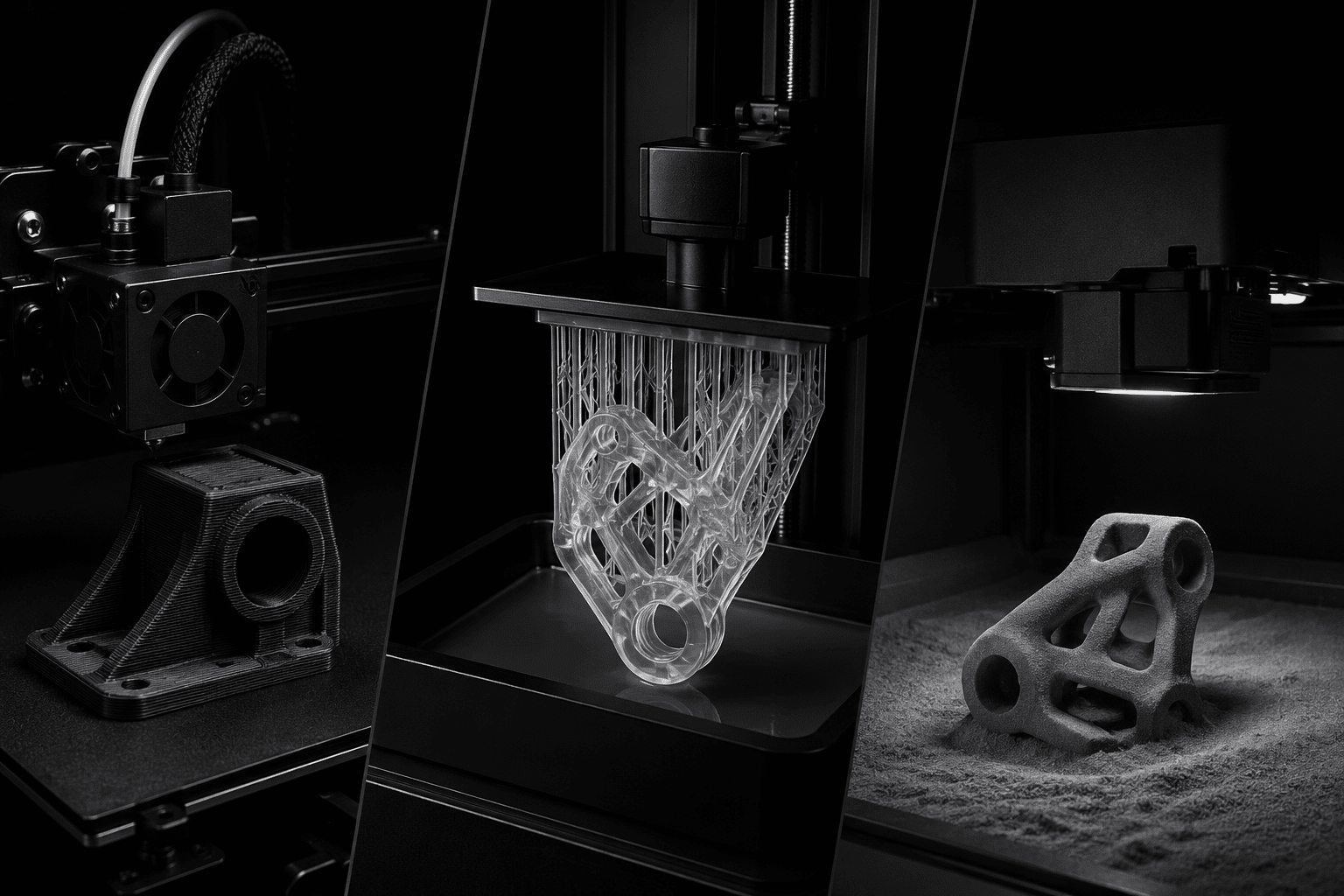
FDM (Fused Deposition Modeling) melts a plastic filament and lays it down layer by layer, a bit like a very precise hot glue gun. It is the technology most people picture when they hear “3D printer.”

SLA (Stereolithography) uses UV light to cure liquid resin into solid plastic. It trades a little speed for stunning detail and smooth surfaces.

SLS (Selective Laser Sintering) uses a laser to fuse fine nylon powder into strong, functional parts — with no support structures needed, because the surrounding powder holds everything in place.

Same goal, three very different routes. The differences matter more than most people expect.

FDM: the budget workhorse

FDM is the cheapest and most accessible process, and for good reason. It handles a wide range of thermoplastics — PLA, ABS, PETG, TPU, nylon, even carbon-fibre-reinforced filaments — and it scales to larger parts without the cost spiralling.

The trade-off is finish and detail. You will see layer lines, and parts are weaker along the layer direction (what engineers call anisotropy). For prototypes, jigs and fixtures, enclosures and functional testing, none of that matters much — which is exactly why FDM dominates everyday prototyping.

SLA: when detail is everything

If your part needs to look finished — smooth surfaces, crisp edges, fine features — SLA is hard to beat. Because it cures liquid resin with light, it captures detail that FDM simply cannot, down to features thinner than a human hair.

The catch: standard resins are more brittle than FDM plastics and can degrade under prolonged UV exposure, and parts need washing and post-curing. A growing range of engineering resins — tough, flexible, heat-resistant, castable and dental-grade — widens what SLA can do, but it is still best thought of as the “looks and detail” process. It shines for display models, jewellery masters, dental and medical models, and detailed scale models.

SLS: strong, functional, no supports

SLS is the quiet favourite among engineers. It sinters nylon powder into parts that are genuinely strong in every direction, with good heat and chemical resistance. Because the powder bed supports the part as it builds, you can print complex geometries, snap-fits, living hinges and interlocking assemblies that would be a nightmare in FDM or SLA.

The surface is slightly grainy and matte rather than glossy, and it costs more than FDM. But for functional end-use parts and low-volume production runs it often works out cheaper overall — there are no support structures to remove, so post-processing is minimal. It is a strong choice for durable IoT and electronic housings.

Side-by-side comparison

 FDMSLASLS
How it worksMelts plastic filament, layer by layerUV light cures liquid resinLaser sinters nylon powder
MaterialsPLA, ABS, PETG, TPU, Nylon, CF blendsStandard, tough, flexible, castable, dental resinsNylon PA12 / PA11, glass-filled nylon
Surface finishVisible layer linesSmooth, high detailSlightly grainy, matte
Detail / resolutionModerateExcellent — the finestGood
StrengthGood; weaker along layersBrittle (standard resin)Strong in every direction
Support removalNeeded; removed manuallyNeeded; wash + UV cureNone — powder self-supports
Cost (India, 2026)₹3–8 / gram (lowest)₹8–15 / gram₹10–20 / gram
Best forPrototypes, large & low-cost partsDetailed & display modelsFunctional end-use parts

So which one should you choose?

Here is the shortcut we give clients:

  • Need it cheap, fast or large? Go FDM.
  • Need it to look beautiful and detailed? Go SLA.
  • Need it strong and functional? Go SLS.

If you need real metal performance, that is a different conversation — see our guide on metal 3D printing in India. And if you are comparing 3D printing against traditional manufacturing for a production run, our 3D printing vs injection molding breakdown will help.

A quick word on cost

Material and process are not the only price drivers — part volume, geometry, finish and quantity all move the number. As a rough 2026 guide in India: FDM starts around ₹3–8 per gram, SLA around ₹8–15 per gram, and SLS around ₹10–20 per gram. The real figure always depends on your specific part, and our complete Cost of 3D Printing in India guide breaks it down properly.

Frequently asked questions

Which 3D printing process is the cheapest?

FDM is the cheapest and most accessible of the three. As a rough 2026 guide in India, FDM starts around ₹3–8 per gram, compared with ₹8–15 per gram for SLA and ₹10–20 per gram for SLS. It also scales well to larger parts without the cost spiralling, which is why FDM dominates everyday prototyping, jigs and fixtures.

Which 3D printing process is the strongest?

SLS produces the strongest, most functional parts. It sinters nylon powder into components that are strong in every direction, with good heat and chemical resistance. Because the powder bed supports the part as it builds, SLS also handles complex geometries, snap-fits and living hinges, making it ideal for functional end-use parts and low-volume production.

Which 3D printing process gives the smoothest finish?

SLA delivers the smoothest surface and the finest detail. Because it cures liquid resin with UV light, it captures features thinner than a human hair with crisp edges and smooth surfaces. That makes SLA the best choice for display models, jewellery masters, dental and medical models, and any part where surface finish sells the product.

Should I use FDM or SLA for prototypes?

Use FDM for fast, low-cost or large functional prototypes where layer lines and minor surface roughness do not matter. Choose SLA when the prototype needs to look finished, with smooth surfaces and fine detail — such as appearance models. In short: FDM for cost and speed, SLA for looks and detail.

The bottom line

There is no single “best” 3D printing process — only the best one for your part. Match the technology to what the part actually has to do, and you will save money and avoid disappointing results.

Not sure which way to go? Send us your design and we will recommend the right process honestly. Talk to our team — our CAD and engineering folks are happy to help.

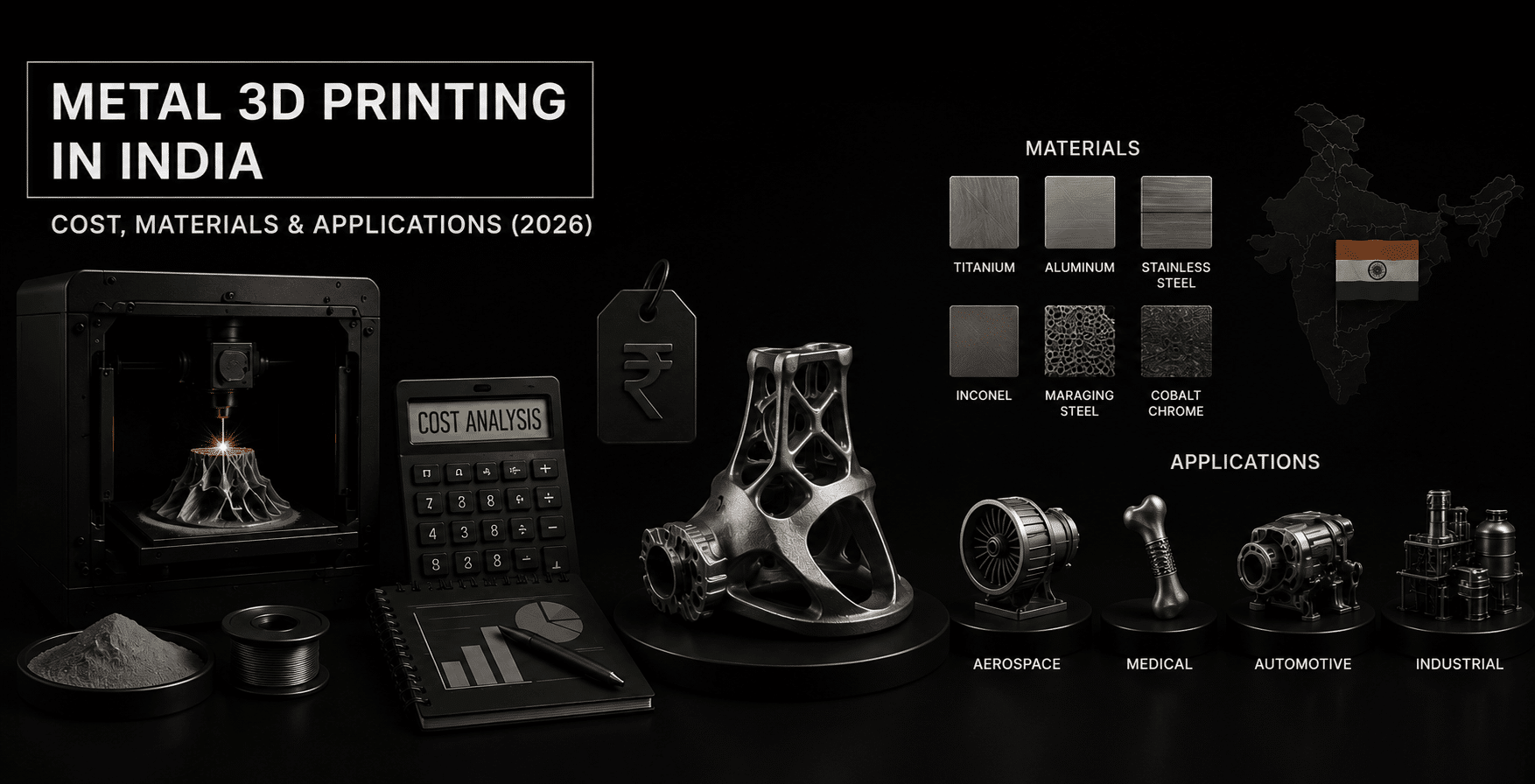
Metal 3D Printing in India: Cost, Materials & Applications (2026)

Metal 3D Printing in India Cost, Materials & Applications (2026)

For years, 3D printing in India basically meant plastic. Prototypes, jigs, display models, the odd enclosure — all useful, but the moment someone needed a part that could take real load, heat or stress, the conversation went straight back to CNC machining or casting. That has quietly changed. Metal 3D printing has grown up, and in 2026 it is a genuinely practical option for Indian businesses, not just aerospace labs with deep pockets.

If you are weighing it up for your own product, this guide covers what it actually costs in India, which metals you can print, and where it makes sense — and, just as importantly, where it doesn’t. If you are new to additive manufacturing altogether, our 3D printing services page is a good starting point.

What is metal 3D printing, really?

Metal 3D printing — also called metal additive manufacturing (AM) — builds a part layer by layer from fine metal powder instead of carving it out of a solid block. The most common process is DMLS (Direct Metal Laser Sintering), where a high-power laser fuses metal powder inside a sealed, inert-gas chamber. Its close cousin SLM (Selective Laser Melting) works almost identically. You will also hear about Binder Jetting (cheaper, better for volume), EBM (electron beam melting) and DED (directed energy deposition).

The big draw is geometry. You can build internal cooling channels, lattice structures and weight-optimised shapes that are simply impossible to machine or cast. The trade-off is cost — and that is the part most people get wrong.

How much does metal 3D printing cost in India? (2026)

Let’s get to the number everyone wants. Metal AM sits at the premium end of the spectrum. As a rough benchmark, DMLS printing in India runs roughly ₹50 to ₹150 per gram depending on the alloy, with a small functional part typically starting around ₹5,000. Compare that with FDM plastic at ₹3–8 per gram and you can see why metal is reserved for parts that earn it.

Process / MaterialTypical Price (India, 2026)Best suited for
Metal DMLS — Stainless Steel (316L / 17-4 PH)₹50–90 / gramFunctional parts, brackets, tooling
Metal DMLS — Titanium (Ti6Al4V)₹100–150 / gramAerospace, medical implants, lightweight parts
Metal DMLS — Aluminium (AlSi10Mg)₹60–100 / gramHeat sinks, automotive, light housings
Metal Binder JettingLower per-part at volumeMid-to-high volume, complex geometry
FDM Plastic (PLA / ABS) — for reference₹3–8 / gramPrototypes, jigs, display models

A few things move the final price more than the per-gram rate suggests:

  • Part volume and weight — you pay for every gram, plus the support structures.
  • Post-processing — heat treatment, support removal by wire EDM and CNC finishing of mating surfaces are usually mandatory, not optional.
  • Alloy choice — titanium and Inconel cost far more than stainless steel.
  • Quantity — batching several parts onto one build plate brings the per-part cost down.

For a fuller breakdown across every technology, our complete Cost of 3D Printing in India guide lays the numbers out side by side.

Metals you can actually print

The material list has expanded a lot. The workhorses in India right now:

  • Stainless Steel (316L, 17-4 PH) — strong, corrosion-resistant and the most economical way into metal AM. 17-4 PH reaches high tensile strength after heat treatment.
  • Titanium (Ti6Al4V) — an exceptional strength-to-weight ratio and biocompatible, which is why it dominates aerospace and medical implants.
  • Aluminium (AlSi10Mg) — light with good thermal conductivity; popular for automotive parts and heat sinks.
  • Inconel (625, 718) — nickel superalloys that hold up under extreme heat, used in turbines and energy applications.
  • Cobalt Chrome & Tool Steel — dental, medical and hard-wearing tooling.

Picking the right alloy is honestly half the battle. If you are not sure, our CAD design and engineering team can advise based on the load, environment and budget your part has to live with.

Where metal 3D printing makes sense

This is where it earns its keep:

  • Aerospace & defence — lightweight, topology-optimised brackets and ducts.
  • Automotive — performance and motorsport parts, prototype components and conformal-cooled tooling. See our automotive manufacturing work.
  • Medical & dental — patient-specific titanium implants and surgical guides.
  • Tooling & moulds — mould inserts with internal cooling channels that cut cycle times, a neat bridge to our injection molding services.
  • Electronics & IoT — rugged metal housings and heat sinks for demanding IoT and electronic devices.
  • Drones — strong, featherweight structural parts where every gram matters, exactly what drone manufacturers need.

India’s metal AM ecosystem has matured too. Homegrown machine builders like Intech Additive Solutions and Amace Solutions now sit alongside global names such as EOS and 3D Systems, which has steadily pushed costs down and capacity up across the country.

When you should NOT use metal 3D printing

Honest answer: if you need simple geometry in high volume, traditional machining or casting will almost always be cheaper. Metal AM wins on complexity, customisation and low-to-mid volumes — not on churning out 10,000 identical brackets. If you are torn between approaches, our 3D printing vs injection molding comparison is a useful next read.

The bottom line

Metal 3D printing in India in 2026 is no longer experimental — it is a credible production route when your part demands real metal performance and a geometry nothing else can deliver. The key is matching the process and alloy to the job, and staying clear-eyed about volume.

If you have a part in mind, the fastest way to a real number is to send us the CAD file. Talk to our team and we’ll tell you honestly whether metal AM is right for it — and what it will cost.

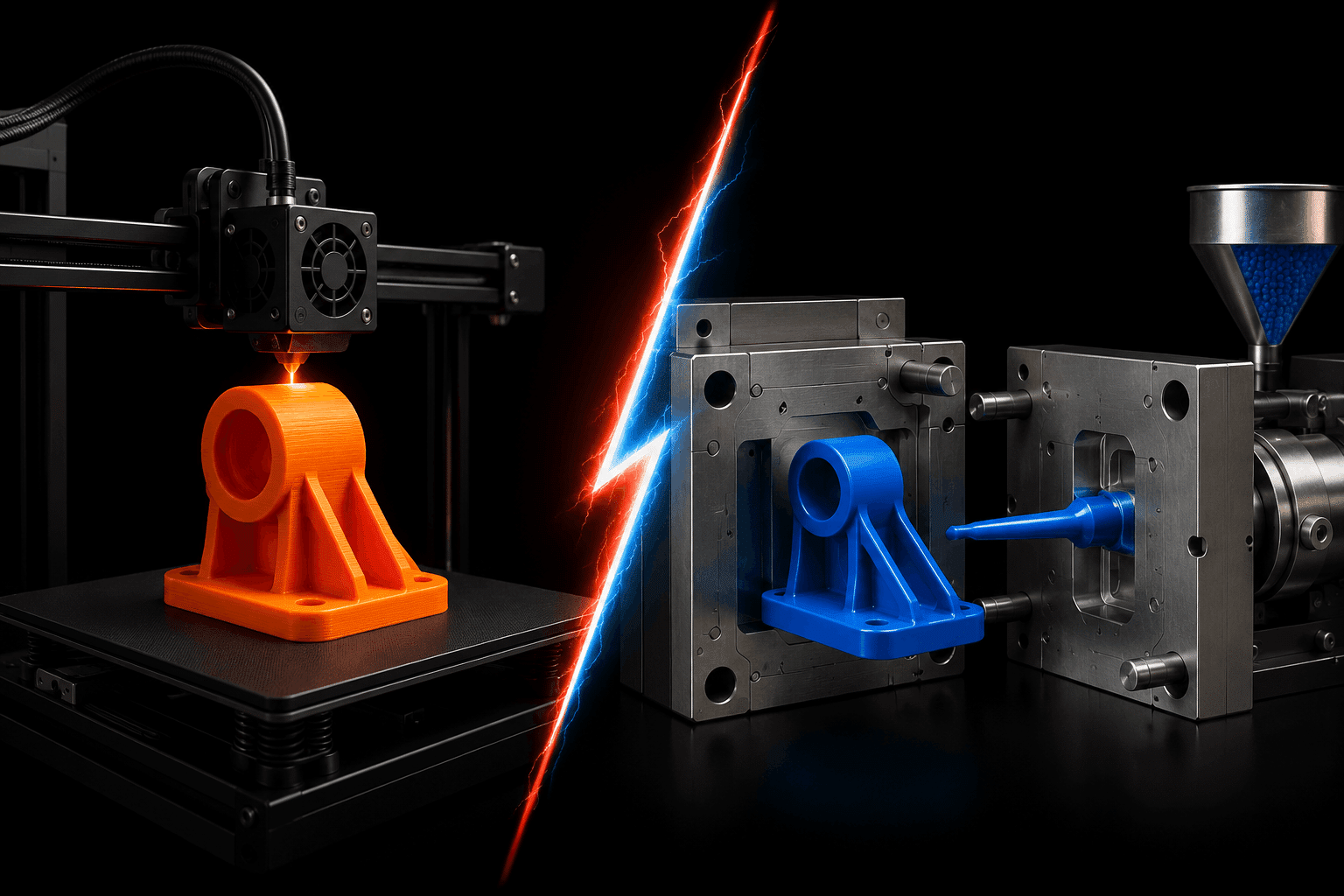
3D Printing vs Injection Molding: Which Should You Choose?

3D printing vs injection molding

Choosing how to manufacture a plastic part comes down to one question more than any other: how many do you actually need? Get that answer right and the rest of the decision – cost, speed, quality – tends to fall into place. Get it wrong and you either sink money into a mould you never recover, or you pay far too much per part for a process that was only ever meant for prototypes.

Here is the short version. If you need a handful of parts, a working prototype, or your design is still changing, 3D printing is almost always the smarter choice – there is no tooling to pay for and you can hold a finished part within a few days. Once your design is locked and you are ordering in the thousands, injection molding takes over, because the cost of the mould is shared across every part and the price per piece keeps dropping. The interesting decisions live in the middle, and that is what the rest of this guide unpacks.

3D printing vs injection molding at a glance

Factor3D PrintingInjection Molding
Upfront tooling costNoneHigh – a mould must be made first
Cost per partFlat – similar at 10 or 1,000 unitsFalls sharply as volume rises
Best volume range1 to ~1,000 parts~1,000+ (excels at 10,000+)
First part in handAround 1–3 daysAround 4–8 weeks (mould making)
Design changesFree – just edit the fileCostly – may need a reworked or new mould
Material optionsResins, nylon, PETG, metal AM and moreCommodity and engineering-grade plastics
Strength & consistencyGood; MJF nears molded-part strengthExcellent and highly repeatable
Geometry freedomVery high – internal & complex featuresLimited by draft angles and undercuts
Ideal usePrototypes, iteration, low volume, complex one-offsValidated designs made at scale

How the two processes actually work

The two methods sit at opposite ends of manufacturing logic. 3D printing is additive – a machine builds your part layer by layer, straight from a CAD file, with nothing made in advance. Because there is no setup beyond the file itself, the first part and the hundredth part cost roughly the same to produce.

Injection molding is the opposite. A steel or aluminium mould is machined first, then molten plastic is injected into it under pressure, cooled, and ejected – over and over, in seconds per cycle. The mould is expensive and slow to make, but once it exists, each part is astonishingly cheap and identical to the last. The whole economic case for molding rests on producing enough parts to justify that upfront tool.

The cost comparison – the part that decides it

Most teams agonise over materials and finish when the real swing factor is tooling. 3D printing carries no tooling cost at all, so the line on a cost chart starts low and stays fairly flat. Injection molding starts high – you pay for the mould before a single sellable part exists – but the per-part cost then falls as that fixed cost is divided across more and more units.

Why 3D printing stays flat

With printing, you are essentially paying for machine time and material on every part, with no fixed cost to amortise. That is what makes it unbeatable for low volumes and prototypes. For a full breakdown of what drives the number in India, see our complete 3D printing cost guide for India.

Why injection molding gets cheaper at scale

Tooling is the lever. Internationally, a simple aluminium mould can start in the low thousands of dollars and last for a few thousand to perhaps ten thousand parts, while a hardened multi-cavity steel tool can run past USD 100,000 but produce hundreds of thousands – even millions – of parts. Spread across a large run, that cost becomes negligible: per-part pricing can drop to well under a dollar at high volumes. For India-specific tooling and per-unit figures, our injection molding cost guide for India (2026) has the local numbers.

Where the two lines cross

Published cost studies put the break-even point anywhere between roughly 1,000 and 13,000 parts, depending on part size, complexity and how expensive the mould is. One widely cited test by Formlabs produced 1,000 parts for around USD 600 by printing versus roughly USD 3,920 with outsourced molding – about 85% cheaper to print at that volume – with molding only pulling ahead well into the thousands. The lesson is not the exact number; it is that the crossover shifts with your specific part, so the volume bands below are a starting point rather than a rule.

Order volumeLower-cost methodWhy
Under ~200 parts3D printingNo tooling to pay off; full design freedom
~200 – 1,000 partsDependsPart size, complexity and mould cost decide it
~1,000 – 10,000 partsUsually moldingTooling cost starts spreading across enough parts
10,000+ partsInjection moldingPer-part cost drops to a fraction of printing

Lead time and speed to market

Speed often matters as much as cost. A 3D-printed part can be in your hands in roughly one to three days because there is no tooling step – you go straight from file to finished part. Injection molding typically needs around four to eight weeks just to design and cut the mould before the first part appears. If you are racing to a launch, testing a design, or iterating quickly, that gap is decisive. If you have a stable design and a long production horizon, the mould lead time is a one-time cost worth absorbing.

Design flexibility and iteration

This is where printing quietly saves projects. Need to move a mounting boss or thicken a wall? With printing you edit the CAD file and reprint – no extra cost. With molding, almost any geometry change means reworking the tool, and a significant change can mean cutting a new one. That is why so many teams prototype and refine with printing, lock the design, and only then commit to a mould. A clean, manufacturing-ready model makes either path smoother, which is where good 3D CAD design earns its keep.

Material and strength considerations

Both processes cover a wide material range, but they behave differently. Injection molding delivers excellent, highly repeatable mechanical properties – every part comes out essentially the same, which matters for regulated or load-bearing components. Modern printing has closed much of the gap: processes such as Multi Jet Fusion can reach close to the tensile strength of a molded part, which is often more than enough for functional prototypes, jigs, fixtures and low-volume end-use parts.

For very small runs where you still want cast-like quality, vacuum casting can bridge the two – our explainer on the vacuum casting process covers when that makes sense.

When to choose 3D printing

  • You need prototypes or design validation before committing to tooling.
  • Your total volume is under roughly 1,000 parts.
  • The design is still changing or you expect revisions.
  • The geometry is complex, with internal channels or features a mould cannot easily release.
  • You need parts in days, not weeks.

When to choose injection molding

  • Your design is finalised and unlikely to change.
  • You are ordering in the thousands, with more runs to follow.
  • You need every part to be identical, with consistent strength.
  • Per-part cost matters more than upfront investment.

Still weighing low versus high volume? Our guide on low-volume vs high-volume injection molding breaks down where each makes sense.

The smartest route is often both

For most new products, the winning strategy is not choosing one process forever – it is sequencing them. Prototype and refine with 3D printing while the design is fluid, validate the part in real use, then transition to injection molding once your volume justifies the tooling. You de-risk the design before spending on a mould, and you reach scale efficiently. Picking the right manufacturing partner for that handover matters too; our guide on how to choose an injection molding partner in India walks through what to look for.

What to expect in India

India’s 3D printing sector is growing quickly – valued at around USD 860 million in 2025 and projected to reach roughly USD 5.2 billion by 2034, a compound growth rate of about 21% a year, according to IMARC Group. Much of that demand is driven by rapid prototyping in automotive, aerospace and electronics. For you, this maturing ecosystem means competitive pricing on both processes and shorter local lead times than importing parts. Whether you are building drone components, automotive parts or IoT enclosures, both routes are well served domestically.

Frequently asked questions

Is 3D printing cheaper than injection molding?

For small quantities, yes – usually significantly so, because there is no mould to pay for. As volume climbs into the thousands, injection molding becomes cheaper per part and eventually far cheaper. The break-even point depends on your part and tooling cost, but commonly falls somewhere between 1,000 and 13,000 parts.

At what quantity does injection molding become worth it?

As a rule of thumb, once you are confident you will produce more than about 1,000 identical parts – and especially beyond 10,000 – the tooling investment starts paying for itself. Below that, printing usually wins on both cost and speed.

Can 3D printing be used for production parts, not just prototypes?

Yes. For low to mid volumes, complex geometries, or parts where modern printed materials meet the strength requirement, 3D printing is a legitimate production method – not only a prototyping tool.

How much faster is 3D printing than injection molding?

Considerably, for the first parts. Printing can deliver a finished part in one to three days, while molding typically needs four to eight weeks to make the tool before production begins.

Not sure which fits your part?

Every part is different, and the right call depends on your volume, budget, timeline and how finalised your design is. Send us your CAD file and we will give you a free design-for-manufacture review and an honest recommendation – printing, molding, or a staged approach – along with a quote. Get in touch with Precious3D to get started.

Injection Molding Cost in India (2026): Tooling, Per Unit & Hidden Costs

Injection Molding Cost in India (2026) Tooling, Per Unit & Hidden Costs

Injection molding is one of the most cost-efficient manufacturing processes in India—but only if you understand the complete cost structure. Many businesses underestimate tooling, ignore hidden costs, or miscalculate per-unit pricing.

This guide breaks down real 2026 costs in India, with comparisons, stats, and practical insights to help you estimate, reduce, and optimize your injection molding budget.


📊 Injection Molding Cost Overview (India vs Global)

Cost TypeIndia (2026)Global AverageKey Insight
Tooling Cost₹80,000 – ₹25,00,000+$1,000 – $100,000+India is 30–60% cheaper
Per Unit Cost₹5 – ₹400+$0.20 – $10Volume reduces cost drastically
Machine Cost₹20L – ₹1Cr+Similar globallyCapex impacts vendor pricing
Lead Time2–8 weeks3–12 weeksFaster turnaround in India

👉 Injection molding services in India is significantly cheaper due to lower labor + operational costs, making it ideal for global outsourcing.


🏭 1. Tooling Cost in India (Biggest Investment)

Tooling (mold) is a one-time cost, but also the largest upfront expense.

💰 Typical Tooling Cost (India)

Mold TypeCost Range
Simple Mold (small part)₹80,000 – ₹1,20,000
Medium Complexity₹1.5L – ₹5L
High Precision / Multi-cavity₹5L – ₹25L+

👉 Example: A basic 250×250 mm mold costs around ₹80K–₹1.2L in India

⚙️ What Drives Tooling Cost?

  • Material (P20 vs H13 steel)
  • Number of cavities
  • Design complexity
  • Surface finish requirements
  • Tool life (low vs high volume production)

📌 Fact: Complex molds globally can exceed $100,000, but India offers much lower alternatives.


🔁 2. Per Unit Cost (Production Cost)

Once tooling is ready, per-unit cost becomes the focus.

💸 Per Part Cost in India

Production VolumeCost per Unit
1,000 units₹50 – ₹400
10,000 units₹10 – ₹80
100,000+ units₹5 – ₹30

👉 Global benchmarks show $0.20–$10 per part depending on volume

📉 Key Insight

  • Higher volume = lower cost per unit
  • Tooling cost gets distributed across production

📌 Example:
A ₹2L mold + ₹20/unit production becomes ₹40/unit at low volume, but drops below ₹10 at scale.


⚖️ Tooling vs Per Unit Cost (Critical Comparison)

FactorTooling CostPer Unit Cost
TypeOne-timeRecurring
ImpactHigh upfrontLong-term
Best forMass productionAll volumes
OptimizationDesign & materialVolume & cycle time

👉 Smart strategy:

  • Low volume → reduce tooling cost
  • High volume → optimize per-unit cost

⚠️ 3. Hidden Costs Most Buyers Ignore

This is where most budgets go wrong.

🚨 Hidden Cost Breakdown

Cost TypeEstimated Impact
Design & CAD10–15%
Material wastage5–10%
Setup & labor5–8%
Finishing / polishing5–20%
Packaging₹2–₹20 per unit
Maintenance of moldLong-term cost

👉 Design + manufacturing alone can account for 30–50% of mold cost


🧠 4. Cost Calculation Formula (Simple)

Total Cost = Tooling Cost + (Per Unit Cost × Quantity)

Example:

  • Tooling = ₹2,00,000
  • Per unit = ₹20
  • Quantity = 50,000

👉 Total = ₹2,00,000 + ₹10,00,000 = ₹12,00,000

👉 Effective cost per unit = ₹24


📈 5. Real Industry Insights (India 2026)

  • India’s plastic molding demand is growing due to automotive, packaging, and electronics sectors
  • Multi-cavity molds reduce cost per part significantly
  • India offers 30–60% lower manufacturing cost vs US/EU
  • Faster lead times = better for startups & MVP production

🔍 People Also Search For (SEO Boost Section)

  • Injection molding cost per kg in India
  • Plastic mold cost calculator India
  • Injection molding vs 3D printing cost
  • Minimum order quantity for injection molding
  • Prototype vs production mold cost

🆚 Injection Molding vs 3D Printing (Cost Comparison)

FactorInjection Molding3D Printing
Setup CostHighLow
Per Unit CostVery low (bulk)High
Best ForMass productionPrototyping
SpeedFast after setupImmediate
ScalabilityExcellentLimited

👉 Insight:

  • Use 3D printing for testing
  • Switch to injection molding for scale

🎯 How to Reduce Injection Molding Cost

  • Simplify part design
  • Use standard materials (PP, ABS)
  • Increase production volume
  • Choose multi-cavity molds
  • Optimize cycle time

🚀 Final Thoughts (Lead Angle)

Injection molding in India is highly cost-effective, but only when you balance:

👉 Tooling investment
👉 Per-unit pricing
👉 Hidden costs

If you’re planning production, the smartest move is to:

✔ Get a DFM (Design for Manufacturing) analysis
✔ Compare multiple vendors
✔ Start with prototype tooling

Sustainable Manufacturing: Is 3D Printing the Future?

You see the word “sustainability” everywhere now. But when you look deeper, most manufacturers still run on old systems that burn energy, create waste, and lock teams into slow processes. If you’ve worked in product development or supply chain, you know how quickly waste adds up. You produce extra stock “just in case.” You store parts you never use. You ship items across the world only to rework them again.

3D printing changes that. It gives you control over how you design, test, and manufacture without the usual waste. It’s not a magic fix, but it solves real problems that slow companies down. And that’s why many people ask the same question: Is 3D printing the future of sustainable manufacturing? Here’s what we know.

Why Sustainability Matters in Today’s Manufacturing

By 2024, manufacturing accounted for around 20% of global CO₂ emissions (Source: IEA). Governments in the US, Europe, and India pressured industries to reduce carbon waste and use cleaner methods. If you work in or around operations, you already feel this pressure. Regulations tighten. Customers expect cleaner products. Teams need faster ways to design and produce parts with less waste.

Sustainable manufacturing isn’t an option anymore. It’s a requirement.

Where 3D Printing Fits into Sustainability

3D printing is simple at its core. You print only what you need, when you need it. No extra inventory. No cutting raw materials into shapes and throwing the rest away. No giant molds that take weeks to build.

Here’s what this procedure means for real teams:

  • You reduce material waste by up to 70% compared to machining.
  • You run production without molds, which cuts tool waste almost entirely.
  • You build parts near the end user, lowering shipping emissions.
  • You test ideas in hours instead of weeks.

The biggest gain is flexibility. You don’t lock yourself into large production runs. You print only what you need.

Quick Comparison: Traditional vs 3D Printing

FactorTraditional Manufacturing3D Printing
Material WasteHighLow
Energy UseHigh for machining and moldingLower for small and medium runs
SpeedSlow for prototypesFast
InventoryNeeds storagePrint on demand
ToolingMolds and dies requiredNo tooling

If you want to compare production costs, check our 3D printing pricing guide.

What Experts Say

“Companies that cut waste at the design stage see the biggest sustainability gains. 3D printing puts design and manufacturing closer together.” — Dr. Elena Brooks, Materials Researcher (2025)

“Localized micro-manufacturing reduces emissions faster than any other shift we’ve tracked.” — Global Supply Chain Index, 2024 Report

How 3D Printing Supports Sustainable Workflows

You lower waste not only by printing less material but also by improving how you design products. When engineers have freedom to test ideas quickly, they avoid late-stage fixes that cost energy, materials, and time. You stop building parts that fail later. You stop shipping prototypes back and forth. You move fast and clean.

Where Companies Already Use It

  • Consumer electronics
  • Healthcare devices
  • Automotive lightweight parts
  • Aerospace brackets and ducting
  • Architecture and industrial tooling

If you want real-world examples you can study, check these:

Does This Make 3D Printing the Future?

For many applications, yes. You gain speed, control, and cleaner workflows. You design smarter from day one. You print only what you need. You avoid the waste you see in traditional plants. Large-scale mass production will still use molding and machining, but the most flexible and sustainable workflows now lean heavily on 3D printing.

If you want sustainable manufacturing that actually works in real teams, 3D printing is already part of the future. It’s not coming later. It’s here now.

FAQs

1. Is 3D printing actually eco-friendly?

Yes. You reduce waste and avoid tooling. That makes the process cleaner.

2. Can 3D printing replace traditional manufacturing?

Not fully. But it takes over prototyping and low-volume production.

3. Which materials are the most sustainable?

PLA, recycled PETG, and some bio-based polymers perform well.

4. Does 3D printing use a lot of electricity?

Not compared to CNC or injection molding setup processes.

5. Are 3D printed parts safe for long-term use?

Yes, if you pick the right material and design the part for its load.

6. Can companies scale with 3D printing?

Yes. Many run hybrid setups: 3D printing services for prototypes and molds for mass runs.

The Future of 3D Printing in India: Trends to Watch

Future of 3D trends in India

If you look at where 3D printing was in India 5–6 years ago and where it is today, the difference is honestly quite noticeable.

Back then, it felt more like a niche technology – something limited to labs, colleges, or a few high-end industries. Now, it’s slowly becoming part of real business workflows. Not everywhere yet, but definitely moving in that direction.

A big reason? Access.

You no longer need to own a machine to use 3D printing. Service providers like Precious3D have made it much easier for businesses to just get things printed when needed. That alone has changed how startups and small manufacturers approach product development.

And once people try it, they usually don’t go back to the old way for early-stage work.

So, what’s actually driving this growth?

It’s not just hype. There are some very practical reasons:

  • You can test ideas quickly without waiting weeks
  • Costs stay under control, especially for small batches
  • Custom designs are much easier to produce
  • There’s far less material wastage
  • It fits well with the whole “manufacture locally” push

None of these are revolutionary on their own—but together, they make a strong case.

What’s changing right now?

A few shifts are becoming pretty clear if you look closely.

It’s no longer just for prototypes

Earlier, 3D printing was mostly used to “see how something looks.” Now, in some cases, those printed parts are actually being used in final products.

Not everywhere, but enough to say things are changing.

On-demand production is catching on

Instead of producing in bulk and storing inventory, some businesses are printing parts only when required.

This works especially well for:

  • Spare parts
  • Custom orders
  • Low-volume products

It reduces risk. And honestly, that’s a big deal for smaller businesses.

Materials are getting better

For a long time, people associated 3D printing with plastic models.

That’s outdated now.

You’ll find:

  • Strong engineering plastics
  • Resin with very fine detail
  • Metal printing (still growing in India, but picking up)

As materials improve, so do use cases.

Healthcare is quietly adopting it

This is one space where the impact feels more meaningful.

We’re seeing:

  • Custom prosthetics
  • Dental applications
  • Surgical models for planning

It’s still evolving, but the direction is promising—especially in a country where affordability matters so much.

Startups are using it smartly

Instead of investing heavily upfront, founders are using 3D printing to test, fail, improve—and then scale.

That flexibility wasn’t really possible earlier, without spending a lot.

Where is it being used the most?

It’s spread out, but some areas stand out:

  • Automotive (prototyping, small components)
  • Architecture (models, concepts)
  • Consumer products (custom items)
  • Education (practical exposure)
  • Healthcare (as mentioned above)

It’s not dominating any single sector yet—but it’s present in many.

One thing people don’t talk about enough: sustainability

3D printing isn’t perfect, but it does reduce waste since material is added layer by layer.

Also, local production means less shipping. That’s another small but important advantage.

What can we expect next?

Nothing dramatic overnight—but steady growth.

  • More awareness among businesses
  • Better and cheaper machines
  • Wider material options
  • More integration with automation and AI

Basically, fewer barriers.

Final thought

3D printing in India is in that interesting middle phase—it’s no longer new, but not fully mainstream either.

And that’s usually where the biggest opportunities are.

Tools and services like Precious3D make it easier for businesses to experiment without overcommitting.

Give it a couple of years, and this might just become a standard part of how products are built—not something “innovative,” just something normal.

Ceramic 3D Printing: Products, Process, Materials, Applications & Benefits

Working of Ceramic 3D Printing

3D printing is a new efficient additive manufacturing technology. During the 3D printing process, metal powder or adhesive materials with a plastic shrinkage characteristic are used in a 3D printer to print layer by layer, which is the principal method of additive manufacturing. This new additive manufacturing technology is extensively used in the areas of product design and prototyping, medical product manufacturing, vehicle design, engineering, spaceflight, etc. Ceramic 3D printing is used to create the ceramic prototypes. There are 2 types of ceramic 3D printing:

  • Indirect 3d printing
  • Direct 3d printing

Ceramic 3D Printing: Comparison Table

TechnologyCostAccuracyBest Use Case
Binder JettingLow to MediumMediumBulk production, complex shapes, industrial parts
SLA / DLP (Photopolymerization)Medium to HighVery HighPrecision parts, dental, medical, fine details
Material Extrusion (DIW / Robocasting)LowLow to MediumPrototypes, research, custom designs
Selective Laser Sintering (SLS)HighHighStrong, functional, heat-resistant components
Laminated Object Manufacturing (LOM)MediumLowLarge parts, simple geometries


Compared with forming in traditional ways, forming with 3D printing is more rapid and efficient, with a lower manufacturing cost for ceramic products. A 3D-printed product from a computer-aided design has a higher precision than a handmade ceramic article. The 3D printer is the essential equipment for 3D printing. Embedded chips precisely control the position of the extruder in this printer. These chips can control the quantities of material extruded and the extrusion time. In addition to high-density ceramic slip, the plastic filament can also be printed directly, and it is the best material to use for indirect 3D printing of a product.

ceramic 3d printing

Working of Ceramic 3D Printing

Ceramic 3D printing is a process where a digital design is turned into a real ceramic part, built layer by layer. Unlike traditional methods that rely heavily on molds, this approach gives more flexibility in design and faster production.

Step-by-Step Process

  • Design creation
    Everything starts with a 3D model, usually made in CAD software. This file is then exported in a printable format like STL.
  • Material preparation
    Depending on the technology used, the ceramic material is prepared as a paste, slurry, or fine powder.
  • Printing process
    The printer builds the object layer by layer. It may deposit material or use light/heat to solidify each layer. Common methods include binder jetting, SLA, and extrusion.
  • Drying stage
    The printed part, often called a “green part,” is left to dry carefully. This step removes moisture and helps avoid cracks.
  • Debinding
    Any binders or additives used during printing are removed, usually by controlled heating.
  • Sintering (final firing)
    The part is heated at high temperatures in a kiln. This step strengthens the ceramic and gives it its final properties.

Benefits of Ceramic 3D Printing

Ceramic 3D printing offers several advantages over traditional manufacturing methods, especially for complex and high-performance applications:

  • Design freedom: Create complex and intricate shapes that are difficult with conventional techniques.
  • No tooling required: Eliminates the need for molds, reducing upfront costs and production time.
  • High heat resistance: Suitable for applications exposed to extreme temperatures.
  • Smooth surface finish: Produces detailed parts with minimal post-processing.
  • Reduced material waste: Uses only the necessary material, making it more efficient.
  • Easy customization: Each part can be customized without increasing production costs.
  • Faster prototyping: Speeds up product development and testing cycles.
  • Strong and lightweight parts: Optimized designs improve strength while reducing weight.
  • Excellent chemical resistance: Ideal for harsh and corrosive environments.
  • Eco-friendly process: Generates less waste compared to traditional ceramic manufacturing.
ceramic 3d printing

3d printed ceramic pot

Currently, ceramic is the only known 3d printing material that is food safe. In the process of creating and glazing the material, a type of gloss that is non-toxic and lead-free is used. This means that one can use it to print utensils like cups, plates, bowls, and other kitchen tools.

ceramic 3d printing

3D printed ceramic cups and plates

Basically, one can safely print tableware and home décor in which you’re going to serve food or beverages. Otherwise, it’s also commonly used for creating vases, candle holders, art, and many more.

What is ceramic 3D printing?

Ceramic 3D printing is an additive manufacturing process where ceramic materials are used to create parts layer by layer, allowing complex and precise designs.

How does ceramic 3D printing work?

The process includes design creation, material preparation, printing, drying, debinding, and sintering to achieve final strength.

What materials are used?

Common materials include alumina, zirconia, silica, and other advanced ceramics depending on the application.

Where is it used?

Used in aerospace, medical, automotive, electronics, and prototyping industries.

Is ceramic 3D printing expensive?

Costs vary based on size, material, and complexity, but it is cost-effective for prototypes and low-volume production.

Cost of 3D Printing in India: Complete Pricing Guide

3D Printing in India

How Much Does 3D Printing Cost in India? A Complete Expert Breakdown for 2026

Clear pricing guide for materials, printers, design, finishing and delivery. Practical numbers you can use today.

Most people ask one practical question before they start: How much will 3D printing cost in India. This guide gives you direct answers. You will find material rates, the effect of different printers, design charges, finishing costs and real examples you can copy. Use this to plan a budget and avoid surprises.

Quick stat: India’s 3D printing market was about USD 707 million in 2024 and is growing above 20% CAGR through the decade

What decides your 3D printing cost

Your final price comes from five things:

  • Material weight and type
  • Printing time
  • Printer type
  • Design work
  • Post processing and delivery
3d printing technology

Material pricing per gram in India

Material cost is the biggest factor. You pay more for strength, detail or specialty materials.

Material

Price per gram

Best for

PLA
5 - 15 Rs
Simple models and prototypes
ABS
10 - 20 Rs
Functional parts and enclosures
PETG
10 - 20 Rs
Outdoor items and food safe parts
Resin (SLA)
20 - 50 Rs
Highly detailed models and miniatures
Nylon PA12
45 - 80 Rs
Durable functional parts
Carbon fiber and metal powders
100 - 500+ Rs
High strength uses in automotive and aerospace

Example: A 100 gram PLA print usually lands between 1000 and 1500 rupees. The same part in resin often costs 2000 to 4000 rupees.

PLA 3D printing

Layer lines visible on surface
Cheaper cost
Good for quick sampling

Resin 3D printing

Smooth surface finish
High and intricate detailing can be captured
Premium look and feel

Printer types and hourly cost

Printer choice changes both finish and price. Choose the printer that fits the part need not the price tag alone.How print time affects cost

Printer typeAverage cost per hour INRTypical use
FDM desktop200 to 500Low cost prototypes and sturdy parts
SLA or DLP500 to 1500Smooth finishes and small details
SLS or MJF1500 to 4000Small batch production and functional parts
Metal printing5000 to 10000Medical and aerospace parts


Design charges if you need a model

If you have an STL file you save money. If not you need a designer to create a print ready file.

ComplexityPrice INR
Simple objects500 to 1000
Medium parts with logos and small features1500 to 3000
Complex mechanical assemblies5000 to 10000

Post processing and finishing

Finishing changes the look and increases cost. Consider which finishes you actually need.

Delivery and shipping within India

Delivery cost depends on weight, distance and urgency.

TaskApprox price INR
Support removal100 to 500
Sanding and smoothing200 to 1500
Spray painting500 to 2000
Resin curing and UV100 to 300
TypeRange INR
Standard courier100 to 300
Express or fragile delivery300 to 1000

Real cost examples for 2026 

Custom name keychain

Material PLA, 12 grams, basic file

Cost 150 to 250 rupees

Branded phone stand

Material PLA, 80 grams, minor edits, FDM print, sanded

Cost 1200 to 2000 rupees

Gaming miniature

Material resin, 40 grams, SLA print, painted

Cost 2500 to 4500 rupees

Industrial electronics enclosure

Material ABS, 120 grams, custom CAD, industrial FDM, polished

Cost 5000 to 8000 rupees

Lead times in India

Prototype: 2 to 5 working days including design

Bulk after approval: 7 to 15 days

Large or complex batches: 20 to 30 days

Trends you should know from 2025

  • Material prices stayed stable through 2024 and into 2025 which helps budgeting.
  • Resin demand rose which lengthened lead times during busy months.
  • Nylon PA12 and MJF gained wider use for low volume manufacturing.
  • Metal printing stays premium because of maintenance and powder handling cost.

Expert notes

“You lower cost when you reduce surface area rather than volume. Many first time users miss this.” – R. Mehta, Additive Manufacturing Consultant

“Choose the right material for the job. Most teams over spend on resin where PLA does the job.” – Ankit Vora, Precious3D Engineering Lead

How do 3D printing companies calculate cost in India?

Is 3D printing cheaper than CNC?

Do colors change the price?

How long does a typical print take?

Can I print flexible parts?

Do I need to prepare the 3D model before printing?

3D Trophies Cost in India: Pricing Guide 2026

3D Trophies Cost in India Pricing Guide 2026

How Much Do 3D Trophies Cost in India? (2026 Overview)

You want 3D printed trophies that feel unique and on budget. This guide shows real price ranges in India, what drives cost, how long production takes, and where to buy. You also get two simple tables you can use for quick budgeting.

Quick stat: India’s 3D printing market was about USD 707 million in 2024 and is growing above 20% CAGR through the decade. Demand for custom awards benefits from this growth.

Short answer

You typically pay ₹700 to ₹1500 for small trophies, ₹1500 to ₹3500 for medium, ₹3500 to ₹9000 for large, and ₹10000+ for premium sculpted pieces. Bulk orders reduce unit cost by 25% to 40%

3D print pricing table

The cost of 3D printed trophies in India varies based on size, complexity, and finish. Unlike mass-produced metal or acrylic awards, 3D printed trophies are fully customizable allowing intricate designs, brand elements and unique shapes. Pricing typically depends on height, level of detail, material quality and timeline

Size

Typical height

Average price (INR)

Notes

Small
10 - 15cm (4-6inch)
700 - 1500 per piece
Budget events , small mementos
Medium
16 - 25cm (6 - 10inch)
1500 - 3500 per piece
Corporate events, Sports trophies
Large
26 - 35cm (10 - 14inch)
3500 - 7000 per piece
High visibility, stage trophies
Extra large
Above 35cm (above 14inch)
7000 +
Showpiece designs, mega events

What drives cost

Pick material for the look you want and the handling your trophy needs. FDM 3D printing is commonly used for budget trophies it has visible layer lines on surface. We generally use resin 3D printing to give a premium and smooth finish

PLA 3D printing

Layer lines visible on surface
Cheaper cost
Good for quick sampling

Resin 3D printing

Smooth surface finish
High and intricate detailing can be captured
Premium look and feel

Average pricing of trophies by Industries

Industry or nicheCommon styleAverage price per piece (INR)
School and college eventsSmall and colorful₹700 to ₹1,500
Corporate and HR recognitionMinimal resin with clean bases₹2,500 to ₹6,000
Esports and gamingCharacters and props₹3,000 to ₹9,000
Cultural and creative festivalsArt inspired forms₹3,500 to ₹12,000
Sports tournamentsDurable and easy to handle₹1,500 to ₹4,500
Brand activationsLogo or product shaped₹4,500 to ₹15,000
Government and institutional awardsPremium resin or metal-plated look₹9,000 to ₹25,000+

Example budget 

You need a 20 cm resin trophy in the shape of your logo. Order 30 pieces.

Design: ₹4,000 to ₹8,000

Unit cost: ₹1,800 to ₹2,600

Estimated total for 30: ₹58,000 to ₹86,000

Per unit including design: ₹1,933 to ₹2,867.

Lead times in India

Prototype: 2 to 5 working days including design

Bulk after approval: 7 to 15 days

Large or complex batches: 20 to 30 days

3D printed trophy vs ready made trophy

Feature3D printed trophiesReady-made trophies
Custom shapeFull freedomLimited
Brand integrationBuilt into formSticker or plate
Cost for small batchesEfficientLow but less unique
Emotional valueHighLow to medium

Best place to buy in India 

Precious3D — https://precious3d.com

Helpful internal links 

3D printing services — https://precious3d.com/services

Custom trophy gallery — https://precious3d.com/gallery

Bulk order enquiry — https://precious3d.com/contact

How long do 3D trophies last?

Can you add names on each piece?

Do colors change the price?

Is PLA eco-friendly?

What is a realistic timeline?

Will reorders cost less?

The Vacuum Casting Process: Reasons To Choose It

vacuum casting process

The vacuum casting process is a copying technique or a casting process which is used for the production of small series of functional materials usually plastic, rubber and metals. Moreover, this method helps in producing exact replicas of a prototype on a large scale. Core and cavity extraction is done manually. Equivalent material to the end material is poured under vacuum so as to produce the component. Ideally, a silicone mold can produce up to 20 good replicas but again the capability may vary as per the design complexity & quality acceptance. The parts produced in this process are functional and with excellent aesthetics. This process is suggested when multiple functional prototypes are required within a short timeline at low cost.

vacuum casting process

The Vacuum Casting Process

Why choose the Vacuum Casting Process?

The vacuum casting process results in high-quality products as compared to injection molded components. Vacuum casted models are usually used for functioning testing and marketing purposes. The end product has such good finishing that this technique has attracted a large set of the audience towards it. The type of finishing which vacuum casting does cannot be matched with any other technique.

vacuum casting process

The vacuum casting prototype machine

Applications of the vacuum casting process

  • The vacuum casting process can be used for testing a product before launching it in the market.
  • This method can be chosen if you want a fast delivery production.
  • This method can be opted for producing cost-effective low volume production.
  • It can be used to build models and prototypes
  • It can be used to build a prototype of any size.

What is special about ‘Precious 3D’?

We at ‘Precious 3D’ provide the manufacturing of your prototypes in the following materials:

  • ABS Plastic
  • Strong Nylon
  • Carbon Fibre
  • Poly Carbonate
  • Industrial Metals
  • Detail Resin
  • Flex Rubber

Usually, people do not choose vacuum casting over injection molding due to its potentially high cost and time-consuming quality but choosing ‘Precious 3D’ over other companies for vacuum casting process would be one of the best decision of your life. Do you want to know why? Well, we cut the cost by 80 percent than what other 3d printing companies provide and come up with the best quality finished product. Not only that, we assure you the fastest delivery rate. Your product would be delivered to you within 5-6 days whereas most of the 3d printing companies take around 20-22 days to deliver it to you.

That is how we differentiate us from others in this industry of 3d printing. Just put your trust in us and rest is our responsibility. We won’t let you down.  Your happiness is our first priority. You imagine we create that is how we work.