Walk into any conversation about 3D printing and within five minutes someone will start throwing around acronyms — FDM, SLA, SLS — as if everyone is supposed to know them. The truth is, picking the wrong one is one of the most common and most expensive mistakes we see. A part that needed strength gets printed brittle. A detailed miniature comes out covered in layer lines. A simple bracket gets quoted at three times what it should cost.
So let’s strip the jargon. Here is what each process actually does, what it costs in India, and how to pick the right one for your part. If you just want to hand it over, our 3D printing services page covers all three under one roof.
The three processes in one minute
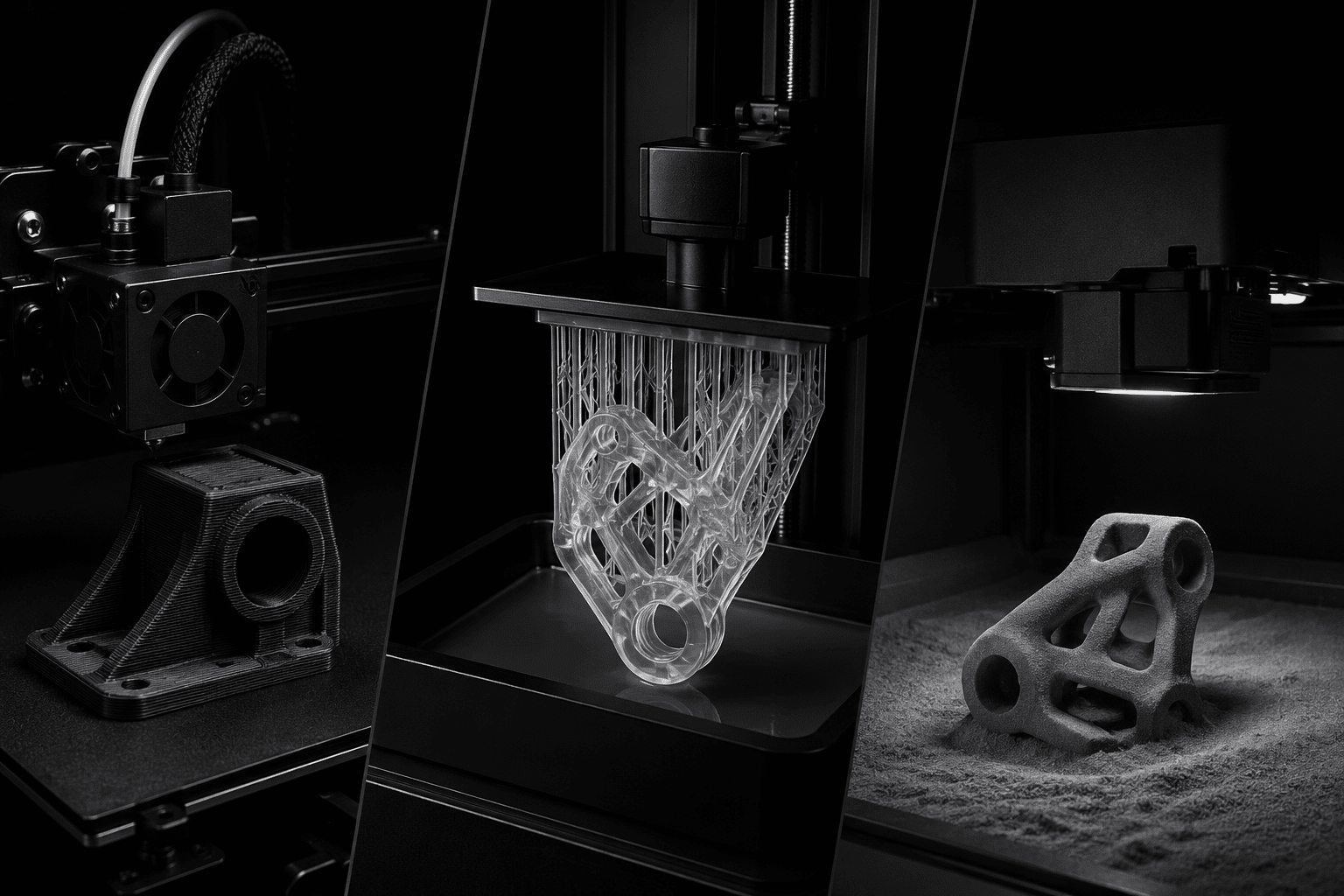
FDM (Fused Deposition Modeling) melts a plastic filament and lays it down layer by layer, a bit like a very precise hot glue gun. It is the technology most people picture when they hear “3D printer.”
SLA (Stereolithography) uses UV light to cure liquid resin into solid plastic. It trades a little speed for stunning detail and smooth surfaces.
SLS (Selective Laser Sintering) uses a laser to fuse fine nylon powder into strong, functional parts — with no support structures needed, because the surrounding powder holds everything in place.
Same goal, three very different routes. The differences matter more than most people expect.
FDM: the budget workhorse
FDM is the cheapest and most accessible process, and for good reason. It handles a wide range of thermoplastics — PLA, ABS, PETG, TPU, nylon, even carbon-fibre-reinforced filaments — and it scales to larger parts without the cost spiralling.
The trade-off is finish and detail. You will see layer lines, and parts are weaker along the layer direction (what engineers call anisotropy). For prototypes, jigs and fixtures, enclosures and functional testing, none of that matters much — which is exactly why FDM dominates everyday prototyping.
SLA: when detail is everything
If your part needs to look finished — smooth surfaces, crisp edges, fine features — SLA is hard to beat. Because it cures liquid resin with light, it captures detail that FDM simply cannot, down to features thinner than a human hair.
The catch: standard resins are more brittle than FDM plastics and can degrade under prolonged UV exposure, and parts need washing and post-curing. A growing range of engineering resins — tough, flexible, heat-resistant, castable and dental-grade — widens what SLA can do, but it is still best thought of as the “looks and detail” process. It shines for display models, jewellery masters, dental and medical models, and detailed scale models.
SLS: strong, functional, no supports
SLS is the quiet favourite among engineers. It sinters nylon powder into parts that are genuinely strong in every direction, with good heat and chemical resistance. Because the powder bed supports the part as it builds, you can print complex geometries, snap-fits, living hinges and interlocking assemblies that would be a nightmare in FDM or SLA.
The surface is slightly grainy and matte rather than glossy, and it costs more than FDM. But for functional end-use parts and low-volume production runs it often works out cheaper overall — there are no support structures to remove, so post-processing is minimal. It is a strong choice for durable IoT and electronic housings.
Side-by-side comparison
| FDM | SLA | SLS | |
| How it works | Melts plastic filament, layer by layer | UV light cures liquid resin | Laser sinters nylon powder |
| Materials | PLA, ABS, PETG, TPU, Nylon, CF blends | Standard, tough, flexible, castable, dental resins | Nylon PA12 / PA11, glass-filled nylon |
| Surface finish | Visible layer lines | Smooth, high detail | Slightly grainy, matte |
| Detail / resolution | Moderate | Excellent — the finest | Good |
| Strength | Good; weaker along layers | Brittle (standard resin) | Strong in every direction |
| Support removal | Needed; removed manually | Needed; wash + UV cure | None — powder self-supports |
| Cost (India, 2026) | ₹3–8 / gram (lowest) | ₹8–15 / gram | ₹10–20 / gram |
| Best for | Prototypes, large & low-cost parts | Detailed & display models | Functional end-use parts |
So which one should you choose?
Here is the shortcut we give clients:
- Need it cheap, fast or large? Go FDM.
- Need it to look beautiful and detailed? Go SLA.
- Need it strong and functional? Go SLS.
If you need real metal performance, that is a different conversation — see our guide on metal 3D printing in India. And if you are comparing 3D printing against traditional manufacturing for a production run, our 3D printing vs injection molding breakdown will help.
A quick word on cost
Material and process are not the only price drivers — part volume, geometry, finish and quantity all move the number. As a rough 2026 guide in India: FDM starts around ₹3–8 per gram, SLA around ₹8–15 per gram, and SLS around ₹10–20 per gram. The real figure always depends on your specific part, and our complete Cost of 3D Printing in India guide breaks it down properly.
Frequently asked questions
Which 3D printing process is the cheapest?
FDM is the cheapest and most accessible of the three. As a rough 2026 guide in India, FDM starts around ₹3–8 per gram, compared with ₹8–15 per gram for SLA and ₹10–20 per gram for SLS. It also scales well to larger parts without the cost spiralling, which is why FDM dominates everyday prototyping, jigs and fixtures.
Which 3D printing process is the strongest?
SLS produces the strongest, most functional parts. It sinters nylon powder into components that are strong in every direction, with good heat and chemical resistance. Because the powder bed supports the part as it builds, SLS also handles complex geometries, snap-fits and living hinges, making it ideal for functional end-use parts and low-volume production.
Which 3D printing process gives the smoothest finish?
SLA delivers the smoothest surface and the finest detail. Because it cures liquid resin with UV light, it captures features thinner than a human hair with crisp edges and smooth surfaces. That makes SLA the best choice for display models, jewellery masters, dental and medical models, and any part where surface finish sells the product.
Should I use FDM or SLA for prototypes?
Use FDM for fast, low-cost or large functional prototypes where layer lines and minor surface roughness do not matter. Choose SLA when the prototype needs to look finished, with smooth surfaces and fine detail — such as appearance models. In short: FDM for cost and speed, SLA for looks and detail.
The bottom line
There is no single “best” 3D printing process — only the best one for your part. Match the technology to what the part actually has to do, and you will save money and avoid disappointing results.
Not sure which way to go? Send us your design and we will recommend the right process honestly. Talk to our team — our CAD and engineering folks are happy to help.