Plain nylon is tough, but it bends under load and softens when things get warm. Add glass or carbon fiber and the same plastic can hold a motor bracket in place next to a hot engine, keep a drone arm stiff in a crash, or replace a small machined aluminium part at a fraction of the weight.
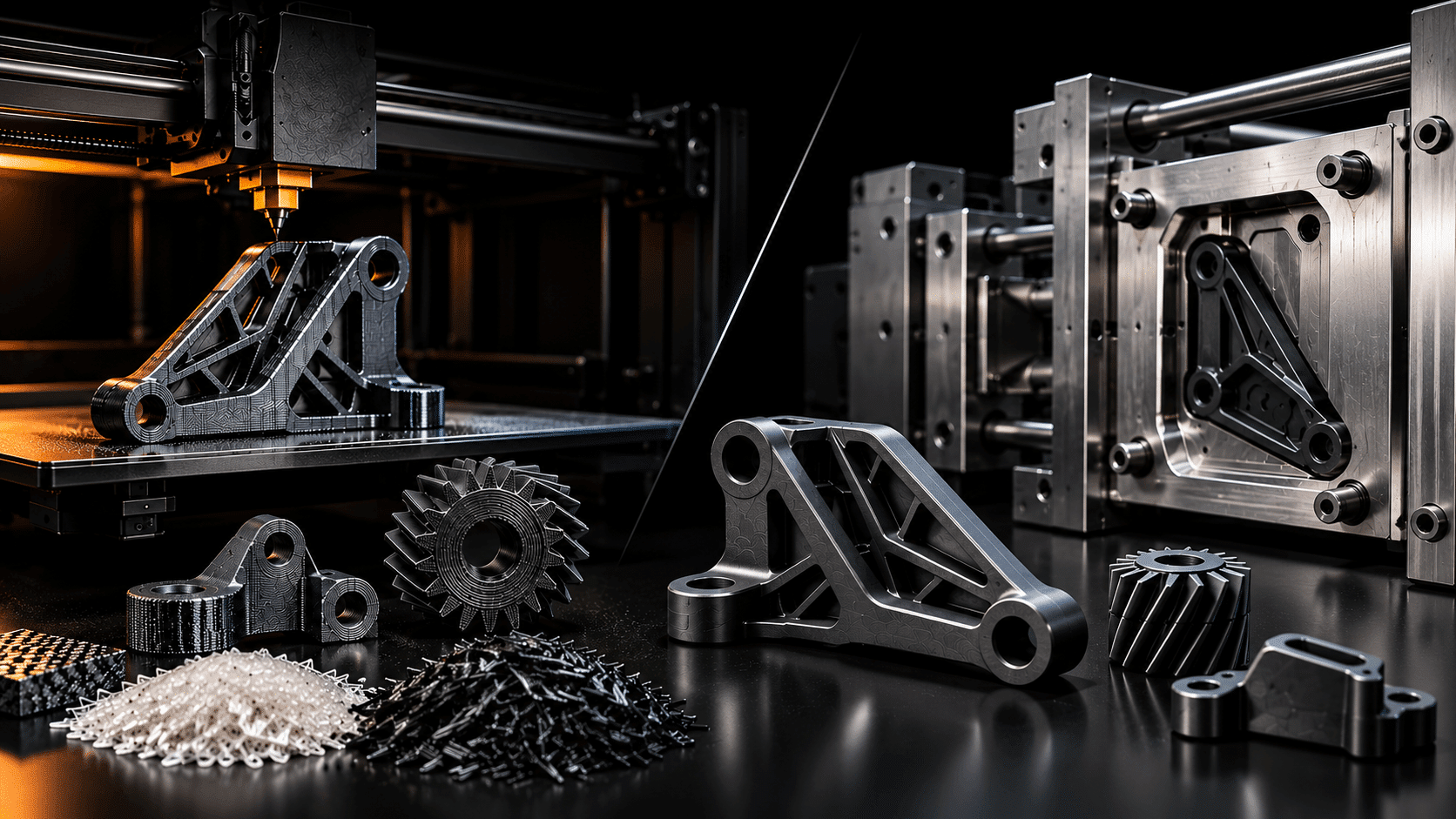
That is why fiber-reinforced plastics show up on so many engineering drawings. The harder question is how to make the part: 3D print it in a carbon-filled nylon, or build an injection mold and shoot glass-filled PA66? This guide walks through the materials, the two processes, the design traps and the volume point where one beats the other.
Quick answer
For 1–200 parts, or while the design is still changing, 3D print in carbon-fiber nylon. For a few hundred parts and up with a frozen design, injection mold in glass-filled nylon (usually PA66-GF30) using a hardened tool. Many projects do both: printed prototypes first, molded parts once the design is proven.
What are fiber-reinforced plastics?
A fiber-reinforced plastic is a base polymer, most often nylon (polyamide), with short glass or carbon fibers mixed in. The fibers carry load the way steel bars carry load in concrete. The grade name tells you the recipe: PA66-GF30 is nylon 66 with 30% glass fiber by weight, and PA12-CF is nylon 12 filled with chopped carbon fiber.
Adding fiber typically brings:
- Higher stiffness – often two to three times the flex resistance of the unfilled grade.
- Higher strength – a big jump in tensile strength, especially with glass fiber.
- Better heat resistance – the part keeps its shape at temperatures that would soften plain nylon.
- Lower shrinkage and creep – better dimensional stability under long-term load.
The trade-offs are real too: lower impact toughness and elongation, a rougher surface, properties that change with fiber direction, and fibers that wear down molds and printer nozzles.
Glass fiber vs carbon fiber
Glass fiber is the workhorse. It is cheaper, adds a lot of strength and heat resistance, and dominates injection molding. Carbon fiber is lighter and stiffer for its weight, gives a clean matte-black finish, and is the most common reinforcement in 3D printing filaments. Carbon-filled parts are also slightly conductive, which matters for some electronics. If a part must be electrically insulating, glass is the safer choice.
Glass bead is not glass fiber
Some powder-bed materials, such as MJF PA12 GB, are filled with tiny glass beads, not fibers. Beads make parts stiffer and more dimensionally stable, but they do not add the strength you get from fiber. Check the datasheet before you assume a “glass-filled” print will match a molded GF30 part.
Common reinforced grades compared
The figures below are typical dry, as-molded or as-printed datasheet ranges. Exact values depend on the resin brand, fiber content and print orientation, so always confirm against the specific grade’s datasheet.
↔ Swipe sideways to see the full table
| Material | Process | Tensile strength | Stiffness (modulus) | Heat deflection (1.8 MPa) | Typical uses |
|---|---|---|---|---|---|
| PA66 (unfilled) | Molding | ~80 MPa | ~3 GPa | ~70–90°C | Baseline for comparison |
| PA6-GF30 | Molding | ~160–180 MPa | ~8–9 GPa | ~190–210°C | Housings, brackets, power-tool bodies |
| PA66-GF30 | Molding | ~180–200 MPa | ~9–10 GPa | ~240–255°C | Under-hood automotive, connectors, metal replacement |
| PC-GF20 | Molding | ~90–110 MPa | ~5–6 GPa | ~140–145°C | Rigid enclosures, electrical parts that must not absorb moisture |
| PA12-CF / PA6-CF | FDM 3D printing | ~50–90 MPa in plane, much lower between layers | ~4–8 GPa | Varies widely by brand | Jigs, fixtures, drone arms, functional prototypes |
| PA12 GB (glass bead) | MJF / SLS | ~30 MPa | ~2.5–2.8 GPa | ~85–90°C | Stiff housings, fixtures needing tight tolerances |
One thing the table does not show: nylon absorbs moisture from the air. Once a nylon part settles into normal humidity, its strength and stiffness drop noticeably compared with the dry figures above, though it gains toughness. Glass-filled PC does not have this issue, which is why it is a good pick for polycarbonate molding jobs where dimensions must stay stable in humid climates.
Option 1: 3D printing fiber-reinforced parts
Carbon-fiber nylon on an FDM printer is the fastest way to get a strong, stiff, lightweight part with no tooling. There is no minimum order, a design change costs nothing but a new file, and prototypes are usually ready in one to two days after we receive your CAD.
Where printing works well:
- Jigs, fixtures and end-of-arm tooling for the shop floor, where weight and stiffness matter more than appearance
- Drone frames, arms and camera mounts during development
- Functional prototypes that need to survive real load testing before you commit to a mold
- Spare parts and low runs where a mold would never pay for itself
What to watch:
- Layer direction. FDM parts are strongest along the layers and weakest between them. A bracket printed the wrong way up can snap at a fraction of its rated load, so print orientation is a design decision, not an afterthought.
- Short fiber limits. Most CF filaments use chopped fiber. They are excellent for stiffness but will not match a molded GF30 part for outright strength.
- Surface finish. Carbon-filled prints have a matte texture with visible layer lines. Fine for functional parts; less ideal for a consumer-facing product.
For a full breakdown of what drives print pricing, see our 3D printing cost guide. If you need metal-level strength, metal 3D printing may be the better comparison.
Option 2: Injection molding glass-filled nylon
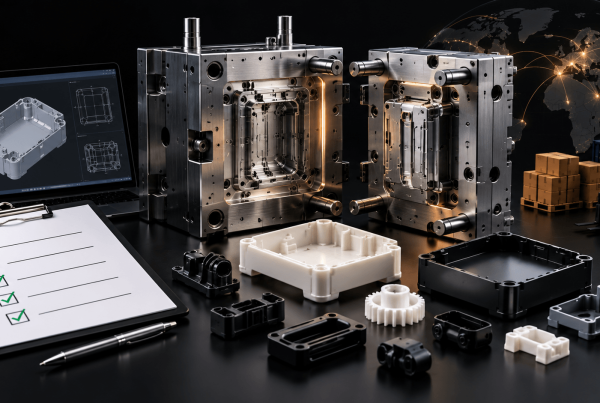
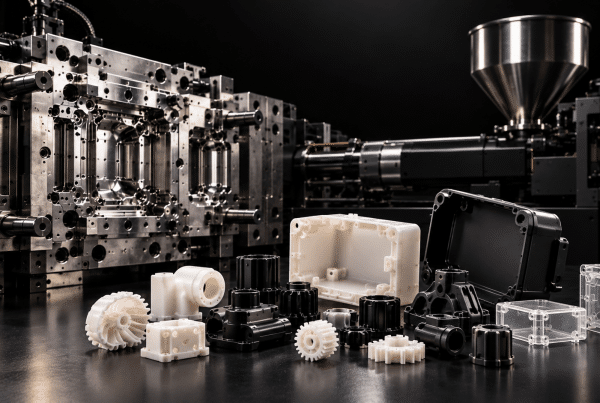
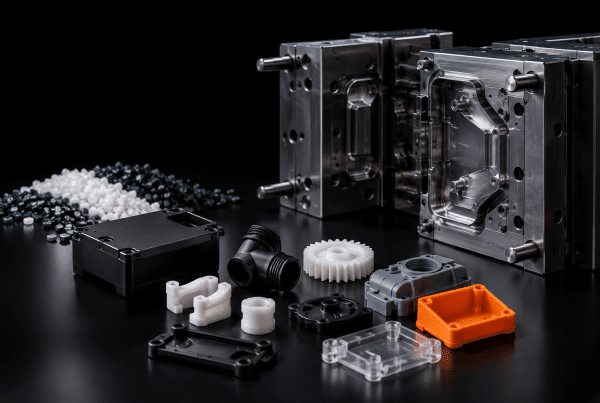
Once the design is final and volumes climb, injection molding wins. Molded glass-filled nylon parts are stronger than any printed equivalent because the fibers are well bonded through the whole part with no layer lines. Every part comes out the same, the surface finish can be controlled through the mold, and the cost per part falls sharply as quantities rise. Our nylon injection molding runs start at 200 pieces.
What makes glass-filled molding different from plain plastic:
- Tool wear. Glass fibers are abrasive. They slowly erode gates, cavities and parting lines. For any serious volume, the mold should be made from hardened tool steel, and high-wear areas may need inserts that can be replaced. A soft tool that is fine for ABS can wear out quickly on GF30.
- Drying. Nylon must be dried properly before molding. Wet resin causes splay marks, brittleness and weak parts.
- Higher pressure and mold temperature. Filled resins flow less easily and need a warmer mold to get a good surface, otherwise fibers show through as a rough, whitish texture.
- Anisotropic shrinkage. Fibers line up with the flow of the melt, so the part shrinks less along the flow than across it. Ignore this and flat parts warp.
Tooling is the biggest upfront cost. Our injection molding cost guide covers mold pricing, per-unit costs and the hidden extras buyers often miss.
Which should you choose? A volume-based guide
↔ Swipe sideways to see the full table
| Quantity | Best route | Why |
|---|---|---|
| 1–20 | FDM carbon-fiber nylon | No tooling, fastest turnaround, design can change freely |
| 20–200 | 3D printing, or vacuum casting for production-look parts | Still too few parts to justify a hardened mold |
| 200–2,000 | Injection molding (single-cavity tool) | Per-part cost drops below printing; full molded GF strength |
| 2,000+ | Injection molding (hardened, possibly multi-cavity) | Lowest unit cost; hardened steel handles glass-fiber wear over long runs |
The crossover point is not fixed. A small, simple part may justify a mold at a few hundred pieces; a large, complex part with side actions may stay cheaper to print for longer. Vacuum casting is worth a look in the middle band, though cast polyurethanes imitate the look and feel of filled nylon rather than matching its heat resistance. Our low-volume manufacturing guide compares these options in detail, and the vacuum casting process page explains how cast parts are made.
Design tips for fiber-reinforced parts
- Keep walls even. Uneven walls cause uneven cooling and fiber orientation, which is the main cause of warpage in molded GF parts. Use ribs to add stiffness rather than thickening walls.
- Think about where the fibers will point. In molding, gate position decides fiber direction. Place gates so the flow runs along the main load path. In printing, orient the part so layers run along the load.
- Watch weld lines. Where two melt fronts meet around a hole or boss, fibers do not cross the joint, leaving a weak seam. Keep weld lines away from high-stress areas.
- Add generous fillets. Filled grades are less forgiving than plain nylon. Sharp inside corners concentrate stress and start cracks.
- Rethink snap fits. Reinforced plastics stretch less before breaking, so snap-fit arms need to be longer or deflect less than they would in unfilled nylon or ABS.
- Use threaded inserts. For screws that will be removed often, brass heat-set or molded-in inserts last far longer than threads cut directly into the plastic.
Not sure your CAD is ready? Our 3D CAD design team can review and adjust parts for printing or molding.
Where reinforced parts are used
- Drones and robotics: lightweight, stiff arms, frames and mounts. See our work for drone manufacturers.
- Automotive: brackets, clips, housings and parts that sit near heat sources. More on our automotive page.
- Industrial equipment: gears, guides, wear pads and fixtures that replace machined metal. See parts for equipment manufacturers.
- Electronics enclosures: rigid housings and internal mounting frames. Our custom enclosures service covers printed, cast and molded options.
Ordering reinforced parts from outside India
We regularly make molded and printed parts for engineering teams abroad. Glass-filled nylon parts are light and compact, so air freight for prototypes and sea freight for production runs keeps landed costs low. Share your CAD file, the target grade (for example PA66-GF30) and your annual volume, and we will quote tooling, unit price and lead time together. Buyers in the US can start with our injection molding for USA page, and UK teams with low-volume manufacturing for the UK.
Frequently asked questions
Is glass-filled nylon stronger than carbon-fiber nylon?
In injection molding, glass-filled PA66 is generally stronger and far cheaper than a carbon-filled equivalent. Carbon fiber gives higher stiffness for the same weight. In 3D printing, carbon-fiber nylon is the more common and better-developed option. The right choice depends on whether strength, stiffness, weight or cost matters most for your part.
Can a 3D printed carbon-fiber part replace a molded glass-filled part?
For prototypes, fixtures and low volumes, often yes. For production parts under high load or heat, a printed part usually will not match a molded GF30 part, mainly because printed parts are weaker between layers. We recommend testing printed prototypes for fit and function, then moving to molding for final parts.
Why does glass-filled nylon need a hardened mold?
Glass fibers are abrasive and gradually wear the steel at gates, cavities and parting lines. A hardened tool steel mold lasts much longer and keeps parts within tolerance over the full production run. For short runs, a softer tool may be acceptable, and we will advise based on your volume.
What does GF30 mean?
GF30 means the plastic contains 30% glass fiber by weight. It is the most widely used reinforced nylon grade because it balances strength, stiffness, heat resistance and ease of molding. Grades from GF10 to GF50 are also available.
What is the minimum order for molded reinforced parts?
Our injection molding orders start at 200 pieces. Below that, 3D printing or vacuum casting is usually more cost-effective, and there is no minimum order for 3D printed parts.
Get a free DFM review for your reinforced part
Send us your CAD file, target material and quantity. Our engineers will recommend printing or molding, flag design risks, and send a quote.
Request a Quote