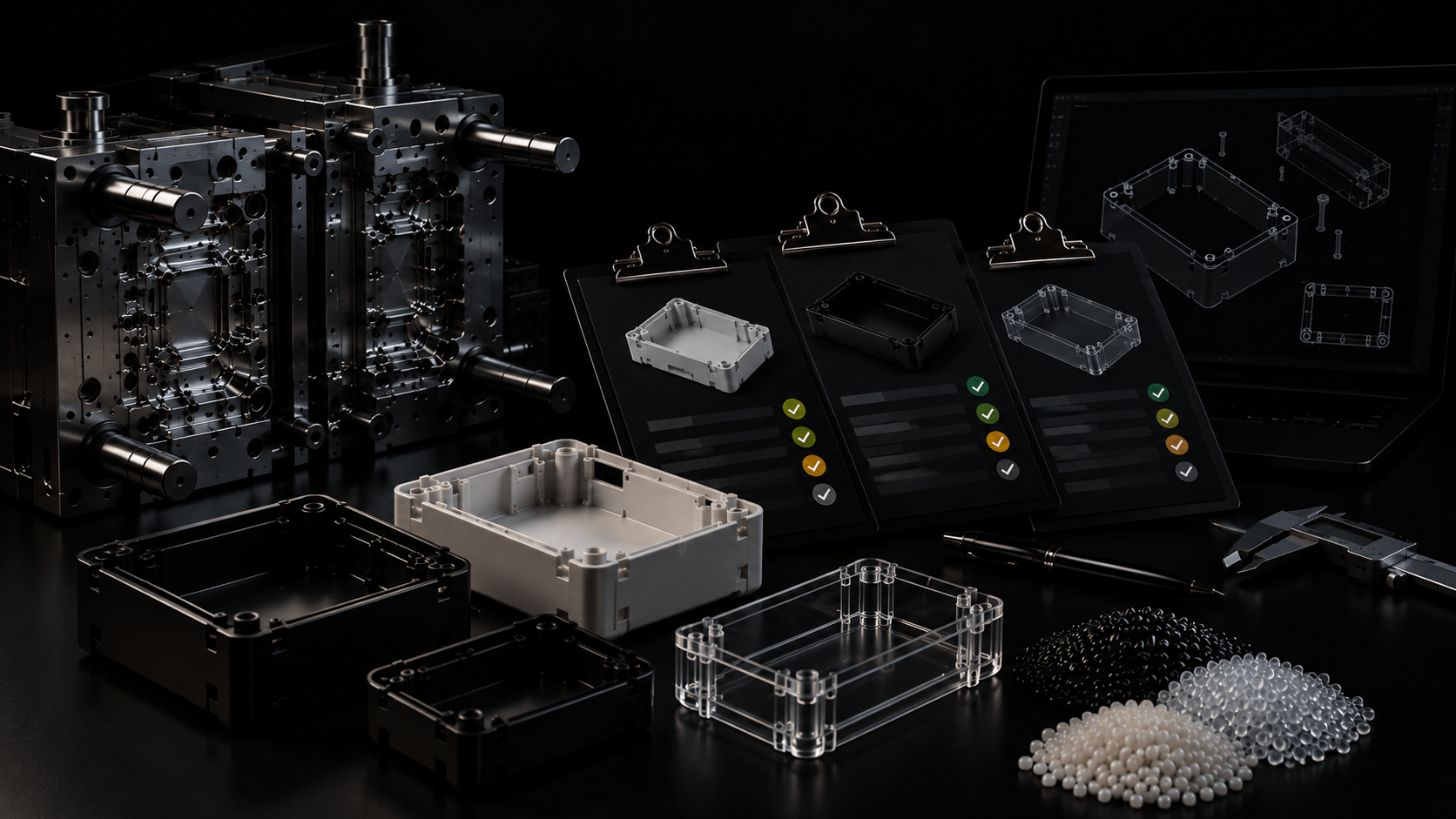
You’ve sent out your RFQ and three injection moulding quotes have landed in your inbox. One is ₹1.8 lakh, another ₹2.6 lakh, and the third ₹3.4 lakh. The obvious move is to pick the cheapest one. In most cases, that’s the wrong move.
Injection moulding suppliers quote in very different ways. Some include mould trials, packaging and freight; others leave them out. Some quote a single-cavity P20 mould, others a two-cavity hardened steel tool. Unless you compare injection moulding quotes on a like-for-like basis, you are comparing apples to oranges.
This guide shows you exactly how to compare injection moulding quotes from suppliers, line by line, with a checklist, a worked example, a scoring template and the red flags to watch for.
Quick Answer: How do you compare injection moulding quotes?
- Send every supplier the same RFQ (CAD, material, quantity, tolerances, finish)
- Normalise each quote into the same line items: tooling, part price, trials, extras
- Compare the mould spec: steel grade, cavities, runner type and guaranteed shot life
- Add the hidden costs each supplier left out
- Calculate the total landed cost per part over your real lifetime volume, then score quality, lead time and support
Why the Cheapest Injection Moulding Quote Is Rarely the Cheapest
A low headline price usually means something has been left out or downgraded. Common reasons a quote looks cheaper than it really is:
- Softer mould steel that wears out after 50,000–1,00,000 shots, forcing a second mould
- Fewer cavities, which keeps tooling cheap but pushes up the price of every part
- Trial and modification charges excluded, then billed after T1 samples
- Packaging, freight and GST left out of the per-unit price
- Generic or recycled material grade instead of the virgin grade you specified
- Unclear mould ownership, so you can’t move the tool to another supplier later
If you’re still building your budget, start with our breakdown of injection molding cost in India, which covers typical tooling, per-unit and hidden cost ranges.
Step 1: Send Every Supplier the Same RFQ
You can only compare injection moulding quotes fairly if every supplier is quoting the same job. A clear Request for Quotation (RFQ) should include:
| RFQ Item | What to Provide |
|---|---|
| 3D CAD + 2D drawing | STEP/IGES file plus a drawing with critical dimensions |
| Material | Exact grade (e.g. ABS, PP, PA66 GF30), colour, virgin or regrind allowed |
| Quantities | First order, annual volume and expected product lifetime volume |
| Tolerances | General and critical tolerances |
| Surface finish | SPI polish grade or texture reference |
| Secondary operations | Printing, inserts, assembly, painting |
| Packaging & delivery | Packing standard, delivery location, Incoterms for exports |
| Quality requirements | Inspection report, FAI, material certificates |
Tip: Always share your lifetime volume, not just the first order. It decides whether a supplier should quote a prototype aluminium mould or a hardened-steel production mould, and that single choice can swing tooling cost by lakhs.
Step 2: Break Each Injection Moulding Quote into the Same Line Items
Suppliers format quotes differently. Put every quote into one comparison sheet with these rows so nothing hides between formats.
| Line Item | What to Check |
|---|---|
| Tooling / mould cost | One-time cost, payment terms, what’s included |
| Part price | Per-unit price at each quantity break |
| Mould trials (T1, T2) | How many trials are included, cost of extra ones |
| Design changes | Cost of mould modifications after approval |
| Secondary operations | Finishing, printing, assembly, inserts |
| Packaging | Included or charged per unit |
| Freight | Ex-works or delivered |
| Taxes | GST included or extra (18% on most moulded parts and tooling) |
| Validity | How long the price holds, and material price escalation clauses |
Step 3: Compare the Mould Specification, Not Just the Mould Price
Two moulds with a ₹1 lakh price difference can be completely different tools. These are the specs that matter most when comparing injection moulding quotes:
| Mould Spec | Cheaper Option | Premium Option | Why It Matters |
|---|---|---|---|
| Steel grade | Aluminium / P20 | H13 / stainless | Mould life and part consistency |
| Cavities | 1 cavity | 2, 4, 8+ cavities | More cavities = lower part price |
| Runner system | Cold runner | Hot runner | Material waste and cycle time |
| Guaranteed shot life | 10k – 1 lakh shots | 5 lakh – 10 lakh+ | Whether you’ll need a second mould |
| Cooling design | Basic channels | Optimised / conformal | Cycle time and warpage |
| Mould flow analysis | Not included | Included | Fewer defects and trial rounds |
The right spec depends on your volume. For short runs a cheaper mould is often the smart choice; for long runs it’s usually false economy. Our guide on low-volume vs high-volume injection molding explains where that line sits.
Step 4: Check What Drives the Part Price
The per-unit price in an injection moulding quote is built from a few inputs. Ask each supplier to share them so you can see where the difference comes from:
- Part weight and runner weight: tells you how much material you’re paying for
- Material grade and price per kg: confirm it matches your spec
- Cycle time: a 30-second vs 45-second cycle is a 50% difference in machine cost
- Machine tonnage and hourly rate: should suit your part size
- Rejection allowance: what scrap rate is built into the price
- MOQ and quantity breaks: how the price changes at 5k, 10k, 50k units
Watch out: A supplier quoting a much shorter cycle time than everyone else may be over-promising. Ask how they arrived at it, and whether the price changes if real production runs slower.
Step 5: Add the Hidden Costs and Calculate Total Landed Cost
This is where the real comparison happens. Add back everything each supplier left out, then divide by your total volume.
Worked Example: Three Injection Moulding Quotes for 20,000 Parts
Here’s a realistic comparison of three supplier quotes for the same ABS enclosure part (all figures excluding GST).
| Item | Supplier A | Supplier B | Supplier C |
|---|---|---|---|
| Mould spec | 1-cavity, P20, 1 lakh shots | 2-cavity, H13, 5 lakh shots | 2-cavity, H13, 5 lakh shots |
| Tooling | ₹1,80,000 | ₹2,60,000 | ₹3,40,000 |
| Part price | ₹18 | ₹16 | ₹15 |
| Quoted total | ₹5,40,000 | ₹5,80,000 | ₹6,40,000 |
| Trial modifications | +₹25,000 (extra) | Included (2 trials) | Included |
| Packaging | +₹60,000 (₹3/unit) | Included | Included |
| Freight | +₹15,000 | +₹15,000 | Included |
| Real total | ₹6,40,000 | ₹5,95,000 | ₹6,40,000 |
| True cost per part | ₹32.00 | ₹29.75 | ₹32.00 |
Result: Supplier A looked cheapest by ₹40,000, but once hidden costs were added, Supplier B is ₹45,000 cheaper on this order.
And B’s mould lasts 5× longer. If you reorder another 20,000 parts, A’s ₹2 higher part price costs you another ₹40,000, plus ₹60,000 more in packaging, before its mould starts to wear out.
Step 6: Score Suppliers Beyond Price
Price is only part of the decision. A delayed mould or a high rejection rate can cost more than any quote difference. Use a simple weighted scorecard to compare injection moulding suppliers:
| Criteria | Suggested Weight | What to Look For |
|---|---|---|
| True landed cost | 30% | Total cost per part over lifetime volume |
| Quality capability | 25% | ISO 9001, inspection reports, CMM, past rejection rates |
| Tooling expertise | 15% | In-house toolroom, DFM feedback, mould flow analysis |
| Lead time | 15% | Weeks to T1 samples and to first production batch |
| Communication & support | 10% | Response time, clarity, single point of contact |
| Commercial terms | 5% | Payment terms, mould ownership, warranty |
Score each supplier from 1 to 5 on every criterion, multiply by the weight and add up the totals. For a deeper look at evaluating vendors, read our guide on how to choose an injection molding partner in India.
Red Flags in Injection Moulding Quotes
- No mould spec mentioned: no steel grade, cavity count or shot life
- A price far below every other quote with no clear explanation
- “Trials extra” or “modifications at actuals” with no cap
- No DFM feedback on your design, suggesting no one reviewed it properly
- Vague mould ownership or a clause that the supplier keeps the tool
- 100% tooling payment upfront instead of staged payments tied to T1 approval
- No inspection or quality documentation offered with samples
10 Questions to Ask Before Accepting an Injection Moulding Quote
- What steel grade, cavity count and runner type is the mould?
- What is the guaranteed mould life in shots?
- How many trials and modifications are included?
- What cycle time and part weight is the price based on?
- Is the material virgin, and which brand and grade?
- Are packaging, freight and GST included?
- Who owns the mould, and can I move it to another supplier?
- Who pays for mould maintenance and repairs?
- What’s the lead time to T1 samples and to first production?
- What inspection reports come with each batch?
Not Sure Injection Moulding Is Right Yet?
If your volumes are low or your design is still changing, an injection moulding quote may not be the right starting point. Compare your options first:
- Validate the design with rapid prototyping services before paying for a mould
- For 20–200 parts, vacuum casting is often far cheaper than tooling
- See how 3D printing vs injection molding compares on cost and volume
- Explore low-volume manufacturing options including soft tooling
Frequently Asked Questions About Injection Moulding Quotes
How many injection moulding quotes should I get?
Three to five quotes is usually enough. Fewer than three gives you no real benchmark, while more than five adds comparison work without much benefit.
Why do injection moulding quotes vary so much?
Differences in mould steel, cavity count, runner system, cycle time assumptions, material grade and what’s included (trials, packaging, freight) can easily make one quote two to three times another for the same part.
How long does it take to get an injection moulding quote?
With a complete RFQ including CAD files, most Indian suppliers respond within 2–5 working days. Complex multi-cavity tools may take longer.
Should I choose the supplier with the lowest tooling cost?
Only if your volumes are low. For higher volumes, a more expensive mould with more cavities and longer life usually gives a lower true cost per part.
What payment terms are normal for injection mould tooling?
A staged structure is common in India, for example 50% on order and 50% after T1 sample approval. Avoid paying the full tooling amount before you’ve seen and approved samples.
Can I negotiate an injection moulding quote?
Yes. Committing to higher annual volumes, accepting a standard material, simplifying the design after DFM feedback, or agreeing to longer lead times can all bring the price down.
Final Thoughts
The best way to compare injection moulding quotes from suppliers is to stop comparing headline prices. Instead:
- Send one clear RFQ to every supplier
- Normalise quotes into the same line items
- Compare mould specs, not just mould prices
- Calculate the true landed cost per part over your lifetime volume
- Score quality, lead time and support alongside price
Do this and the cheapest quote and the best-value quote stop being a guessing game.
Want a transparent injection moulding quote?
Share your CAD file and get a clear, itemised quote covering tooling, part price, trials and lead time, with nothing hidden.
Get a Free Quote