Quick answer
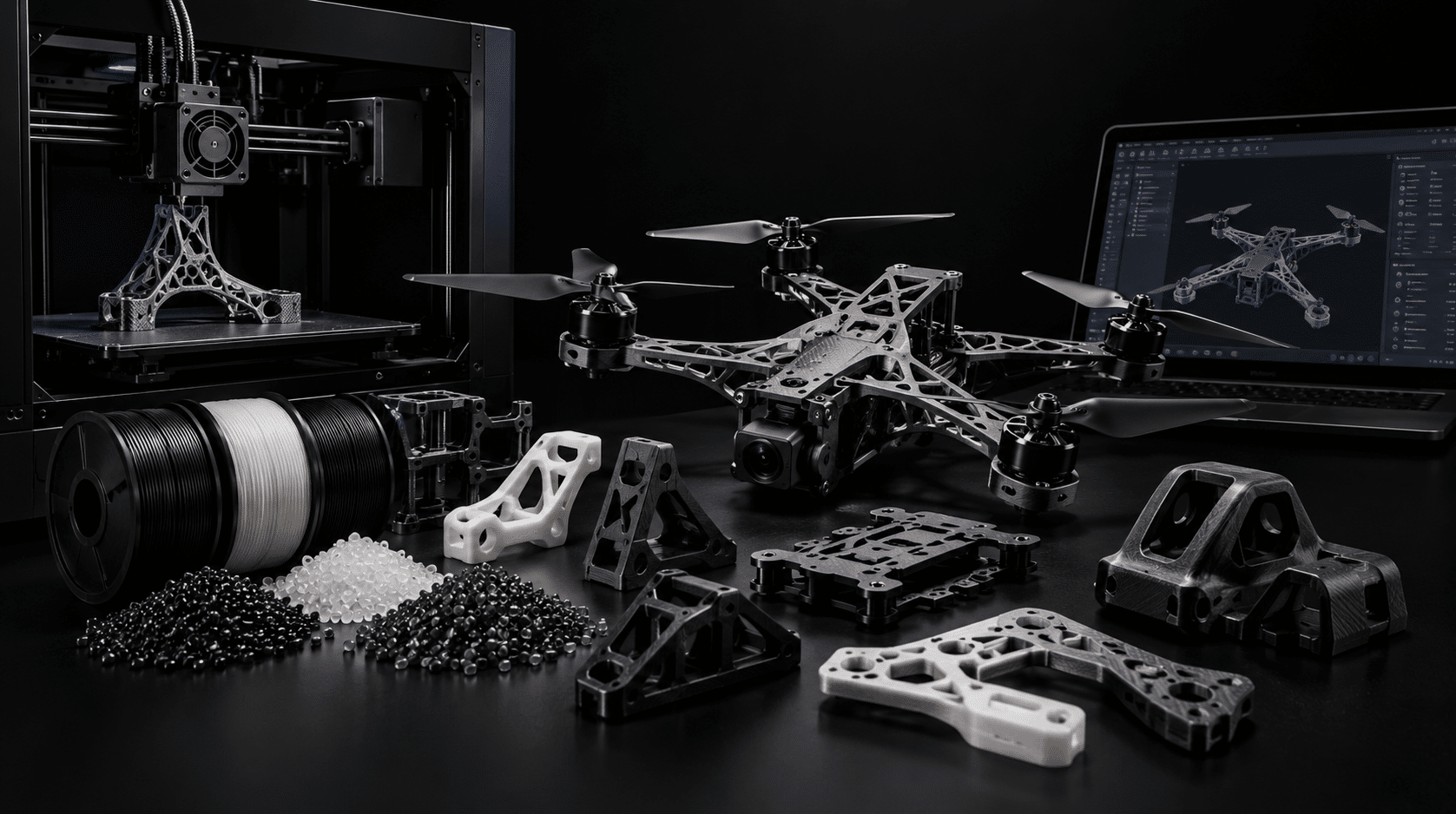
3D printed drone parts are custom UAV components — arms, motor and camera mounts, canopies, landing gear, battery housings and payload enclosures — made by additive manufacturing instead of moulding or machining. In India, nylon PA12 (SLS/MJF) and carbon-fibre nylon are the best all-round materials for strength-to-weight. Indicative 2026 prices range from about ₹300 for a small mount to ₹12,000 for a large canopy, with typical lead times of 2–5 working days.
Key takeaways
- Use PA12 nylon (SLS/MJF) for most flight parts, carbon-fibre nylon for stiff arms, and TPU for dampers and landing feet.
- Avoid PLA on flight parts — it softens at around 55–60°C, a temperature a drone can reach sitting in Indian summer sun.
- Keep carbon-fibre-filled parts away from GPS and antennas — carbon is conductive and can weaken signal.
- 3D printing is fastest for 1–1,000 parts; beyond that, injection molding usually becomes cheaper per part.
- Main frame plates on racing drones are still best in CNC-cut carbon fibre — 3D printing complements them rather than replacing them.
India’s drone industry has changed quickly. The government liberalised the Drone Rules in August 2021, launched a Production Linked Incentive (PLI) scheme for drones and drone components in September 2021, and banned imports of fully built drones from 9 February 2022 — while keeping imports of components open. The result: Indian companies now design their own airframes, and they need custom parts fast. The civil aviation ministry noted in 2022 that 50–60% of high-value drone components were still imported, which is exactly the gap local manufacturing is filling.
That is where 3D printing fits. Instead of waiting weeks for a mould, a drone team can test a new arm, mount or canopy in days, fly it, and change the design the same week. This guide covers which parts to print, the best materials, real cost ranges in India and the design rules that stop parts failing in the air.
Which Drone Parts Can Be 3D Printed?
Most non-electronic structural and housing parts on a small or mid-size drone can be 3D printed. The table below shows the most common ones and the material we typically recommend.
| Drone part | Recommended material | Process | Why 3D print it |
|---|---|---|---|
| Arms / booms | Carbon-fibre nylon, PA12 | FDM (CF), SLS / MJF | Change arm length and motor spacing between test flights |
| Motor mounts | Glass-filled PA12, CF-nylon; aluminium for heavy-lift | SLS, FDM, metal (DMLS) | Custom bolt patterns and built-in vibration damping |
| Camera & gimbal mounts | PA12 + TPU dampers | SLS + FDM | Isolates vibration for cleaner footage and mapping data |
| GPS & antenna mounts | PETG, PA12 (no carbon) | FDM, SLS | Lightweight and RF-transparent |
| Canopy / body shell | PA12, ASA | SLS / MJF, FDM | Complex aerodynamic shapes with no tooling cost |
| Landing gear & skids | TPU, PA12 | FDM, SLS | Absorbs hard landings instead of cracking |
| Battery trays & housings | PA12, PC-ABS | SLS, FDM | Exact fit around custom battery packs |
| Payload & sensor pods | PA12, ASA, PETG | SLS, FDM | Custom housings for sprayers, LiDAR and multispectral sensors |
| Propeller guards & ducts | PA12, PETG | SLS, FDM | Lightweight protection for indoor and inspection drones |
← Swipe to see the full table on mobile
What should not be 3D printed
- Flight propellers — print them for fit checks only. Balance and fatigue requirements make moulded or carbon props the safe choice.
- Main frame plates on racing or FPV drones — CNC-cut carbon fibre plate is still stiffer and lighter for flat parts.
- Parts right next to hot motors or ESCs in standard plastics — use glass-filled nylon or aluminium instead.
Best Materials for 3D Printed Drone Parts
For drones, weight is everything, so density matters as much as strength. Lower density means a lighter part for the same volume and more flight time.
| Material | Density (approx. g/cm³) | Strength-to-weight | Impact | Heat | Best for |
|---|---|---|---|---|---|
| PA12 nylon (SLS/MJF) | 1.01 | High | High | Good | Arms, canopies, mounts, enclosures — the all-rounder |
| Glass-filled PA12 | 1.2–1.3 | High (stiff) | Medium | Very good | Motor mounts, parts near heat |
| Carbon-fibre nylon (FDM) | 1.1–1.2 | Very high (stiff) | Medium | Very good | Arms and frames (not near antennas) |
| ASA | 1.07 | Medium | Medium | Good + UV stable | Outdoor shells, agri-drone covers |
| PETG | 1.27 | Medium | Medium | Moderate | Mounts, covers, early prototypes |
| TPU (95A) | 1.2 | Flexible | Very high | Moderate | Dampers, bumpers, landing feet |
| Engineering resin (SLA) | 1.1–1.2 | Medium | Low–medium | Varies | Fit-check prototypes, fine details |
| Aluminium AlSi10Mg (DMLS) | 2.67 | High | High | Excellent | Heavy-lift motor mounts, heat sinks |
← Swipe to see the full table on mobile
Our default recommendation: start with PA12 for almost everything, move arms to carbon-fibre nylon if you need more stiffness, and use TPU wherever a part should flex rather than break. For heavy-lift motor mounts, see our metal 3D printing guide.
Why not PLA?
PLA is cheap and easy to print, but it softens at around 55–60°C. A drone left in a car or on an open field in an Indian summer can pass that, and arms or mounts will sag or warp. Use PLA only for display models and early shape checks.
FDM vs SLS/MJF vs SLA: Which Process Suits Drone Parts?
| Process | Strength | Surface finish | Typical lead time | Best stage |
|---|---|---|---|---|
| FDM | Strong along layers, weaker between them | Visible layer lines | 1–3 days | Early prototypes, CF-nylon arms, jigs |
| SLS / MJF | Near-uniform in all directions; no supports needed | Slightly grainy, can be dyed black | 2–4 days | Functional parts and low-volume production |
| SLA | Precise but more brittle | Very smooth | 1–3 days | Fit checks, aerodynamic models |
← Swipe to see the full table on mobile
For a deeper comparison, read FDM vs SLA vs SLS: which 3D printing process is right for your part.
How Much Do 3D Printed Drone Parts Cost in India?
Cost depends on part volume, material, process, finish and quantity. The ranges below are indicative 2026 prices per piece in India, excluding GST, design and shipping.
| Part | Material / process | Typical weight | Price per piece (1–5 pcs) | Price per piece (50+ pcs) |
|---|---|---|---|---|
| GPS / antenna mount | PETG, FDM | 10–25 g | ₹300–₹800 | ₹150–₹400 |
| Camera mount with TPU dampers | PA12 SLS + TPU | 20–40 g | ₹800–₹2,000 | ₹400–₹1,000 |
| Drone arm (small multirotor) | CF-nylon FDM or PA12 SLS | 40–100 g | ₹1,200–₹3,500 | ₹600–₹1,800 |
| Landing gear set (4 legs) | TPU or PA12 | 60–150 g | ₹1,000–₹3,000 | ₹500–₹1,500 |
| Battery housing / tray | PA12 SLS | 80–200 g | ₹2,000–₹6,000 | ₹1,000–₹3,000 |
| Canopy / body shell | PA12 SLS / MJF | 150–400 g | ₹4,000–₹12,000 | ₹2,000–₹6,000 |
| Payload / sensor enclosure | PA12 or ASA | 150–500 g | ₹3,500–₹12,000 | ₹1,800–₹6,000 |
| Heavy-lift motor mount | Aluminium AlSi10Mg, DMLS | 30–80 g | ₹5,000–₹15,000 | Quote-based |
← Swipe to see the full table on mobile
Need a model made first? CAD design is charged separately — see 3D CAD design services. For the full rate card by material, read our cost of 3D printing in India guide.
5 ways to reduce the cost of drone parts
- Batch parts together — several arms and mounts in one SLS build share the machine cost.
- Hollow or rib the design — material you remove is money and flight time saved.
- Combine parts — one printed part can replace a bracket, spacer and screws.
- Pick the right process — use FDM for early tests and move to SLS only when the design is close to final.
- Order a spare set — a second set in the same build costs far less than a rush reprint after a crash.
Design Tips for Strong, Light 3D Printed Drone Parts
- Orient FDM arms lengthwise so layers run along the arm and carry the bending load.
- Keep structural walls 1.5–2.5 mm thick in PA12; walls under 1 mm are fragile.
- Use heat-set brass inserts instead of cutting threads into plastic — they survive repeated assembly.
- Add fillets where arms meet the body — sharp inside corners are where cracks start.
- Keep carbon-fibre materials away from GPS, compass and radio antennas to protect signal quality.
- Isolate vibration with TPU dampers under cameras and flight controllers.
- Allow 0.3–0.5 mm clearance for fits in SLS parts; typical SLS tolerance is about ±0.3 mm.
- Design for heat and UV — choose ASA or dyed PA12 for drones that work outdoors all day.
- Test, fly, iterate — print, flight-test and revise; 3D printing makes a new version cheap.
If your drone carries electronics in a sealed housing, our custom enclosure 3D printing page covers sealing, mounting bosses and cable routing.
From Prototype to Production: Scaling Drone Parts
The best manufacturing route changes as your order quantity grows. Here is how drone makers typically scale:
| Quantity | Best route | Typical lead time |
|---|---|---|
| 1–10 parts | FDM or SLS 3D printing | 2–5 days |
| 10–50 identical parts | SLS batch or vacuum casting | 1–2 weeks |
| 50–1,000 parts | SLS / MJF production batches | 1–3 weeks |
| 1,000+ parts | Injection molding (aluminium or steel tool) | 2–8 weeks including tooling |
← Swipe to see the full table on mobile
Learn more about vacuum casting, compare 3D printing vs injection molding, or see our injection mold tool-making services for high volumes.
Why Drone Makers Choose Precious3D
Precious3D is a Chennai-based manufacturing partner for drone manufacturers across India, including teams in Bangalore and Hyderabad. We keep every stage of drone part production under one roof:
- CAD and design-for-manufacturing support — we flag weak points before printing.
- FDM, SLA, SLS and metal 3D printing — so we recommend the right process, not the one machine we own.
- Vacuum casting and injection molding — one partner from first prototype to production.
- NDA-backed confidentiality — your airframe design stays yours.
Get a quote for your drone parts
Send your STEP or STL files, quantity and preferred material, and we’ll reply with a price and lead time within [24–48 hours].
Request a Quote Call +91 86100 39566Frequently Asked Questions
Can a drone frame be 3D printed?
Yes. Small and mid-size drone frames, arms, canopies and mounts are routinely 3D printed in PA12 nylon or carbon-fibre nylon. For racing drones, flat main plates are still usually CNC-cut carbon fibre, with 3D printed arms, mounts and covers added around them.
What is the best material for 3D printed drone parts?
PA12 nylon printed by SLS or MJF is the best all-round choice because it is light (about 1.01 g/cm³), tough and heat resistant. Carbon-fibre nylon suits stiff arms, TPU suits dampers and landing feet, and aluminium suits heavy-lift motor mounts.
How much does it cost to 3D print a drone arm in India?
A small multirotor drone arm typically costs ₹1,200–₹3,500 per piece for 1–5 pieces in carbon-fibre nylon or PA12, and around ₹600–₹1,800 per piece for 50 or more. Final price depends on size, material, finish and quantity.
Is PLA good for drone parts?
No, not for flight parts. PLA softens at around 55–60°C, which a drone can reach in direct Indian summer sun or inside a parked vehicle. Use PLA only for display models and early shape checks, and PA12, ASA or PETG for anything that flies.
Are 3D printed drone parts strong enough for commercial or agricultural drones?
Yes, when the right material and design are used. SLS-printed PA12 parts are used in functional and end-use drone components. Adding fillets, correct wall thickness and metal inserts, and flight-testing each design revision, gives reliable parts for commercial use.
Can I 3D print drone propellers?
Printed propellers are fine for fit checks and wind-tunnel models, but not recommended for flight. Propellers need precise balance and high fatigue resistance, so moulded plastic or carbon-fibre propellers are the safer choice.
Does carbon fibre filament affect GPS signal?
It can. Carbon fibre is electrically conductive and can weaken radio signals, so avoid carbon-filled materials for GPS, compass and antenna mounts. Use PETG or plain PA12 for those parts instead.
How long does it take to get drone parts 3D printed in India?
Most 3D printed drone parts are ready in 2–5 working days from an approved file. Batches of 50–1,000 parts usually take 1–3 weeks, and injection-moulded parts take 2–8 weeks including tooling.
What file format do I need to send?
STEP files are preferred because they keep exact geometry for design review. STL files are also accepted. If you only have a sketch or a broken part, a CAD designer can create a print-ready model for you.
Sources
- Ministry of Civil Aviation — PLI scheme for drones and drone components
- DGFT notification prohibiting import of drones in CBU/CKD/SKD form from 9 February 2022, as reported by Deccan Herald
- Ministry of Civil Aviation statement (6 July 2022) on 50–60% of high-value drone components being imported