Choosing the wrong 3D printing material is one of the most common (and most expensive) mistakes we see. A PLA bracket that looks perfect on your desk can warp inside a parked car in Chennai in May. A Nylon part that tested well in Bengaluru can swell slightly during a humid monsoon month in Mumbai. The material decides whether your part survives real use.
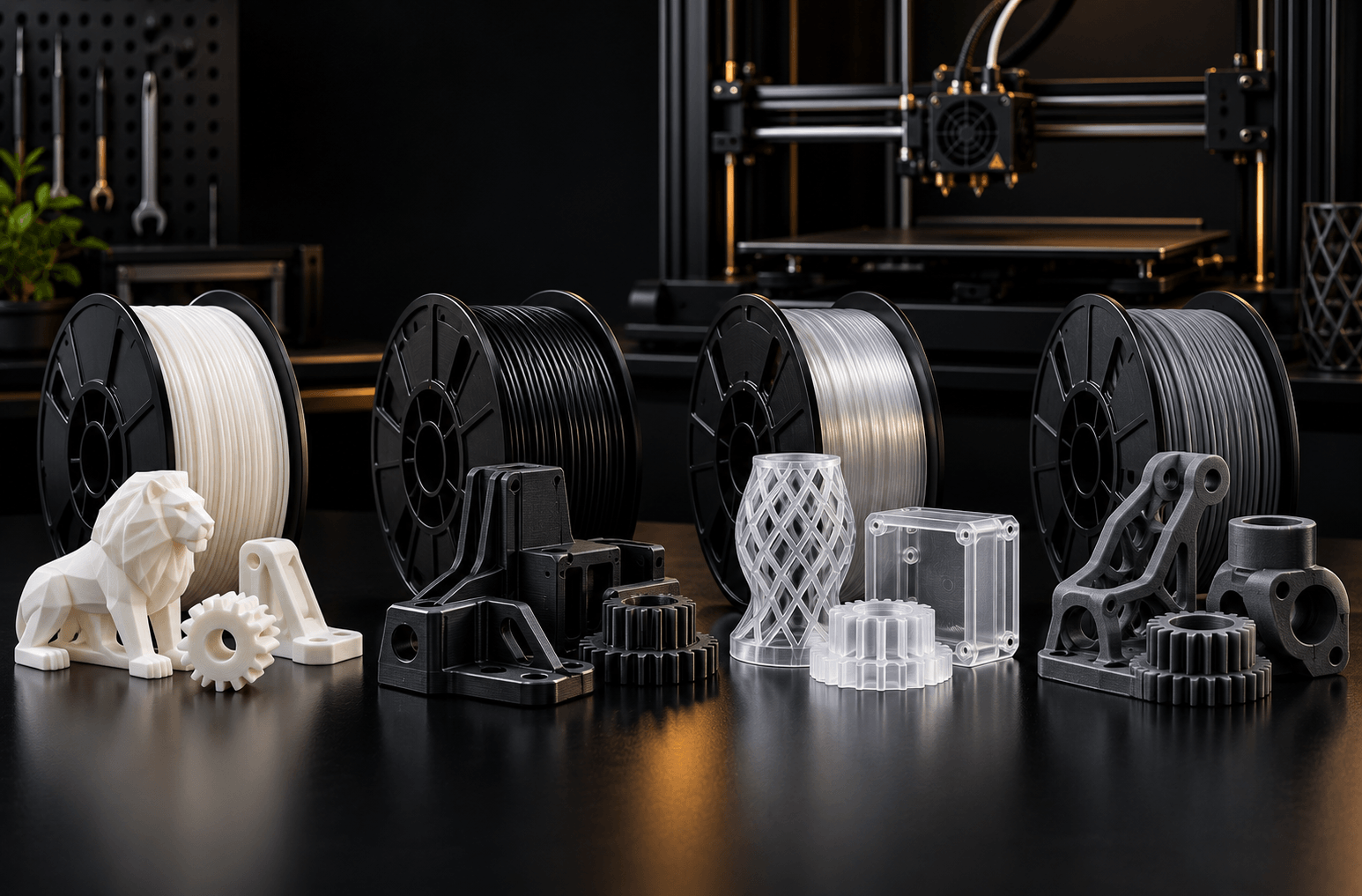
This guide compares the four materials Indian businesses ask us about most: PLA, ABS, PETG and Nylon. It covers strength, heat resistance, finish, cost and the parts each one is best for, so you can pick the right one before you send your file for a quote.
Quick answer
- PLA: cheapest and best for display models, concept prototypes and indoor parts. Avoid for anything hot or load-bearing.
- PETG: the best all-rounder for functional parts. Tougher than PLA, handles moisture and moderate heat.
- ABS: for enclosures and parts near heat (up to roughly 90–100°C). Can be smoothed and painted well.
- Nylon: for strong, wear-resistant, engineering-grade parts such as gears, clips, hinges, jigs and end-use components.
Key takeaways
- Indian summers and vehicle interiors easily exceed PLA’s softening point, so heat is the first question to ask.
- Nylon absorbs moisture. Factor in humidity if parts will be used in coastal cities or during monsoon.
- PLA, PETG and ABS are usually printed on FDM. Nylon is available on FDM and as SLS/MJF powder, which gives stronger, more isotropic parts.
- Material choice can change part cost by 2–4x, so match the material to the job instead of defaulting to “the strongest one”.
At a Glance: PLA vs ABS vs PETG vs Nylon
Use this table as a first filter. The ratings are relative to each other, not absolute engineering values.
← Swipe to see the full table on mobile
| Property | PLA | PETG | ABS | Nylon |
|---|---|---|---|---|
| Strength (tensile) | Good, but brittle | Good | Moderate | High |
| Toughness / impact | Low | High | High | Very high |
| Heat resistance (approx. softening) | ~55–60°C | ~70–80°C | ~90–100°C | ~80–150°C+ (grade dependent) |
| Flexibility | Stiff | Slight flex | Slight flex | Flexes without snapping |
| Wear / friction resistance | Poor | Fair | Fair | Excellent |
| Moisture sensitivity | Low | Low | Low | High (absorbs water) |
| UV / outdoor use | Poor | Fair | Poor (yellows) | Fair |
| Surface finish | Clean, crisp detail | Glossy | Matte; can be vapour-smoothed | Matte, slightly grainy (SLS) |
| Relative cost | ₹ | ₹₹ | ₹₹ | ₹₹₹ |
| Best for | Models, concept prototypes | Functional parts, fixtures | Enclosures, housings | Gears, clips, end-use parts |
PLA: Fast, Affordable and Ideal for Visual Prototypes
PLA (polylactic acid) is a plant-based thermoplastic and the most widely used FDM material. It prints with sharp detail, minimal warping and a good surface finish, which makes it the most economical way to check form and fit.
Choose PLA for
- Concept models and design reviews
- Architectural and product display models
- Early-stage fit checks before moving to an engineering material
- Indoor fixtures, organisers and low-stress parts
- Trophies, mementos and corporate gifts
Avoid PLA when
The part will sit in direct sun, inside a vehicle, near a motor or anywhere above about 50°C. PLA starts to soften at around 55–60°C. In Indian summers, a car dashboard can exceed this within an hour. PLA is also brittle: it snaps rather than bends, so it is a poor choice for snap-fits, living hinges or anything that takes impact.
PETG: The Practical All-Rounder for Functional Parts
PETG is a modified version of the PET used in water bottles. It combines most of PLA’s ease of printing with much better toughness, chemical resistance and heat tolerance. If you are unsure which material to choose for a working part, PETG is usually the safest starting point.
Choose PETG for
- Functional prototypes that will be handled, dropped or tested
- Jigs, fixtures and shop-floor tools
- Brackets, mounts and covers for machines
- Parts exposed to water, oils or mild chemicals
- Translucent parts such as light covers and indicator windows
Limitations
PETG is not ideal above roughly 70–80°C. Its glossy surface can show layer lines more than PLA, and it is harder to sand and paint. For very fine cosmetic detail, PLA or resin is a better choice.
ABS: Heat-Tolerant and Good for Enclosures
ABS is the same family of plastic used in many injection-moulded consumer products, from TV remotes to automotive interior trims. That makes it a good choice for prototypes that should behave like the final moulded part.
Choose ABS for
- Electronics and IoT enclosures
- Automotive interior parts and under-dash brackets
- Parts near motors, power supplies or heat sources (up to about 90–100°C)
- Prototypes that will later be injection moulded in ABS
- Parts that need sanding, priming and painting for a presentation finish
Limitations
ABS shrinks as it cools, so large flat parts can warp unless printed on a properly enclosed machine. It also degrades and yellows in sunlight, so it is not recommended for permanent outdoor use without painting or UV-protective coating.
Nylon: Engineering-Grade Strength and Wear Resistance
Nylon (polyamide, commonly PA12 or PA6) is the strongest and toughest material in this comparison. It flexes under load instead of cracking, resists wear and friction, and holds up well to oils and fuels. At Precious3D we offer Strong Nylon for tough general-purpose parts and Glass Nylon (glass-filled) for extra stiffness and heat resistance.
Choose Nylon for
- Gears, bushings, hinges and sliding parts
- Snap-fits and clips that must flex repeatedly
- Low-volume end-use parts and spare parts
- Drone, robotics and automotive components (see our guide to 3D printed drone parts)
- Complex assemblies printed as one piece using SLS or MJF
FDM Nylon vs SLS/MJF Nylon
Nylon can be printed as filament (FDM) or as powder (SLS/MJF). Powder-bed Nylon parts are stronger in every direction, need no support structures and are better for complex or production-quality parts. FDM Nylon is useful for larger, simpler parts and is typically more economical in very low quantities. Not sure which process fits? Read FDM vs SLA vs SLS: which 3D printing process is right for your part.
Limitations
Nylon absorbs moisture from the air. This slightly changes its dimensions and stiffness, which matters in humid cities like Chennai, Mumbai and Kolkata. For tight-tolerance parts, tell us the operating environment so we can recommend the right grade or post-treatment. Nylon also costs more than the other three materials.
Which Material Should You Choose? Use-Case Guide
← Swipe to see the full table on mobile
| Your requirement | Recommended | Why |
|---|---|---|
| Investor demo or design review model | PLA | Lowest cost, best detail |
| Functional prototype for testing | PETG | Tough, easy to iterate |
| Electronics housing / control box | ABS | Heat tolerant, finishes well |
| Part inside a vehicle or near a motor | ABS or Glass Nylon | Survives 80–100°C+ |
| Gear, hinge, clip or snap-fit | Nylon | Flexes, resists wear |
| Shop-floor jig or fixture | PETG or Nylon | Durable, chemical resistant |
| Outdoor part | PETG (or coated ABS) | Better UV and weather tolerance |
| 10–200 end-use parts | Nylon (SLS/MJF) | Production-quality, consistent |
How Much Does Each Material Cost to 3D Print in India?
3D printing cost depends on part volume, print time, process, infill and finishing, not just the material. The figures below are indicative 2026 ranges for a small part (roughly a palm-sized bracket or cover) to help you compare materials. They exclude GST, design and shipping.
← Swipe to see the full table on mobile
| Material | Typical process | Small part (1–5 pcs) | Relative cost |
|---|---|---|---|
| PLA | FDM | ₹300 – ₹1,200 | Baseline |
| PETG | FDM | ₹400 – ₹1,500 | ~1.2–1.4x PLA |
| ABS | FDM (enclosed) | ₹450 – ₹1,600 | ~1.3–1.5x PLA |
| Strong Nylon | FDM / SLS / MJF | ₹900 – ₹3,500 | ~2.5–3x PLA |
| Glass Nylon | SLS / MJF | ₹1,200 – ₹4,500 | ~3–4x PLA |
Prices are indicative only. Your exact price depends on your CAD file. For a full breakdown, see our complete guide to 3D printing cost in India.
4 ways to reduce material cost
- Prototype in PLA, validate in the final material. Run early fit checks in PLA and switch only the final iterations to ABS or Nylon.
- Reduce wall thickness and infill where the part does not carry load.
- Batch parts together. SLS/MJF Nylon gets significantly cheaper per part when multiple parts share one build.
- Don’t over-specify. If the part never goes above 50°C and isn’t load-bearing, you don’t need Nylon.
Beyond the Big Four: Other Materials Worth Considering
Some jobs need properties none of these four can deliver. We also print in:
- Flex Rubber (TPU-type): gaskets, seals, grips, bumpers and wearable parts.
- Polycarbonate: very high impact strength and heat resistance for demanding functional parts.
- Carbon fibre-filled materials: very stiff, lightweight parts for drones, robotics and tooling.
- Detail Resin (SLA): ultra-smooth surfaces and fine detail for jewellery, dental and cosmetic models.
- Metals (Stainless steel, Aluminium, Titanium): see our metal 3D printing guide.
If you need production-like plastic parts in quantities of 20–200, vacuum casting or soft tooling may be more economical than 3D printing. For thousands of parts, compare 3D printing vs injection moulding.
Common Material Mistakes We See
- Using PLA for automotive parts. It looks fine on delivery and deforms after the first sunny afternoon.
- Choosing ABS for outdoor signage or fixtures. It becomes brittle and yellow under UV unless coated.
- Designing tight press-fits in Nylon without allowing for moisture. Parts can become slightly tighter in humid conditions.
- Judging strength from an FDM test part. FDM parts are weakest between layers. If your final part will be SLS Nylon or injection moulded, test accordingly.
Not sure which material your part needs?
Send us your CAD file and tell us how the part will be used. Our engineers will recommend the right material and process, and send a quote within 24–48 hours.
Request a Quote Call +91 86100 39566Frequently Asked Questions
Which is stronger, PLA or PETG?
PLA is slightly stiffer and can have similar tensile strength, but it is brittle. PETG is far tougher and handles impact and bending without snapping, so for most functional parts PETG is the stronger choice in practice.
Is ABS better than PETG?
It depends on the job. ABS handles higher temperatures (around 90–100°C vs 70–80°C) and is easier to sand, paint and smooth. PETG is better for moisture, chemicals and outdoor use, and warps less. For electronics enclosures near heat, choose ABS. For general functional parts, PETG.
Which 3D printing material is best for high temperatures?
Of these four, Glass Nylon and ABS handle heat best. For even higher temperatures, polycarbonate or metal 3D printing may be needed. Tell us the maximum operating temperature and we will recommend a suitable material.
Can PLA parts be used outdoors in India?
Not reliably. Direct sunlight can push surface temperatures above PLA’s softening point, and UV exposure weakens it over time. PETG is a better choice for outdoor parts.
Is Nylon food-safe?
Some Nylon grades are food-contact rated as raw material, but 3D printed parts can trap bacteria in surface pores, and certification depends on the exact grade and process. Talk to us about your application before using any printed part for food contact.
Which material is cheapest for 3D printing?
PLA is the cheapest, followed closely by PETG and ABS. Nylon typically costs 2.5–4x more than PLA for the same part, depending on the process.
Can I get the same part printed in multiple materials to compare?
Yes. Many clients order one part in PLA or PETG for fit testing and another in Nylon or ABS for functional testing. Mention this when you request a quote.
What file format do I need to send?
STL or STEP files work best. If you only have a sketch or drawing, our 3D CAD design team can create the model for you.
The Bottom Line
Start with how and where the part will be used, not with which material sounds strongest. PLA for looks and low-cost iteration, PETG for everyday functional parts, ABS for enclosures and heat, and Nylon for strength, wear and end-use performance. Get that one decision right and you’ll save on reprints, delays and failed tests.
Precious3D offers PLA, PETG, ABS, Strong Nylon, Glass Nylon and 50+ other materials across multiple 3D printing technologies from our Chennai facility, with delivery across India. Explore our 3D printing services or get a quote today.