You send the same part to three molders and get three quotes: one at $2,500 for the mold, one at $6,000 and one at $11,000. Is someone overcharging? Usually not. In most cases, each supplier simply guessed differently about what you need: how many parts per year, what steel the mold should be made from, how tight the tolerances are, and what “black ABS with a matte finish” actually means.
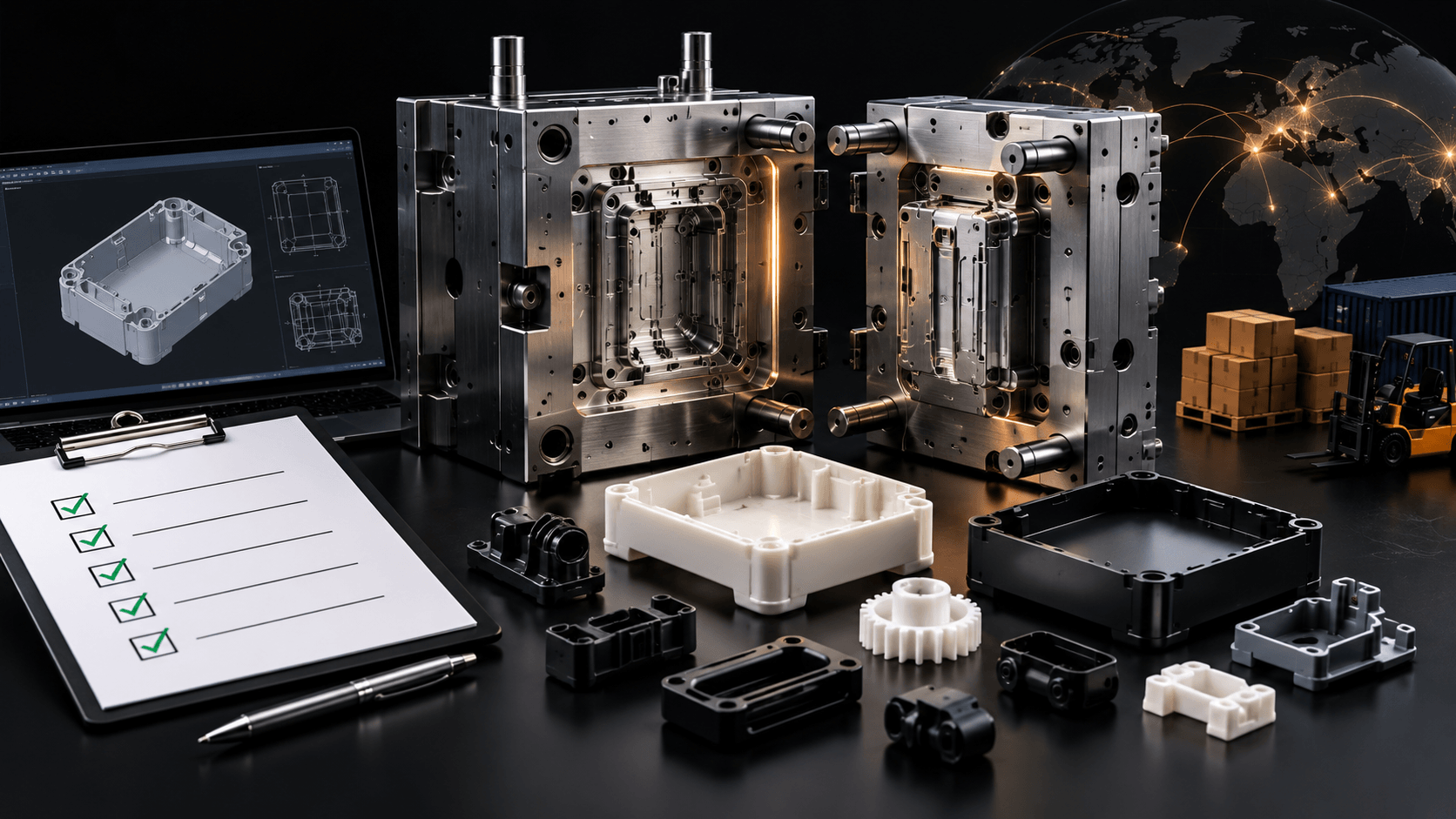
An accurate injection molding quote starts with an accurate request. This guide gives overseas buyers a complete RFQ (request for quote) checklist: what to send, why each item changes the price, and what a good quote should contain when it comes back. Use it with any supplier, including us at Precious3D.
Quick answer
To get an accurate injection molding quote, send a 3D CAD file (STEP), a 2D drawing with critical tolerances, the exact material grade, color and finish, your first order quantity and annual volume, the expected mold life, any certifications you need, and your delivery country and Incoterm. The more of these you fix up front, the closer the quote will be to what you actually pay.
Why quotes for the same part can differ by 3x or more
An injection molding quote has two parts: the one-time tooling cost (the mold) and the recurring part price. Both depend on assumptions the supplier has to make when your RFQ leaves gaps. The biggest ones are:
- Mold material. An aluminum or soft-steel mold costs far less than hardened tool steel but wears out sooner. One supplier quotes a prototype tool, another a production tool.
- Number of cavities. A four-cavity mold costs more upfront but makes four parts per cycle, so the part price drops.
- Side actions and undercuts. Snap hooks, side holes and undercuts need sliders or lifters, which add cost. A supplier who misses them in your CAD will quote low and revise later.
- Runner system. A hot runner saves material and cycle time but adds cost to the mold.
- What is included. Texturing, T1 samples, inspection reports, packing and freight are sometimes in the price and sometimes extras.
None of these are hidden tricks. They are decisions. If your RFQ makes them for every supplier, the quotes become comparable. For typical price ranges, see our injection molding cost guide.
The RFQ checklist: what to send
Here is everything a molder needs to quote accurately the first time, and why it matters.
↔ Swipe sideways to see the full table
| What to send | Why it changes the quote | Example |
|---|---|---|
| 1. 3D CAD file | Used to size the mold, find undercuts and estimate cycle time | STEP (.stp) or IGES for each part |
| 2. 2D drawing | Shows which dimensions are critical and how tight they must be | PDF with tolerances; general tolerance note (e.g. ISO 2768-m) |
| 3. Material and grade | Resin price, shrinkage, tool wear and drying all depend on it | PC/ABS, PA66-GF30, or “SABIC Lexan 943A or equal” |
| 4. Color | Custom color matching adds masterbatch cost and approval time | Natural, black, or Pantone / RAL code |
| 5. Surface finish | Polishing and texturing are priced per face of the mold | SPI A-2 gloss, SPI C-1, or VDI 3400 Ref 27 |
| 6. First order quantity | Affects setup cost spread across each part | 500 pcs initial order |
| 7. Annual volume and program life | Decides mold steel, cavity count and expected tool life | 5,000 pcs/year for 3 years |
| 8. Secondary operations | Each one adds labor and fixtures | Brass inserts, pad printing, ultrasonic welding, assembly |
| 9. Certifications and tests | Certified resins cost more; test reports take time | RoHS, REACH, UL94 V-0, food contact |
| 10. Inspection needs | Full dimensional reports take measuring time | First article inspection (FAI) report on critical dimensions |
| 11. Packing | Protects cosmetic parts in transit; bulk vs individual bags | Individually bagged, 100 per carton, labeled |
| 12. Delivery country, date and Incoterm | Decides who pays freight, duty and customs clearance | Austin, USA, by 15 March, DAP |
Do not send only an STL file
STL files are meshes made for 3D printing. They lose the true curves and exact dimensions a toolmaker needs to machine a mold. Always export a STEP file from your CAD software. If you only have an STL or a physical sample, our 3D CAD design team can rebuild the model.
The number that matters most: annual volume
If you send only one extra detail, make it your expected volume over the life of the product. “1,000 parts” is not enough. A supplier needs to know whether that is 1,000 once, or 1,000 a month for five years, because that decides how the mold is built.
Many molders use the SPI mold classes as a shorthand for expected tool life. Telling a supplier which class you expect, or giving them the volume so they can choose, removes one of the biggest sources of price difference.
↔ Swipe sideways to see the full table
| Total parts over product life | Typical mold | SPI class (approx.) |
|---|---|---|
| Under 500 | Consider 3D printing or vacuum casting instead of a mold | Class 105 (prototype) |
| 500 – 100,000 | Aluminum or pre-hardened steel (e.g. P20), single cavity | Class 104 |
| 100,000 – 500,000 | Pre-hardened or hardened steel, one or more cavities | Class 103 |
| 500,000 + | Hardened tool steel (e.g. H13), multi-cavity, often hot runner | Class 102 / 101 |
If your design may still change, say so. A supplier can suggest a cheaper bridge tool now and a production tool later. For runs in the hundreds, our low-volume manufacturing guide compares 3D printing, vacuum casting and soft tooling, and our 3D printing vs injection molding post shows where the crossover usually sits.
Details overseas buyers often leave out
Buying from a molder in another country adds a few items that local buyers rarely think about. Including them in your first email saves a week of back-and-forth.
- Incoterm. EXW means you collect from the factory; DAP means the supplier delivers to your door but you pay import duty; DDP means the supplier pays duty too. Ask for the quote on the Incoterm you will actually use.
- Freight for samples vs production. T1 samples and small batches usually go by air courier. Larger production runs often go by sea. Ask for both if your volumes justify it.
- Duties and tariffs. These depend on the part’s HS code and your country, and they change. Confirm your rate with a customs broker. Our guide to outsourcing injection molding to India covers shipping, duties and IP in more detail.
- Units and standards. State whether your drawing is in mm or inches, and which tolerance standard applies.
- Approval process. Say who signs off samples, how many sample rounds you expect, and whether you need parts shipped for approval before production starts.
- Time zone and contact. Name one technical contact who can answer DFM questions quickly. A one-day reply delay on each question adds up.
What a complete quote should include
When quotes come back, check that each one states:
- ☐ Tooling cost, shown separately from part price
- ☐ Mold steel, number of cavities and runner type (cold or hot)
- ☐ Guaranteed mold life (in shots or cycles)
- ☐ Part price at several quantities (price breaks)
- ☐ Material grade exactly as specified, or the proposed equivalent
- ☐ Lead time to T1 samples and to first production shipment
- ☐ Number of free sample rounds and design-change policy
- ☐ Who owns the mold, and where it will be stored
- ☐ Inspection reports included
- ☐ Packing, freight and Incoterm
Once you have several complete quotes, our guide on how to compare injection moulding quotes from suppliers shows how to line them up fairly.
Red flags in a quote
- No questions asked. A good toolmaker almost always raises at least one DFM point: a missing draft angle, a thick wall, an undercut. A quote with no questions may mean nobody really looked at your CAD.
- Mold steel not stated. If the quote does not say what the mold is made from, you cannot tell whether it will last.
- Very low tooling with high part price. This can mean a soft tool that will need replacing, or a supplier recovering the mold cost through each part.
- Unclear mold ownership. If you pay for the tool, you should own it and be able to move it.
- “Plastic” instead of a grade. Vague material terms make it easy to swap in a cheaper resin later.
Choosing between suppliers involves more than price. See how to choose an injection molding partner in India for what to check beyond the numbers.
Protecting your design when you share files
Sending CAD files abroad worries many buyers. A few simple steps reduce the risk:
- Sign an NDA first, before sending full drawings.
- Send only what is needed to quote. Individual part files are enough; you do not need to share the full assembly or electronics.
- Put mold ownership in writing, including your right to collect the mold.
- Mark drawings as confidential with your company name and revision number.
How Precious3D handles your RFQ
We build molds in-house in Chennai and make prototypes under the same roof, so we can quote the whole path from first sample to production. When you send an RFQ, we:
- Review your CAD for moldability and send back DFM notes: draft, wall thickness, undercuts, gate position.
- Quote tooling, part price and lead time together, with the mold steel and cavities stated.
- Offer printed or cast samples first through our 3D printing services if you want to check fit before cutting steel.
- Suggest a material if you only know the performance you need. See our ABS, polycarbonate and nylon injection molding pages.
Building a product housing? Our custom enclosures service covers printed, cast and molded options. US buyers can start with our injection molding for USA page, and UK teams with low-volume manufacturing for the UK.
Frequently asked questions
What file format do I need for an injection molding quote?
A STEP file (.stp or .step) is the standard. IGES also works. Add a 2D PDF drawing showing critical dimensions and tolerances. Avoid sending only STL files, because they do not carry the exact geometry a toolmaker needs.
Can I get a quote without a 2D drawing?
Yes, a budget quote can be made from the 3D file alone. But without a drawing the supplier has to assume general tolerances, so the final price may change once you confirm which dimensions are critical.
How long does it take to get an injection molding quote?
With a complete RFQ, simple parts can often be quoted within a few working days. Complex parts, multi-part assemblies or unclear specifications take longer, because the toolmaker has to come back with questions first.
What if I don’t know which plastic to use?
Describe what the part must do instead: operating temperature, impact, outdoor use, flame rating, food contact, look and feel. A good molder will propose a grade and explain the trade-offs.
Who owns the mold after I pay for it?
Normally the buyer owns the mold once tooling is paid in full, and the molder stores and maintains it. Make sure the quote or purchase order states this, along with your right to move the mold to another supplier.
Should I ask for a quote on a prototype mold or a production mold?
If the design may still change or your total volume is a few thousand parts, a prototype or bridge mold is usually the better first step. If the design is final and volumes are high, quote a production mold directly. You can also ask for both and compare.
Send your STEP file for a free DFM review and quote
Share your CAD, material, volumes and delivery country. Our engineers will check moldability, flag design risks and send tooling, part price and lead time together.
Request a Quote