You have a part ready to make. One supplier says 3D print it, another says machine it. Both can be right, and picking the wrong one can mean paying three times more than you need to, or getting a part that cannot hold the tolerance you designed.
This guide compares 3D printing and CNC machining on what matters to buyers in India: cost at different quantities, accuracy, materials and lead time. It finishes with a simple way to decide.
Quick answer
For 1 to about 50 plastic parts, especially complex shapes, 3D printing is usually cheaper and faster because there is almost no setup. CNC machining wins when you need metal, tight tolerances (around ±0.01–0.05 mm) or a machined finish, and it becomes more competitive from tens to a few hundred parts. In India, CNC job shops typically charge ₹500–₹900 per hour for 3-axis work and ₹1,200–₹2,500 per hour for 5-axis or high-precision machining. Above roughly 1,000 parts, injection moulding is usually the cheapest.
How the two processes work
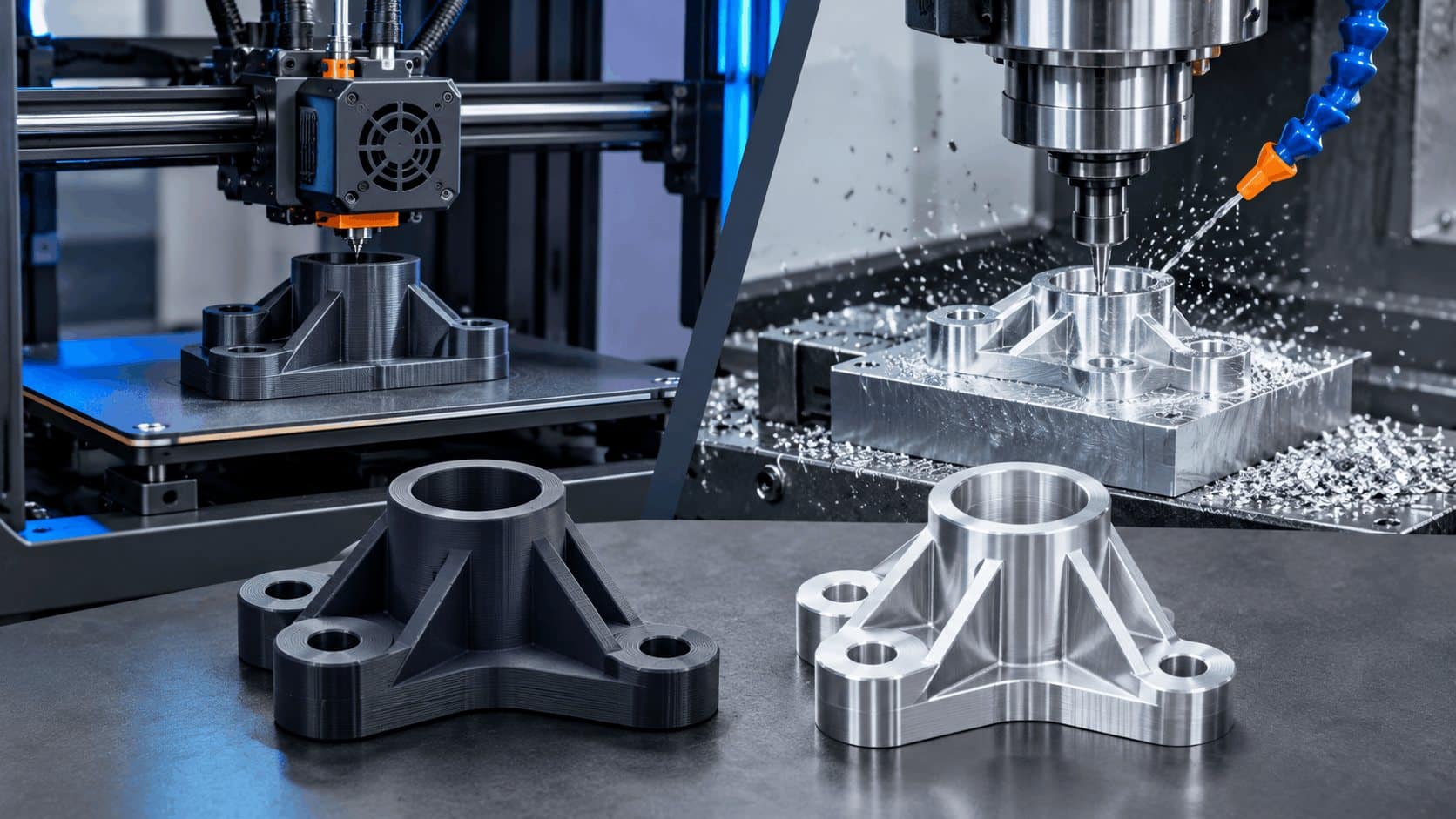
3D printing is additive. It builds the part layer by layer straight from the CAD file. There is no tooling, no fixtures and very little programming, so the first part costs about the same as the tenth.
CNC machining is subtractive. A cutting tool removes material from a solid block of metal or plastic. Before the first cut, someone has to write the CAM program, choose tools and fix the workpiece. For small orders, that setup is a large share of the price, while the actual cutting time is often short.
What drives the cost of each
CNC machining cost
Indian job shops usually quote a blended machine rate that already includes the operator, overhead and tool wear. A useful way to think about the price per part is:
Cost per part = material + (cycle time × machine rate) + (setup and programming cost ÷ batch quantity) + finishing
| Machine type | Typical rate in India |
|---|---|
| 3-axis VMC, general work | ₹500 – ₹900 per hour |
| Typical job-shop range for standard VMC work | ₹500 – ₹1,500 per hour |
| 5-axis or high-precision machining | ₹1,200 – ₹2,500 per hour |
Material, part complexity, the number of setups (each new face can mean a new fixture), tight tolerances and finishes such as anodising push the price up.
3D printing cost
3D printing cost is driven mainly by the material used and machine time. Setup is a few minutes of file preparation, which is why the price per part barely changes with quantity.
| Process | Typical machine rate in India | Best for |
|---|---|---|
| FDM | ₹200 – ₹500 per hour | Low-cost prototypes, jigs, fixtures |
| SLA (resin) | ₹500 – ₹1,500 per hour | Fine detail, smooth surfaces |
| SLS / MJF (nylon) | ₹1,500 – ₹4,000 per hour | Strong functional parts in batches |
| Metal (DMLS) | ₹5,000 – ₹10,000 per hour | Complex metal parts |
Per-gram material rates for each process are in our 3D printing cost guide.
Cost comparison by quantity
Here is an illustrative example: a small bracket about 80 × 40 × 20 mm. For CNC we assume 2 hours of programming and setup at ₹800 per hour, a 25-minute cycle, about ₹250 of aluminium and ₹100 of deburring per part. Your own quotes will differ, but the pattern holds.
| Quantity | CNC, aluminium 6061 | SLS nylon (PA12) | FDM (ABS / PETG) |
|---|---|---|---|
| 1 part | ~₹2,300 | ~₹1,500 | ~₹400 – ₹600 |
| 10 parts (each) | ~₹850 | ~₹1,200 | ~₹400 – ₹600 |
| 50 parts (each) | ~₹700 | ~₹1,200 | ~₹400 – ₹600 |
Two things stand out. First, the CNC price falls sharply as setup is spread across more parts, while the 3D printing price stays almost flat. Second, the cheapest option depends on the material you need. If the bracket must be aluminium, CNC is the answer at any quantity. If nylon is good enough, SLS wins for small runs.
A real-world example from an Indian prototyping service shows the same pattern for a single standard part: about ₹4,500 to 3D print, ₹7,000 to CNC machine, ₹4,000 by urethane casting, and ₹60 per part by injection moulding, but only after a mould costing from ₹70,000.
Accuracy and surface finish
CNC machining is more accurate. Good Indian job shops routinely hold tolerances of about ±0.01–0.05 mm and leave a clean machined surface. 3D printing tolerances are looser: typically around ±0.1–0.3 mm for SLA and SLS on small parts, and somewhat more for FDM. Printed parts also show layer lines unless they are post-processed.
- Choose CNC for bearing fits, sealing faces, threads in metal and precision assemblies.
- Choose 3D printing for form and fit checks, housings, organic shapes and parts where ±0.2 mm is fine.
- Combine both when needed. Print the part, then machine critical holes or faces.
Materials
| 3D printing | CNC machining | |
|---|---|---|
| Plastics | PLA, ABS, PETG, nylon, PC, TPU, resins, carbon-fibre-filled grades | Delrin (POM), nylon, PC, acrylic, PEEK, UHMW and more |
| Metals | Stainless steel, aluminium, titanium, Inconel (DMLS), at high cost | Aluminium, steel, stainless steel, brass, copper, titanium |
| Material properties | Printed parts can be weaker between layers | Full bulk properties of the stock material |
If you need a specific engineering grade with certified properties, CNC from bar or plate stock is usually the safer route. Our guide to PLA vs ABS vs PETG vs nylon covers the common printing plastics.
Design freedom and lead time
3D printing handles internal channels, lattices, undercuts and organic shapes that a cutting tool cannot reach, and it does not care how complex the part is. CNC is limited by tool access, so deep pockets, sharp internal corners and hidden cavities add cost or are impossible.
On lead time, 3D printed prototypes often ship in 1–3 days because there is no programming queue. CNC prototypes usually take longer, from a few days to a few weeks depending on the shop, the material and the number of setups.
When to choose which
| Your situation | Best fit |
|---|---|
| 1–50 plastic prototypes, complex shape | 3D printing |
| Quick form, fit and ergonomic checks | 3D printing (FDM or SLA) |
| Metal parts, tight tolerances or threads | CNC machining |
| 50–500 identical functional parts | CNC, SLS or vacuum casting. Compare quotes |
| 1,000+ plastic parts | Injection moulding |
| Complex metal part with internal channels | Metal 3D printing, then CNC finishing |
Many products use all three in sequence: 3D print early prototypes, CNC machine parts for testing in real materials, then move to injection moulding for production. See 3D printing vs injection molding and our injection molding cost guide for the next step.
How to reduce your cost with either process
- For CNC: avoid unnecessary tight tolerances, use standard hole sizes, add internal corner radii, reduce the number of setups and order a few spares in the same batch.
- For 3D printing: hollow or shell thick sections, orient parts to cut supports, and nest several parts in one SLS build.
- For both: send a STEP file and a 2D drawing marking only the critical dimensions, so the supplier does not quote everything at the tightest tolerance.
Frequently asked questions
Is 3D printing cheaper than CNC machining?
For small quantities of plastic parts, yes. 3D printing has almost no setup, so one-off and small-batch parts usually cost less. For metal parts, tight tolerances or larger batches, CNC machining is often cheaper.
What is the CNC machining cost per hour in India?
Most Indian job shops charge about ₹500–₹900 per hour for general 3-axis VMC work, and ₹1,200–₹2,500 per hour for 5-axis or high-precision machining. The rate usually includes the operator and overhead.
At what quantity does CNC become cheaper than 3D printing?
It depends on the part and material. As a rule of thumb, 3D printing is most competitive below about 50 parts, CNC from around 50 to a few hundred parts, and injection moulding from about 1,000 parts upward.
Which is more accurate, CNC or 3D printing?
CNC machining. Good shops hold around ±0.01–0.05 mm, while most 3D printing processes hold about ±0.1–0.3 mm on small parts. Critical features on printed parts can be machined afterwards.
Can Precious3D help me choose between 3D printing and CNC?
Precious3D focuses on 3D printing (FDM, SLA, SLS and metal), vacuum casting and low-volume injection moulding. Send us your assembly and we will tell you which parts suit these processes and which are better machined.
The bottom line
Do not choose a process first. Start from your quantity, material and tolerance. For a few plastic parts, print them. For precise metal parts, machine them. For anything in between, ask for quotes on both, because the right answer often surprises people. If 3D printing, vacuum casting or moulding suits your part, we can quote it, and if it really needs machining, we will tell you.
Not sure whether to print or machine your part?
Send your STEP file, quantity and material. We will tell you whether 3D printing suits it and send a clear quote.
Get a Free QuoteCall +91 86100 39566