

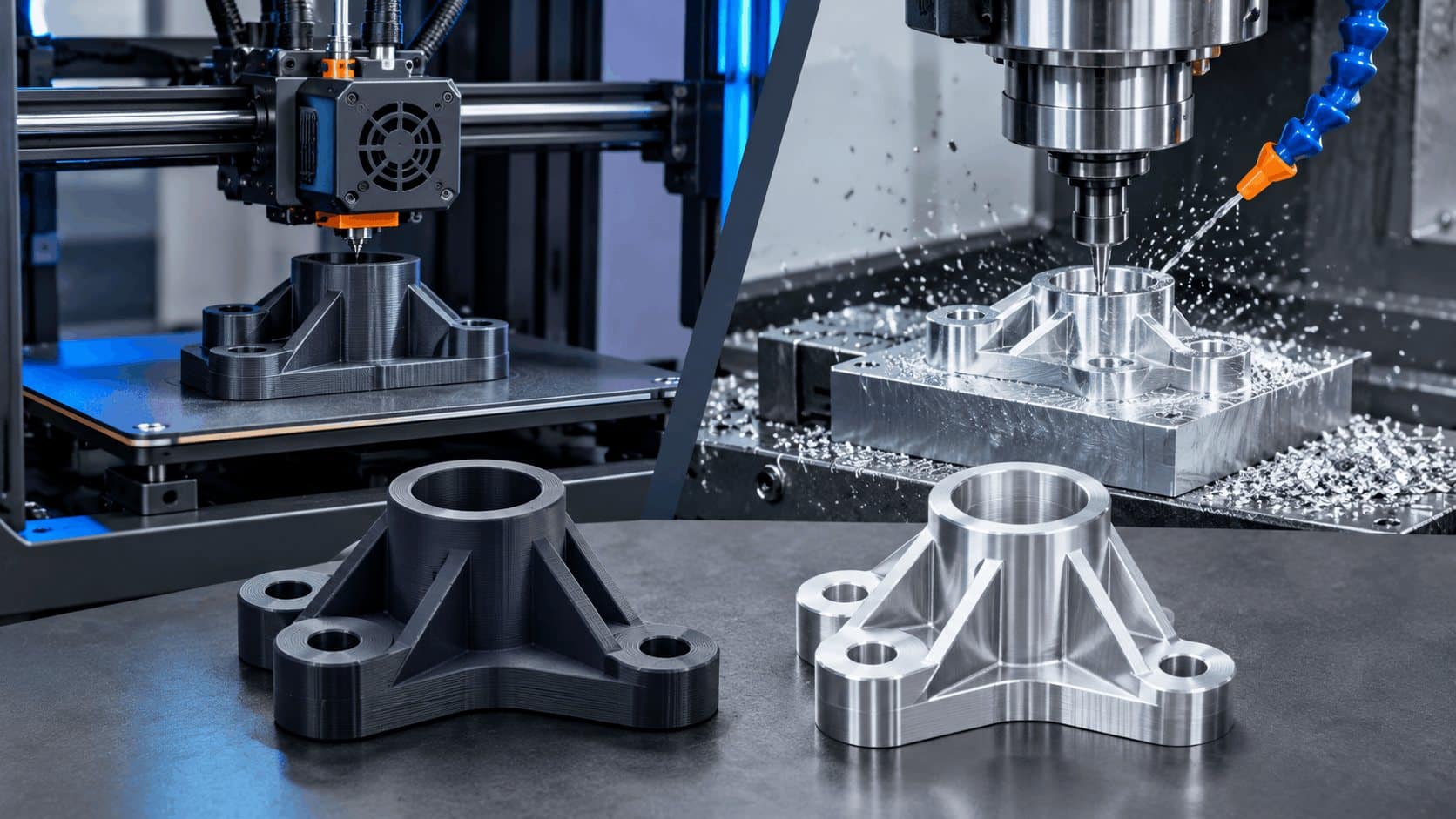
3D printing or CNC machining? Compare cost at 1, 10 and 50 parts, CNC hourly rates in India, tolerances, materials and lead times, with a simple guide to choosing the…
Read MoreFounder of Precious3D, Chennai. Chinmay helps hardware startups and manufacturers take products from concept to manufacturing through rapid prototyping, 3D printing and low-volume injection molding.
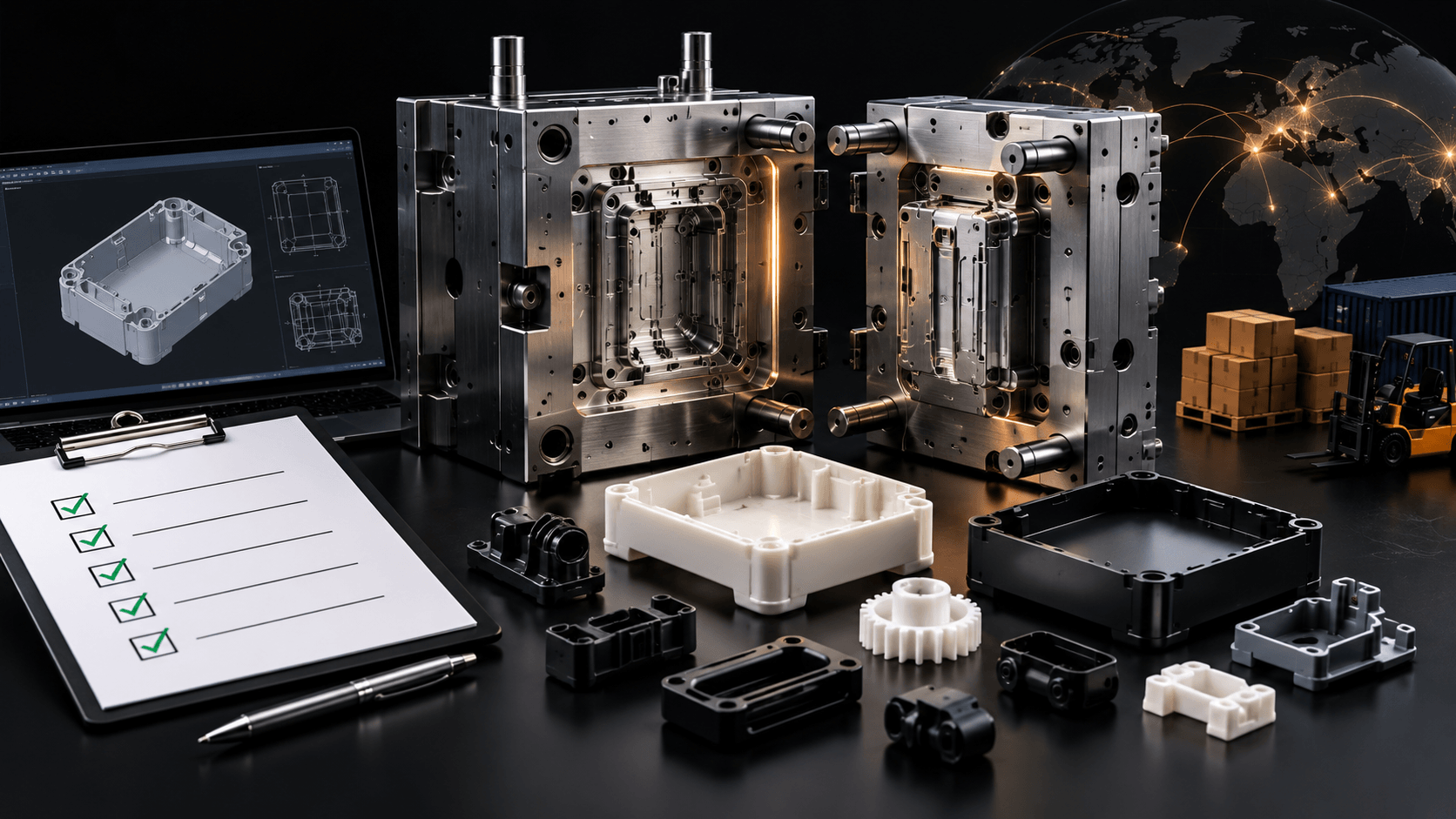
You send the same part to three molders and get three quotes: one at $2,500 for the mold, one at $6,000 and one at $11,000. Is someone overcharging? Usually not. In most cases, each supplier simply guessed differently about what you need: how many parts per year, what steel the mold should be made from, how tight the tolerances are, and what “black ABS with a matte finish” actually means.
An accurate injection molding quote starts with an accurate request. This guide gives overseas buyers a complete RFQ (request for quote) checklist: what to send, why each item changes the price, and what a good quote should contain when it comes back. Use it with any supplier, including us at Precious3D.
Quick answer
To get an accurate injection molding quote, send a 3D CAD file (STEP), a 2D drawing with critical tolerances, the exact material grade, color and finish, your first order quantity and annual volume, the expected mold life, any certifications you need, and your delivery country and Incoterm. The more of these you fix up front, the closer the quote will be to what you actually pay.
An injection molding quote has two parts: the one-time tooling cost (the mold) and the recurring part price. Both depend on assumptions the supplier has to make when your RFQ leaves gaps. The biggest ones are:
None of these are hidden tricks. They are decisions. If your RFQ makes them for every supplier, the quotes become comparable. For typical price ranges, see our injection molding cost guide.
Here is everything a molder needs to quote accurately the first time, and why it matters.
↔ Swipe sideways to see the full table
| What to send | Why it changes the quote | Example |
|---|---|---|
| 1. 3D CAD file | Used to size the mold, find undercuts and estimate cycle time | STEP (.stp) or IGES for each part |
| 2. 2D drawing | Shows which dimensions are critical and how tight they must be | PDF with tolerances; general tolerance note (e.g. ISO 2768-m) |
| 3. Material and grade | Resin price, shrinkage, tool wear and drying all depend on it | PC/ABS, PA66-GF30, or “SABIC Lexan 943A or equal” |
| 4. Color | Custom color matching adds masterbatch cost and approval time | Natural, black, or Pantone / RAL code |
| 5. Surface finish | Polishing and texturing are priced per face of the mold | SPI A-2 gloss, SPI C-1, or VDI 3400 Ref 27 |
| 6. First order quantity | Affects setup cost spread across each part | 500 pcs initial order |
| 7. Annual volume and program life | Decides mold steel, cavity count and expected tool life | 5,000 pcs/year for 3 years |
| 8. Secondary operations | Each one adds labor and fixtures | Brass inserts, pad printing, ultrasonic welding, assembly |
| 9. Certifications and tests | Certified resins cost more; test reports take time | RoHS, REACH, UL94 V-0, food contact |
| 10. Inspection needs | Full dimensional reports take measuring time | First article inspection (FAI) report on critical dimensions |
| 11. Packing | Protects cosmetic parts in transit; bulk vs individual bags | Individually bagged, 100 per carton, labeled |
| 12. Delivery country, date and Incoterm | Decides who pays freight, duty and customs clearance | Austin, USA, by 15 March, DAP |
Do not send only an STL file
STL files are meshes made for 3D printing. They lose the true curves and exact dimensions a toolmaker needs to machine a mold. Always export a STEP file from your CAD software. If you only have an STL or a physical sample, our 3D CAD design team can rebuild the model.
If you send only one extra detail, make it your expected volume over the life of the product. “1,000 parts” is not enough. A supplier needs to know whether that is 1,000 once, or 1,000 a month for five years, because that decides how the mold is built.
Many molders use the SPI mold classes as a shorthand for expected tool life. Telling a supplier which class you expect, or giving them the volume so they can choose, removes one of the biggest sources of price difference.
↔ Swipe sideways to see the full table
| Total parts over product life | Typical mold | SPI class (approx.) |
|---|---|---|
| Under 500 | Consider 3D printing or vacuum casting instead of a mold | Class 105 (prototype) |
| 500 – 100,000 | Aluminum or pre-hardened steel (e.g. P20), single cavity | Class 104 |
| 100,000 – 500,000 | Pre-hardened or hardened steel, one or more cavities | Class 103 |
| 500,000 + | Hardened tool steel (e.g. H13), multi-cavity, often hot runner | Class 102 / 101 |
If your design may still change, say so. A supplier can suggest a cheaper bridge tool now and a production tool later. For runs in the hundreds, our low-volume manufacturing guide compares 3D printing, vacuum casting and soft tooling, and our 3D printing vs injection molding post shows where the crossover usually sits.
Buying from a molder in another country adds a few items that local buyers rarely think about. Including them in your first email saves a week of back-and-forth.
When quotes come back, check that each one states:
Once you have several complete quotes, our guide on how to compare injection moulding quotes from suppliers shows how to line them up fairly.
Choosing between suppliers involves more than price. See how to choose an injection molding partner in India for what to check beyond the numbers.
Sending CAD files abroad worries many buyers. A few simple steps reduce the risk:
We build molds in-house in Chennai and make prototypes under the same roof, so we can quote the whole path from first sample to production. When you send an RFQ, we:
Building a product housing? Our custom enclosures service covers printed, cast and molded options. US buyers can start with our injection molding for USA page, and UK teams with low-volume manufacturing for the UK.
A STEP file (.stp or .step) is the standard. IGES also works. Add a 2D PDF drawing showing critical dimensions and tolerances. Avoid sending only STL files, because they do not carry the exact geometry a toolmaker needs.
Yes, a budget quote can be made from the 3D file alone. But without a drawing the supplier has to assume general tolerances, so the final price may change once you confirm which dimensions are critical.
With a complete RFQ, simple parts can often be quoted within a few working days. Complex parts, multi-part assemblies or unclear specifications take longer, because the toolmaker has to come back with questions first.
Describe what the part must do instead: operating temperature, impact, outdoor use, flame rating, food contact, look and feel. A good molder will propose a grade and explain the trade-offs.
Normally the buyer owns the mold once tooling is paid in full, and the molder stores and maintains it. Make sure the quote or purchase order states this, along with your right to move the mold to another supplier.
If the design may still change or your total volume is a few thousand parts, a prototype or bridge mold is usually the better first step. If the design is final and volumes are high, quote a production mold directly. You can also ask for both and compare.
Send your STEP file for a free DFM review and quote
Share your CAD, material, volumes and delivery country. Our engineers will check moldability, flag design risks and send tooling, part price and lead time together.
Request a Quote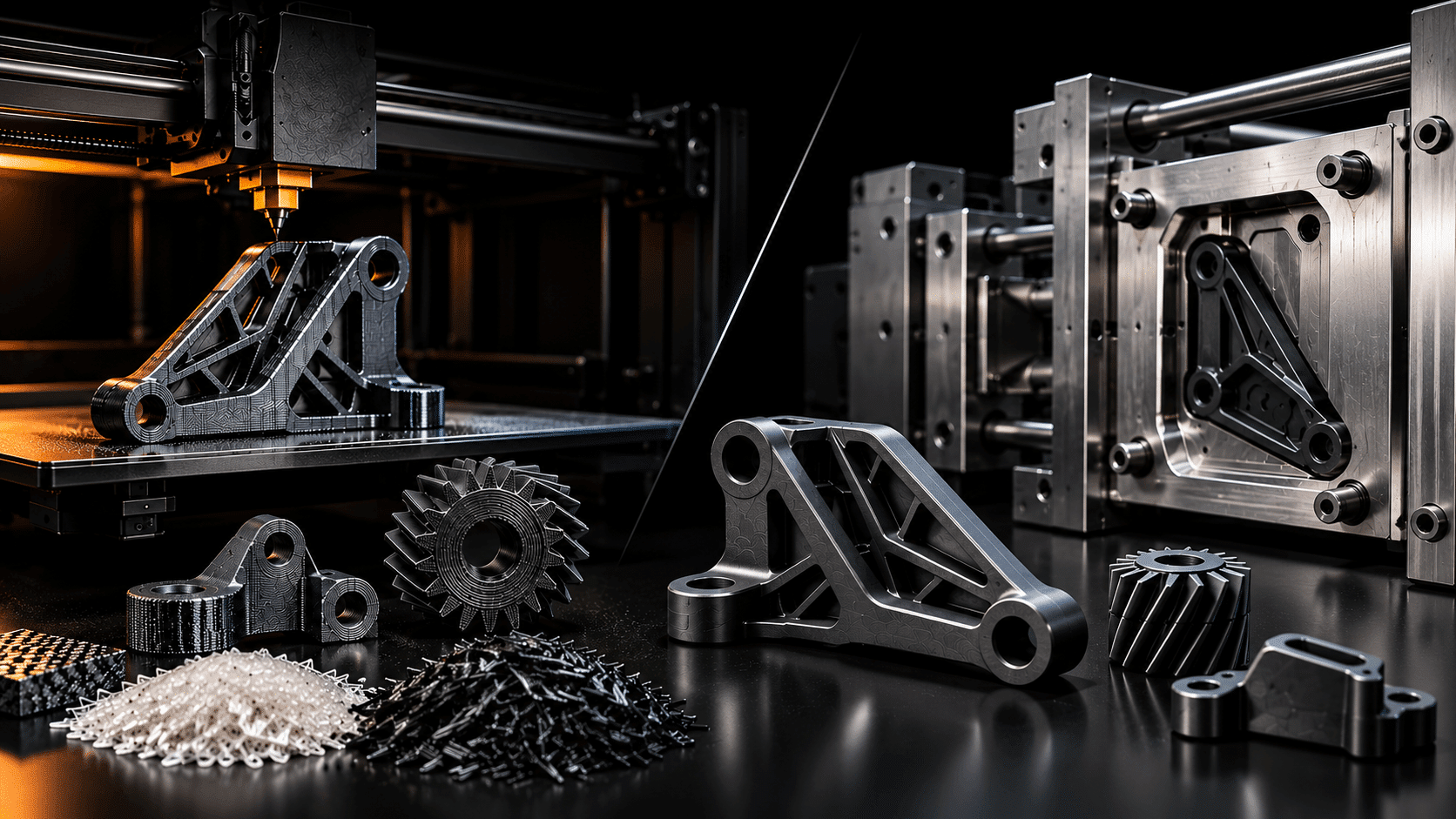
Plain nylon is tough, but it bends under load and softens when things get warm. Add glass or carbon fiber and the same plastic can hold a motor bracket in place next to a hot engine, keep a drone arm stiff in a crash, or replace a small machined aluminium part at a fraction of the weight.
That is why fiber-reinforced plastics show up on so many engineering drawings. The harder question is how to make the part: 3D print it in a carbon-filled nylon, or build an injection mold and shoot glass-filled PA66? This guide walks through the materials, the two processes, the design traps and the volume point where one beats the other.
Quick answer
For 1–200 parts, or while the design is still changing, 3D print in carbon-fiber nylon. For a few hundred parts and up with a frozen design, injection mold in glass-filled nylon (usually PA66-GF30) using a hardened tool. Many projects do both: printed prototypes first, molded parts once the design is proven.
A fiber-reinforced plastic is a base polymer, most often nylon (polyamide), with short glass or carbon fibers mixed in. The fibers carry load the way steel bars carry load in concrete. The grade name tells you the recipe: PA66-GF30 is nylon 66 with 30% glass fiber by weight, and PA12-CF is nylon 12 filled with chopped carbon fiber.
Adding fiber typically brings:
The trade-offs are real too: lower impact toughness and elongation, a rougher surface, properties that change with fiber direction, and fibers that wear down molds and printer nozzles.
Glass fiber is the workhorse. It is cheaper, adds a lot of strength and heat resistance, and dominates injection molding. Carbon fiber is lighter and stiffer for its weight, gives a clean matte-black finish, and is the most common reinforcement in 3D printing filaments. Carbon-filled parts are also slightly conductive, which matters for some electronics. If a part must be electrically insulating, glass is the safer choice.
Glass bead is not glass fiber
Some powder-bed materials, such as MJF PA12 GB, are filled with tiny glass beads, not fibers. Beads make parts stiffer and more dimensionally stable, but they do not add the strength you get from fiber. Check the datasheet before you assume a “glass-filled” print will match a molded GF30 part.
The figures below are typical dry, as-molded or as-printed datasheet ranges. Exact values depend on the resin brand, fiber content and print orientation, so always confirm against the specific grade’s datasheet.
↔ Swipe sideways to see the full table
| Material | Process | Tensile strength | Stiffness (modulus) | Heat deflection (1.8 MPa) | Typical uses |
|---|---|---|---|---|---|
| PA66 (unfilled) | Molding | ~80 MPa | ~3 GPa | ~70–90°C | Baseline for comparison |
| PA6-GF30 | Molding | ~160–180 MPa | ~8–9 GPa | ~190–210°C | Housings, brackets, power-tool bodies |
| PA66-GF30 | Molding | ~180–200 MPa | ~9–10 GPa | ~240–255°C | Under-hood automotive, connectors, metal replacement |
| PC-GF20 | Molding | ~90–110 MPa | ~5–6 GPa | ~140–145°C | Rigid enclosures, electrical parts that must not absorb moisture |
| PA12-CF / PA6-CF | FDM 3D printing | ~50–90 MPa in plane, much lower between layers | ~4–8 GPa | Varies widely by brand | Jigs, fixtures, drone arms, functional prototypes |
| PA12 GB (glass bead) | MJF / SLS | ~30 MPa | ~2.5–2.8 GPa | ~85–90°C | Stiff housings, fixtures needing tight tolerances |
One thing the table does not show: nylon absorbs moisture from the air. Once a nylon part settles into normal humidity, its strength and stiffness drop noticeably compared with the dry figures above, though it gains toughness. Glass-filled PC does not have this issue, which is why it is a good pick for polycarbonate molding jobs where dimensions must stay stable in humid climates.
Carbon-fiber nylon on an FDM printer is the fastest way to get a strong, stiff, lightweight part with no tooling. There is no minimum order, a design change costs nothing but a new file, and prototypes are usually ready in one to two days after we receive your CAD.
Where printing works well:
What to watch:
For a full breakdown of what drives print pricing, see our 3D printing cost guide. If you need metal-level strength, metal 3D printing may be the better comparison.
Once the design is final and volumes climb, injection molding wins. Molded glass-filled nylon parts are stronger than any printed equivalent because the fibers are well bonded through the whole part with no layer lines. Every part comes out the same, the surface finish can be controlled through the mold, and the cost per part falls sharply as quantities rise. Our nylon injection molding runs start at 200 pieces.
What makes glass-filled molding different from plain plastic:
Tooling is the biggest upfront cost. Our injection molding cost guide covers mold pricing, per-unit costs and the hidden extras buyers often miss.
↔ Swipe sideways to see the full table
| Quantity | Best route | Why |
|---|---|---|
| 1–20 | FDM carbon-fiber nylon | No tooling, fastest turnaround, design can change freely |
| 20–200 | 3D printing, or vacuum casting for production-look parts | Still too few parts to justify a hardened mold |
| 200–2,000 | Injection molding (single-cavity tool) | Per-part cost drops below printing; full molded GF strength |
| 2,000+ | Injection molding (hardened, possibly multi-cavity) | Lowest unit cost; hardened steel handles glass-fiber wear over long runs |
The crossover point is not fixed. A small, simple part may justify a mold at a few hundred pieces; a large, complex part with side actions may stay cheaper to print for longer. Vacuum casting is worth a look in the middle band, though cast polyurethanes imitate the look and feel of filled nylon rather than matching its heat resistance. Our low-volume manufacturing guide compares these options in detail, and the vacuum casting process page explains how cast parts are made.
Not sure your CAD is ready? Our 3D CAD design team can review and adjust parts for printing or molding.
We regularly make molded and printed parts for engineering teams abroad. Glass-filled nylon parts are light and compact, so air freight for prototypes and sea freight for production runs keeps landed costs low. Share your CAD file, the target grade (for example PA66-GF30) and your annual volume, and we will quote tooling, unit price and lead time together. Buyers in the US can start with our injection molding for USA page, and UK teams with low-volume manufacturing for the UK.
In injection molding, glass-filled PA66 is generally stronger and far cheaper than a carbon-filled equivalent. Carbon fiber gives higher stiffness for the same weight. In 3D printing, carbon-fiber nylon is the more common and better-developed option. The right choice depends on whether strength, stiffness, weight or cost matters most for your part.
For prototypes, fixtures and low volumes, often yes. For production parts under high load or heat, a printed part usually will not match a molded GF30 part, mainly because printed parts are weaker between layers. We recommend testing printed prototypes for fit and function, then moving to molding for final parts.
Glass fibers are abrasive and gradually wear the steel at gates, cavities and parting lines. A hardened tool steel mold lasts much longer and keeps parts within tolerance over the full production run. For short runs, a softer tool may be acceptable, and we will advise based on your volume.
GF30 means the plastic contains 30% glass fiber by weight. It is the most widely used reinforced nylon grade because it balances strength, stiffness, heat resistance and ease of molding. Grades from GF10 to GF50 are also available.
Our injection molding orders start at 200 pieces. Below that, 3D printing or vacuum casting is usually more cost-effective, and there is no minimum order for 3D printed parts.
Get a free DFM review for your reinforced part
Send us your CAD file, target material and quantity. Our engineers will recommend printing or molding, flag design risks, and send a quote.
Request a Quote
For twenty years, the answer to “where should we get our parts molded?” was simple: China. It still has the largest mold-making and molding industry in the world. But in 2026 the question has become harder. US tariffs on Chinese plastic parts now stack to more than 40% on many products, the UK has a new trade agreement with India, and more hardware teams are being asked by their boards to find a second source.
This guide compares China vs India for injection molding (or injection moulding, as it is spelled in the UK) on the four things that actually decide the outcome: cost, tariffs, lead time and risk. We are a molder ourselves, Precious3D builds injection molds and molded parts in Chennai, so we will also be honest about where China is still the better choice.
Quick answer
Very few companies are leaving China completely. What has changed is that relying on one country for every molded part now looks risky. Three things have pushed buyers to compare:
The result is the “China+1” approach: keep what works in China, and qualify a second supplier elsewhere. India is one of the most common choices for that second source. If you are new to the idea, our guide to outsourcing injection molding to India covers the basics of shipping, IP and supplier selection.
Swipe sideways to see the full table →
| Factor | China | India |
|---|---|---|
| Scale of industry | Largest in the world; deep supply of mold bases, hot runners and resins | Smaller but fast-growing; strong in automotive, appliances and industrial parts |
| Tooling cost | Low | Low, often similar or lower for simple tools |
| Per-part price, very high volume | Usually the lowest | Competitive |
| Per-part price, 100–20,000 parts | Competitive, but large factories may deprioritise small orders | Very competitive; short runs are normal work |
| US tariff on plastic parts (Oct 2026) | Normal duty + 25% + 12.5% Section 301 | Normal duty + 10% Section 301 |
| UK tariff | Standard UK Global Tariff | Zero on most goods with proof of origin |
| Working language | English at sales level; engineering talks may need a translator or agent | English throughout, including drawings and engineering calls |
| Time-zone overlap | Short overlap with UK/EU; almost none with US | Good overlap with UK/EU; early-morning overlap with US |
| Sea freight to US West Coast | Roughly 2–3 weeks | Roughly 4–6 weeks |
| Legal system for contracts | Civil law; NNN agreements under Chinese law recommended | Common law; English-language contracts and NDAs |
On the factory price alone, China and India are close. Both have far lower toolroom labour rates than the US, UK or Europe, which is why molds from either country usually cost a fraction of a comparable domestic tool. The differences show up at the edges:
For detailed price ranges, see our injection molding cost in India (2026) guide. If you are weighing a short run against a full production tool, our comparison of low-volume vs high-volume injection molding explains the trade-offs.
The unit price is the wrong number to compare. What matters is landed cost: tooling + parts + packing + freight + duty + import taxes + the cost of any rejected or late batch. In 2026, duty is often the biggest single difference between a Chinese and an Indian quote.
Most molded plastic parts fall under HS heading 3926 (“other articles of plastics”). Enclosures and parts made for a specific device are sometimes classified with that device instead, so confirm your exact code with your customs broker before you compare quotes.
US tariffs changed several times in 2025–26. After the Supreme Court struck down the IEEPA “reciprocal” tariffs in February 2026, a temporary 10% global tariff applied until 24 July 2026. On that date it was replaced by new Section 301 “forced labour” tariffs on 60 economies: 12.5% on China and 10% on India.
The key difference is that China’s new 12.5% stacks on top of the original 2018 Section 301 tariffs, which put 25% on many Chinese plastic articles and were not affected by the Supreme Court ruling. Here is how that works out for a typical plastic part under HTS 3926.90.99 (normal duty 5.3%):
Swipe sideways to see the full table →
| US duty layer | Made in China | Made in India |
|---|---|---|
| Normal (MFN) duty | 5.3% | 5.3% |
| Section 301 (2018 China tariffs) | 25%* | Not applicable |
| Section 301 forced labour (from 24 July 2026) | 12.5% | 10% |
| Approximate total | 42.8% | 15.3% |
*Applies to most, but not all, Chinese plastic articles. Some products have exclusions. Customs processing fees are not included.
One detail many buyers miss: in the US, a mold you pay for that stays at the supplier’s factory is usually treated as an “assist”. Its cost must be added to the declared value of the parts, which means the tariff applies to your tooling as well. With a 42.8% duty rate, that adds up quickly.
US policy is still moving. A second Section 301 investigation into “excess manufacturing capacity”, covering 16 economies including both China and India, is still open and could add further duties to either country. Check the current rate with your broker at the time of order. Our injection molding services for US companies page explains how we quote and ship to the US.
The UK–India Comprehensive Economic and Trade Agreement came into force on 15 July 2026 and removed UK tariffs on the vast majority of Indian goods. To claim the zero rate, your supplier must provide valid proof of origin and the parts must meet the agreement’s rules of origin. Chinese parts still pay the standard UK Global Tariff. Import VAT applies to both. For UK pricing and delivery, see our low-volume injection molding service for UK businesses, or compare with domestic prices in how much low-volume injection molding costs in the UK.
The EU and India concluded their free trade agreement in January 2026, and the EU has said it will sign by the end of the year, so it could enter into force in 2027. Until then, Chinese and Indian plastic parts pay the same standard EU duty plus import VAT. For EU buyers today, the decision comes down to price, capability and risk rather than tariffs.
Note: Trade rules in this section reflect the position in October 2026. Duty rates depend on your product’s HS code and origin paperwork. This is general guidance, not customs or legal advice.
To show how tariffs change the picture, here is a simplified example: 5,000 ABS electronics enclosures shipped to the US by air. The prices are illustrative, not quotes. We have deliberately given China the lower unit price and the lower freight cost.
Swipe sideways to see the full table →
| First order (illustrative) | China | India |
|---|---|---|
| Mold | $5,500 | $5,000 |
| Parts (5,000 units) | $6,000 ($1.20 each) | $6,750 ($1.35 each) |
| Duty (on parts + mold as assist) | $4,922 (42.8%) | $1,798 (15.3%) |
| Air freight | $1,000 | $1,200 |
| Landed cost | $17,422 ($3.48/part) | $14,748 ($2.95/part) |
| Repeat order (no new mold) | $9,568 ($1.91/part) | $8,983 ($1.80/part) |
Even with a cheaper Chinese quote, the Indian route lands about 15% cheaper on the first order and still wins on repeat orders. The gap narrows if the Chinese unit price is much lower, if you ship by sea, or if your product has a tariff exclusion, so run the numbers with your own quotes. Our guide on how to compare injection molding quotes shows how to line them up fairly, and the custom electronics enclosure cost guide covers enclosure pricing in more detail.
For a simple single-cavity mold, the factory side takes a similar time in both countries:
Swipe sideways to see the full table →
| Stage | China | India |
|---|---|---|
| Quote and DFM review | 1–3 days | 1–3 days |
| Mold design and manufacture | About 2–5 weeks | About 2–4 weeks |
| T1 samples | 2–5 days | 2–5 days |
| Production run | 3–10 days | 3–10 days |
| Air freight | About a week | About a week |
| Sea freight to US West Coast | Roughly 2–3 weeks | Roughly 4–6 weeks |
| Sea freight to UK / Europe | Roughly 5–7 weeks | Roughly 4–6 weeks |
Transit times vary with route, port and carrier, so treat these as rough guides. In practice, the biggest delays in either country come from design changes after steel is cut and from slow sample approval, not from geography. Time zones matter more than most buyers expect: India is 4.5–5.5 hours ahead of the UK, so questions sent in the morning get answered the same day. China is 7–8 hours ahead, so many questions wait overnight.
If you need parts before a mold is ready, bridge the gap with vacuum casting, which produces 20–50 molding-quality parts in about two weeks.
China carries the highest and most volatile US tariff exposure, and US–China trade terms are still being negotiated. India is not risk-free: its US tariff rate has moved between 10% and 50% since 2025, and it is included in the open excess-capacity investigation. The difference is that India currently sits in a lower tier, and the UK and EU are moving towards lower tariffs on Indian goods, not higher.
In China, the standard protection is an NNN agreement (non-disclosure, non-use, non-circumvention) written in Chinese and enforceable in Chinese courts. In India, contracts and NDAs are written in English under a common-law system that UK and US legal teams find familiar. In both countries, put mold ownership in writing and share full CAD only after the NDA is signed.
China has more molders at every level, which makes it easier to find a replacement supplier quickly. India’s supplier base is smaller and quality varies widely between shops, so careful selection matters more. Ask for in-house tool making, T1 sample reports and examples of export work. Our guide on choosing an injection molding partner in India lists what to check.
The biggest risk is having all your tooling in one place. A port closure, a new tariff or a dispute with one supplier can stop your entire product line. A second source in a different country is insurance, even if it costs slightly more per part.
We would rather you choose the right country than the wrong supplier. China is usually the better option when:
Choosing materials for the new source? Our guides to ABS injection molding, polycarbonate injection molding and nylon injection molding explain where each one fits. For housings, see our custom injection molded enclosures service.
On the factory price alone, China is often slightly cheaper, especially at very high volumes. Once US tariffs are included, Indian parts usually have the lower landed cost for US buyers. For UK buyers, India’s zero-duty access can also tip the balance. For EU buyers, the two are currently on equal tariff terms.
As of October 2026, many Chinese plastic articles pay the normal duty plus 25% (2018 Section 301) plus 12.5% (2026 Section 301 forced labour). Indian plastic parts pay the normal duty plus 10%. For a part under HTS 3926.90.99, that is roughly 42.8% vs 15.3%. Always confirm your own HS code and the current rate with a customs broker.
Usually, yes. A mold you pay for that stays at the overseas factory is normally treated as an “assist”, and its value is added to the declared value of the parts. That means the tariff rate applies to the tooling as well, which makes a high tariff rate even more expensive on a first order.
Often, yes. Confirm in writing that you own the mold, then have the receiving molder check its size, ejection and cooling layout against their machines. Some molds need minor refurbishment before production. Many buyers prefer a second mold instead, so they keep two working sources.
The best Indian molders supply automotive and appliance OEMs to international standards. Quality varies more between Indian shops than between top-tier Chinese ones, so choose a supplier with in-house tool making, dimensional reports and export experience, and approve T1 samples before production.
By air, there is little difference. By sea, China is faster to the US West Coast, while India is similar or faster to the UK and Europe. For most low- and mid-volume orders, air freight keeps the total lead time to a few weeks from either country.
China remains a powerful manufacturing base, and for very high volumes it is still hard to beat. But in 2026, the choice is no longer just about the factory price. For US buyers, tariffs now make India the lower-cost option for many molded parts. For UK buyers, the new trade agreement adds a clear duty advantage. And for anyone with all their tooling in one country, a second source in India is a practical way to reduce risk.
The simplest way to find out is to compare real numbers. Send the same part to both suppliers, calculate landed cost with today’s tariffs, and let the result decide.
Get a landed-cost quote to compare with China
Send us your CAD file, target quantity and destination country. We will review it for moldability and quote tooling and parts in USD, GBP or EUR, ready to compare with your current supplier.
Request a Free Quote
You have a part that is ready for injection molding. You send it to a few molders, and the replies come back: “Minimum order 10,000 pieces.” “We don’t take jobs under 5,000.” One doesn’t reply at all. If you only need 300 parts for a pilot batch, or 1,000 for a first production run, that is frustrating.
The good news is that a minimum order quantity (MOQ) is not a law of physics. It is a business decision based on cost, and with the right mold and the right molder, small batches are entirely possible. This guide explains why molders set MOQs, how the cost per part changes with quantity, how to get a genuinely low MOQ, and when you should skip injection molding altogether. We work with small batches every week at Precious3D’s mold and tool making shop in Chennai, so the advice here comes from real quotes, not theory.
Quick answer
When a molder quotes an MOQ, it can mean one of three different things. Ask which one they mean, because the answer changes how you plan your orders:
None of these is fixed. They depend on the molder’s machines, how busy they are and what kind of customers they usually serve.
Every production run has fixed costs that do not change whether you make 100 parts or 10,000:
On a long run, these costs disappear into the price of thousands of parts. On a short run, they are a big share of the bill. That is why a high-volume factory sets a high MOQ, while a molder that specializes in short runs plans its shop around frequent changeovers and can accept much smaller orders.
The easiest way to understand MOQ is to see the numbers. Below is an illustrative example for a small ABS housing made in a single-cavity aluminum mold. The prices are examples to show the pattern, not a quote: mold $3,000, setup $150 per run, and $0.80 per part for material and machine time.
Swipe sideways to see the full table →
| Quantity | Mold + setup | Parts | Total | Cost per part |
|---|---|---|---|---|
| 100 | $3,150 | $80 | $3,230 | $32.30 |
| 500 | $3,150 | $400 | $3,550 | $7.10 |
| 1,000 | $3,150 | $800 | $3,950 | $3.95 |
| 5,000 | $3,150 | $4,000 | $7,150 | $1.43 |
| 20,000 | $3,150 | $16,000 | $19,150 | $0.96 |
Two things stand out. First, the cost per part falls steeply up to about 1,000 parts and then flattens out. Second, at 100 parts you are mostly paying for the mold. Making 100 molded parts is entirely possible; it just means each part costs much more than at higher volumes.
This is why the right question is not “what is your MOQ?” but “at what quantity does molding beat the alternatives?” For a full breakdown of mold prices, per-part costs and the charges that are easy to miss, read our injection molding cost guide.
Plan for the whole product life, not the first order. If you need 300 parts now and expect 5,000 next year, the mold pays for itself over both orders. Quote the mold once, and plan reorders from the same tool.
Aluminum molds are faster to machine and cheaper than hardened steel. They wear faster, but they typically last thousands to tens of thousands of shots, which is plenty for pilot runs and early production. A lower mold cost directly lowers the quantity at which molding makes sense.
Multi-cavity molds make more parts per shot, but they cost more to build. For small batches, a single cavity keeps the mold cost down. You can add a multi-cavity production mold later, once demand is proven.
If your product has several small parts in the same material and color, such as a top and bottom housing and a button, a family mold can produce them together in one shot. You pay for one mold instead of three, and every run gives you a complete set. Family molds work best when the parts are similar in size and wall thickness, so check this with your molder at the design review stage.
Many molders keep standard mold bases, sometimes called MUD (Master Unit Die) frames, and machine only the cavity inserts for your part. You pay for the inserts rather than a complete mold, which can reduce tooling cost significantly for small, simple parts.
Undercuts, side actions, threads and textured finishes all add cost to the mold. Small design changes, such as adding draft or replacing an undercut with a snap-fit that releases in the direction of the mold opening, can make the mold simpler and cheaper. A good molder will suggest these during the DFM (design for manufacturing) review.
This is the simplest fix. A molder that serves startups, product designers and small OEMs plans its shop around frequent mold changes, so a 300-part order is normal work. Our guide on choosing the right injection molding partner explains what to look for, and our comparison of low-volume vs high-volume injection molding shows how the two kinds of shops differ.
For very small quantities, paying for a mold rarely makes sense. Here is a simple guide:
Swipe sideways to see the full table →
| Quantity | Usually the best process | Why |
|---|---|---|
| 1–50 parts | 3D printing | No tooling cost; parts in days; design changes are free |
| 20–200 parts | Vacuum casting | Low-cost silicone molds; parts that look and feel molded |
| 200–5,000 parts | Aluminum or prototype mold | Real molded parts at a moderate tooling cost |
| 5,000+ parts | Steel production mold | Lowest cost per part over long production life |
These ranges overlap, and the exact break-even point depends on your part’s size and complexity. Using the example above, if the same housing costs $12 to 3D print, molding becomes cheaper at around 280 parts. A larger or more detailed part would move that point higher.
For a deeper comparison, read 3D printing vs injection molding and our guide to low-volume manufacturing: 3D printing vs vacuum casting vs soft tooling. If vacuum casting looks like the right fit, our vacuum casting cost guide covers pricing and lead times.
Once your mold is paid for, reorders are much cheaper, because you only pay for setup and parts. But each run still carries a setup cost, so very small reorders cost more per part than larger ones. A few practical tips:
Short runs are one of the main reasons US, UK and European companies come to India. Domestic molders in those countries often have high MOQs or very high tooling costs for small jobs, while Indian low-volume molders can offer both a low mold cost and small batches.
For small batches, air freight is usually the practical choice. Parts typically arrive in about a week, and for a few hundred small parts the freight cost per part is modest. Remember to include import duty in your comparison. Our guide to outsourcing injection molding to India explains shipping, duties and IP protection, and our China vs India injection molding comparison shows how 2026 tariffs affect landed cost. US companies can also see our low-volume manufacturing service for the USA, and UK companies our low-volume molding service for the UK.
To get an accurate small-batch quote quickly, send:
Not sure which material to choose? Our guides to ABS injection molding, polycarbonate injection molding and nylon injection molding explain where each one fits. For housings and covers, see our custom injection molded enclosures.
It depends on the molder. Large production molders often ask for 1,000 to 10,000 or more parts per order. Low-volume and prototype molders commonly accept 50 to 500 parts. Technically, you can mold any quantity; the limit is whether the mold cost makes sense for the number of parts you need.
Yes, with a low-volume molder and a simple aluminum or prototype mold. Each part will cost much more than at higher volumes, because most of the price is the mold. For 100 parts, compare the quote with 3D printing and vacuum casting before you decide.
Every run has fixed costs for setup, purging and quality checks, and large molders keep their machines booked with long runs. Stopping a big job for a small one costs them money. Molders that specialize in short runs plan for frequent changeovers, so small orders work for them.
Usually there is a practical minimum, because each run carries a setup cost. Reorders are still much cheaper than the first order, since the mold is already paid for. Ordering in fewer, larger batches keeps the cost per part down.
Typically thousands to tens of thousands of shots, depending on the material, part design and how the mold is maintained. Abrasive materials such as glass-filled nylon wear molds faster. If you expect high volumes later, plan to move to a steel production mold.
A high MOQ does not mean injection molding is out of reach for your project. It usually means you have asked the wrong kind of molder. With an aluminum or prototype mold, a simpler design and a supplier that specializes in short runs, a few hundred molded parts is a normal job. And if your quantity is very small, 3D printing or vacuum casting will get you real parts faster and for less.
The best next step is to get a quote at two or three quantities, for example 300, 1,000 and 5,000 parts. That shows you exactly where the cost curve flattens for your part.
Have a small batch? Send us your CAD
Tell us your first order and expected annual volume. We will review your part for moldability and quote at several quantities, so you can see where molding makes sense.
Request a Free Quote
“How much will my enclosure cost?” is the first question almost every hardware team asks us, and the honest answer is: it depends far more on how many you need than on the box itself. The same 120 mm housing can cost the equivalent of US$50 as a one-off 3D print, or less than US$2 per set once it is injection molded in the thousands.
This guide breaks down what a custom plastic enclosure really costs in 2026 using the three processes most products move through: 3D printing, vacuum casting and injection molding. You will find price ranges by quantity, a worked example for a typical IoT sensor housing, the extra costs people forget, and practical ways to bring the price down. The figures are based on 2026 price ranges from Precious3D, a custom enclosure manufacturer in Chennai that ships to clients in India and abroad.
Quick answer
Indicative 2026 ranges for a medium-sized enclosure, excluding GST and shipping. USD converted at about ₹96 = US$1 (October 2026).
The table below uses one realistic part so the numbers are comparable: a two-piece ABS housing (base + lid), about 120 × 80 × 40 mm, 2.5 mm walls, four screw bosses and a light texture, with no painting. Prices are per complete set and include each process’s tooling cost spread over the quantity.
Swipe sideways to see the full table →
| Quantity | 3D printed | Vacuum cast | Injection molded |
|---|---|---|---|
| 1 set | ₹2,500–5,000 (US$26–52) | Not economical | Not economical |
| 20 sets | ₹2,000–4,500 (US$21–47) | ₹2,900–6,600 (US$30–69) | Not economical |
| 100 sets | ₹1,500–3,000 (US$16–31) | ₹2,100–5,000 (US$22–52) | ₹1,560–2,650 (US$16–28) |
| 500 sets | ₹1,200–2,500 (US$13–26) | Not ideal (molds must be remade) | ₹360–650 (US$3.80–6.80) |
| 1,000 sets | Rarely sensible | Rarely sensible | ₹210–400 (US$2.20–4.20) |
| 5,000 sets | Rarely sensible | Rarely sensible | ₹90–200 (US$0.90–2.10) |
Green = usually the lowest cost per set at that quantity. Indicative 2026 ranges excluding GST, design, finishing and shipping; your quote will depend on your exact part.
Two things stand out. First, the three processes overlap around 50–300 units, so in that range finish, material and lead time often decide the choice, not price alone. Second, the cost per set drops sharply once a mold exists, which is why the timing of your move to injection molding matters so much.
Whatever the process, the same handful of factors push the price up or down:
3D printing needs no tooling, so you pay only for material, machine time and finishing. That makes it the cheapest way to get your first enclosures and to test fit, buttons and connector cut-outs before anything else is committed.
For a medium two-part housing, expect roughly ₹2,500–5,000 (US$26–52) per set at one or two units, falling to ₹1,500–3,000 per set at around 100 units on SLS or MJF. If you also need us to model the enclosure, simple CAD work typically adds ₹1,500–3,000, and complex assemblies more. See our 3D printing cost guide for per-gram and hourly rates, and FDM vs SLA vs SLS to pick the right process.
Best for: prototypes, design iterations, trade-show units and very small batches. Learn more about our 3D printed enclosures and product cases.
Vacuum casting copies a 3D printed master into a silicone mold, then casts polyurethane parts that look and feel like injection molded ABS, PC or even clear and flame-retardant plastics. It is the go-to bridge between prototypes and production.
How the cost builds up for a medium (~150 mm) part:
For 20 sets of our example enclosure, that works out to roughly ₹2,900–6,600 (US$30–69) per set. Because molds must be remade every 15–20 shots, the per-set price does not fall much beyond a hundred or so units. For a full breakdown, read vacuum casting cost in India or see how the vacuum casting process works step by step.
Best for: pilot runs, beta units for customers, certification samples and products that need production-like color and finish before tooling is justified.
Injection molding has a high upfront cost (the mold) and a very low cost per part. The trick is choosing the right type of tool for your volume:
Swipe sideways to see the full table →
| Tool type | Typical cost (India) | Suits |
|---|---|---|
| Prototype / aluminium tool | ₹50,000–1,50,000 per part | 100 to a few thousand parts |
| Family tool (base + lid in one mold) | About ₹1.5–2.5 lakh for a small enclosure | Low to mid volumes where parts share a material and color |
| Production steel tool (P20 / H13) | ₹1.5 lakh–5 lakh+ per part | 10,000+ parts, long product life |
| Multi-cavity / high precision | ₹5 lakh–25 lakh+ | Very high volumes |
Once the tool exists, each set of our example enclosure costs roughly ₹60–150 in material and machine time. Spread a ₹1.5–2.5 lakh family tool over 1,000 sets and the all-in price is about ₹210–400 (US$2.20–4.20) per set; at 5,000 sets it falls to roughly ₹90–200. Tooling typically takes 2–3 weeks, with samples about a week later.
For the full picture of mold prices and hidden charges, see our injection molding cost guide. If you are ready to tool up, our custom injection molded enclosures service covers design review, tooling, samples and production.
The break-even point is simply where the tool cost, spread over your order, plus the low per-part price drops below the cost of printing or casting each unit. A quick way to estimate it:
Break-even quantity ≈ Tool cost ÷ (Cost per printed or cast set − Cost per molded set)
Example: ₹2,00,000 tool ÷ (₹2,500 cast − ₹100 molded) ≈ 83 sets. Against MJF printing at about ₹2,000 per set, it is roughly 105 sets.
For most small electronics enclosures, that crossover lands somewhere around 100–300 sets. Below it, print or cast. Above it, mold, but only once the design is stable, because every change to a cut mold costs money. Our comparison of 3D printing vs injection molding goes deeper into this decision.
Here is how a typical IoT project moves through all three processes, and what each stage costs for the example enclosure above:
Skipping straight to tooling might look cheaper on paper, but a design change after the mold is cut can easily cost more than the prototype and pilot stages combined. Building smart enclosures? Our IoT enclosure page shows the housings we design and manufacture for connected devices.
These are the line items most often missing from early budgets. Typical additions:
Swipe sideways to see the full table →
| Extra | What it adds | When you need it |
|---|---|---|
| Enclosure CAD & DFM | One-off design fee; DFM is often 10–15% of tooling | If you only have a PCB or a sketch |
| Painting / soft-touch | Per part; higher for multiple colors | Premium look, color matching |
| EMI / RF shielding coating | Per part, plus masking | EMC compliance for sensitive electronics |
| Heat-set brass inserts | Small cost per insert, installed after molding | Screws that are opened repeatedly |
| Logo printing / laser marking | Small cost per part, plus a screen or setup | Branding, labels, regulatory marks |
| Texture (VDI / SPI) | One-off tooling cost | Hide scratches and sink marks |
| Assembly & packing | Per set; packaging often ₹2–20 per unit | Ready-to-ship units |
As a rule of thumb, add 15–30% to the bare part price to cover these items, plus GST in India or freight and import duty if you are ordering from overseas. If you only have a PCB, start with our custom enclosure design service.
Many of our enclosure clients are in the US, UK and Europe. Indian tooling costs are typically far lower than local tooling there, and short runs are routine. When you compare quotes, compare the landed cost: tooling, parts, finishing, packing, freight and import duty together. Our guide to outsourcing injection molding to India covers shipping, duties, IP and quality control in detail.
For one to about 20 units, 3D printing. For hundreds or thousands, injection molding, because the tool cost is spread over every part. Vacuum casting sits in between and is usually chosen for its production-like finish.
In India, simple prototype tools start at around ₹50,000 per part. A family tool for a small two-part enclosure is typically ₹1.5–2.5 lakh, and production steel tools cost more. Complexity, size and undercuts drive the price.
With prototype tooling, runs of around 100 sets are possible. Below that, 3D printing or vacuum casting is usually better value.
SLS and MJF nylon enclosures are strong enough for many low-volume and industrial products. For consumer products sold in volume, molded ABS or PC gives better surface finish and lower cost per unit.
3D printed parts can be ready in a few days, vacuum cast parts from about 5–6 working days, and injection molded parts typically 3–5 weeks after design approval, including tooling and samples.
Yes. Sealed enclosures need gasket grooves or welded joints designed in from the start, which adds some design and tooling cost. Tell us your IP rating when you request a quote.
A custom enclosure can cost anywhere from under ₹100 to several thousand rupees per set. The process you use, and the quantity you order it in, matter far more than the box itself. Print your first few, cast your pilot batch, and invest in a mold once the design is stable and your volumes pass the break-even point.
Get an enclosure quote in 24 hours
Upload your CAD or PCB file and tell us your quantity. We will suggest the most cost-effective process and quote in INR, USD, GBP or EUR.
Request a Quote
If you design hardware in the US, UK or Europe, you have probably been told two things about injection molding: making parts at home is expensive, and making them in China is getting complicated. That is why more product teams are now asking a third question: can we mold our parts in India instead?
This guide answers that honestly. It covers what outsourcing injection molding to India really costs, how long it takes from CAD file to parts on your desk, how shipping and import duties work in 2026, how to protect your tooling and IP, and how to pick a supplier you can trust from thousands of miles away. We have written it from the supplier side: Precious3D builds injection molds and molded parts in Chennai for clients in India and abroad, so we see the questions overseas buyers ask every week.
Key takeaways
For two decades, China was the default answer for overseas molding. It still has unmatched scale. But since 2018, tariffs, shipping disruptions and growing concerns about supply-chain concentration have pushed many companies toward a “China+1” strategy: keep some supply in China, and qualify a second source elsewhere. India has become one of the most common choices for that second source.
The reasons are practical rather than political:
India is not the right answer for everything. If you need millions of identical parts a month from 32-cavity hot-runner tools, a large Chinese or Southeast Asian molder may still win on price. But for most hardware startups, scale-ups and industrial OEMs ordering in the hundreds to tens of thousands, India deserves a serious look.
Every quote depends on part size, geometry, material, tolerance and volume, so treat the table below as a directional comparison for a simple, single-cavity part around the size of a palm-sized electronics housing. It is meant to show where the savings come from, not to replace a quote.
Swipe sideways to see the full table →
| Cost factor | India | China | UK / USA (domestic) |
|---|---|---|---|
| Prototype / aluminium tool | Lowest – often under $1,000 for small, simple parts | Low | Typically several times higher |
| Production steel tool | Low to medium | Low to medium | High |
| Per-part price (100–5,000 units) | Very competitive | Competitive, but many large molders prefer high volumes | Highest (labor and overheads) |
| Per-part price (100,000+ units) | Competitive | Often lowest at very high volumes | Competitive only with heavy automation |
| Engineering / DFM support | Usually included, in English | Varies; language can be a barrier | Included, but charged at local rates |
| Freight & duty | Add freight + duty (see below) | Add freight + duty (US tariffs on China are higher) | None |
The biggest saving is almost always tooling. A mold is a one-off piece of precision engineering, so the labor rate of the toolroom drives a large share of its price. That is why the gap between India and the UK or US is widest on the tool and narrower on per-part cost, where material and machine time dominate.
For a detailed breakdown of mold prices, per-part cost and the hidden charges that catch buyers out, read our injection molding cost in India (2026) guide. UK buyers can compare those numbers with domestic pricing in how much low-volume injection moulding costs in the UK.
Compare landed cost, not unit price. Landed cost = tool + (parts × unit price) + packing + freight + duty + any import taxes + your own inspection time. A supplier with a lower unit price can still cost more once a delayed or rejected batch is included.
Overseas buyers often assume India will be slow. For simple parts, it doesn’t have to be. Here is a typical timeline for a single-cavity aluminium or soft-steel tool:
Swipe sideways to see the full table →
| Stage | Typical time | What happens |
|---|---|---|
| 1. Quote & DFM review | 1–3 days | Supplier checks wall thickness, draft, undercuts and gate location, and flags changes. |
| 2. Prototype print (optional) | 3–5 days | A 3D printed part confirms fit before steel is cut. |
| 3. Tool design & manufacture | About 2–4 weeks | Mold designed, machined, polished and assembled. |
| 4. T1 samples | 2–5 days | First shots molded, measured, photographed and sent (or couriered) for approval. |
| 5. Production run | 3–10 days | Depends on quantity, cycle time and finishing. |
| 6. Shipping | Air: about a week · Sea: about 4–6 weeks | Air for small, urgent batches; sea freight for large volumes. |
In practice, that means about 3–5 weeks from approved design to parts in hand by air for a straightforward part. Complex multi-cavity steel tools, tight tolerances, side actions or textured finishes add time. The biggest delays usually come from design changes after the tool is cut, so invest in the DFM review up front.
Not sure molding is the right step yet? If you need fewer than a few hundred parts, 3D printing or vacuum casting may be faster and cheaper. Our comparison of 3D printing vs injection molding explains where the break-even point usually falls.
This is where most first-time importers get surprised, so agree the details in writing before you place the order.
Most molded plastic parts fall under HS heading 3926 (“other articles of plastics”), but enclosures and parts made for a specific device are sometimes classified with that device. Confirm your exact HS code with your customs broker before you calculate landed cost.
Note: Trade rules in this section reflect the position in October 2026. Duty rates depend on your product’s HS code and origin paperwork. This is general guidance, not customs or legal advice.
Handing your CAD files to a factory overseas is the step that worries buyers most. You cannot remove the risk completely, but you can manage it the same way you would with any supplier:
Distance makes quality agreements more important, not less. Before production, agree on:
If your parts are enclosures, also agree how screw bosses, snap-fits and sealing faces will be checked. Our page on custom injection molded enclosures shows the process we follow for housings and covers.
India is 4.5–5.5 hours ahead of the UK and 9.5–12.5 hours ahead of the US. Teams that work well together usually treat that as an advantage: you send changes at the end of your day, and the answers are waiting the next morning. A simple weekly rhythm works for most projects:
Price matters, but the right partner saves more money through fewer mistakes than through a lower quote. Look for:
We cover this in more depth in how to choose an injection molding partner in India, and once you have several offers, our guide on how to compare injection moulding quotes from suppliers shows how to line them up fairly.
The more complete your request, the faster and more accurate the quote. Send:
Choosing a material? Our guides to ABS injection molding, polycarbonate injection molding and nylon injection molding explain where each one fits.
For low and mid volumes, often yes, especially on tooling and engineering support. At very high volumes with large multi-cavity tools, China can still be cheaper per part. For US buyers, tariffs on Chinese goods are currently higher than on Indian goods, which can tip the landed cost toward India.
It depends on the supplier. Many Indian molders, including Precious3D, work with small batches of a few hundred parts. Prototype tooling makes short runs economical.
You should, once it is paid for. Make sure ownership, storage and release terms are written into the quote or purchase order.
Often, yes. The receiving molder will need to check that the tool fits their machines and is in good condition. Some tools need minor refurbishment before production.
A common structure is a tooling deposit, the tooling balance on T1 approval, and payment for parts before shipment. Bank transfer is standard; agree the currency (USD, GBP or EUR) up front.
The agreement removed UK tariffs on the vast majority of Indian goods from 15 July 2026. Whether your part qualifies depends on its HS code and on meeting the rules of origin, so ask your supplier for proof of origin and confirm with your broker.
Outsourcing injection molding to India is no longer a gamble for overseas buyers. It is a practical way to cut tooling costs, add a second source beyond China and get engineering support in your own language. The teams that succeed treat the first project as a partnership: they send complete data, approve samples properly, agree on ownership and shipping terms in writing, and keep a steady weekly rhythm.
Start with one part, a prototype tool and a small batch. If the quality, communication and landed cost work for you, scale from there.
Get a free DFM review and quote
Send us your CAD file and target quantity. We will review it for moldability and quote tooling and parts in USD, GBP or EUR.
Request a Quote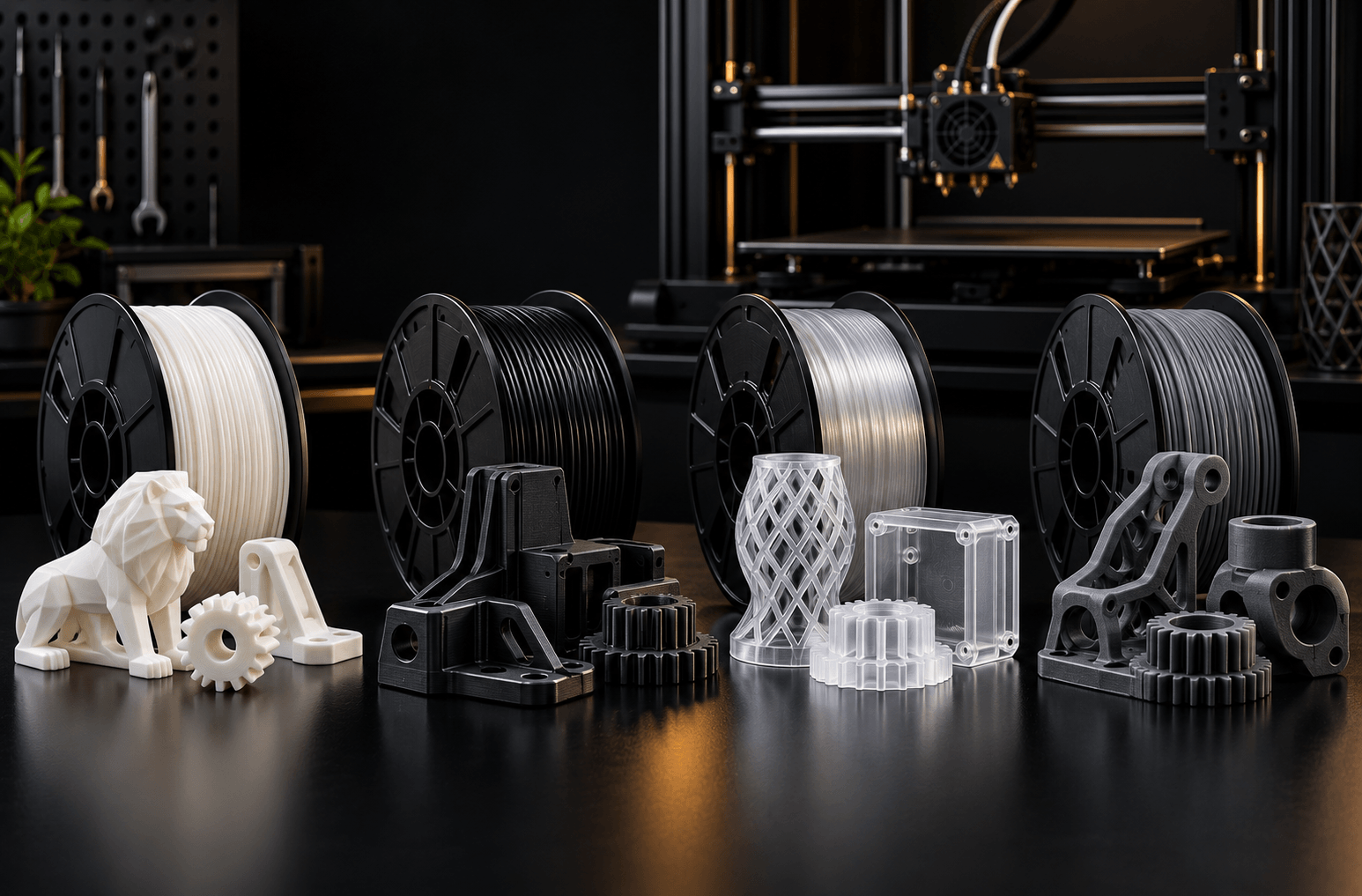
Choosing the wrong 3D printing material is one of the most common (and most expensive) mistakes we see. A PLA bracket that looks perfect on your desk can warp inside a parked car in Chennai in May. A Nylon part that tested well in Bengaluru can swell slightly during a humid monsoon month in Mumbai. The material decides whether your part survives real use.
This guide compares the four materials Indian businesses ask us about most: PLA, ABS, PETG and Nylon. It covers strength, heat resistance, finish, cost and the parts each one is best for, so you can pick the right one before you send your file for a quote.
Quick answer
Key takeaways
Use this table as a first filter. The ratings are relative to each other, not absolute engineering values.
← Swipe to see the full table on mobile
| Property | PLA | PETG | ABS | Nylon |
|---|---|---|---|---|
| Strength (tensile) | Good, but brittle | Good | Moderate | High |
| Toughness / impact | Low | High | High | Very high |
| Heat resistance (approx. softening) | ~55–60°C | ~70–80°C | ~90–100°C | ~80–150°C+ (grade dependent) |
| Flexibility | Stiff | Slight flex | Slight flex | Flexes without snapping |
| Wear / friction resistance | Poor | Fair | Fair | Excellent |
| Moisture sensitivity | Low | Low | Low | High (absorbs water) |
| UV / outdoor use | Poor | Fair | Poor (yellows) | Fair |
| Surface finish | Clean, crisp detail | Glossy | Matte; can be vapour-smoothed | Matte, slightly grainy (SLS) |
| Relative cost | ₹ | ₹₹ | ₹₹ | ₹₹₹ |
| Best for | Models, concept prototypes | Functional parts, fixtures | Enclosures, housings | Gears, clips, end-use parts |
PLA (polylactic acid) is a plant-based thermoplastic and the most widely used FDM material. It prints with sharp detail, minimal warping and a good surface finish, which makes it the most economical way to check form and fit.
The part will sit in direct sun, inside a vehicle, near a motor or anywhere above about 50°C. PLA starts to soften at around 55–60°C. In Indian summers, a car dashboard can exceed this within an hour. PLA is also brittle: it snaps rather than bends, so it is a poor choice for snap-fits, living hinges or anything that takes impact.
PETG is a modified version of the PET used in water bottles. It combines most of PLA’s ease of printing with much better toughness, chemical resistance and heat tolerance. If you are unsure which material to choose for a working part, PETG is usually the safest starting point.
PETG is not ideal above roughly 70–80°C. Its glossy surface can show layer lines more than PLA, and it is harder to sand and paint. For very fine cosmetic detail, PLA or resin is a better choice.
ABS is the same family of plastic used in many injection-moulded consumer products, from TV remotes to automotive interior trims. That makes it a good choice for prototypes that should behave like the final moulded part.
ABS shrinks as it cools, so large flat parts can warp unless printed on a properly enclosed machine. It also degrades and yellows in sunlight, so it is not recommended for permanent outdoor use without painting or UV-protective coating.
Nylon (polyamide, commonly PA12 or PA6) is the strongest and toughest material in this comparison. It flexes under load instead of cracking, resists wear and friction, and holds up well to oils and fuels. At Precious3D we offer Strong Nylon for tough general-purpose parts and Glass Nylon (glass-filled) for extra stiffness and heat resistance.
Nylon can be printed as filament (FDM) or as powder (SLS/MJF). Powder-bed Nylon parts are stronger in every direction, need no support structures and are better for complex or production-quality parts. FDM Nylon is useful for larger, simpler parts and is typically more economical in very low quantities. Not sure which process fits? Read FDM vs SLA vs SLS: which 3D printing process is right for your part.
Nylon absorbs moisture from the air. This slightly changes its dimensions and stiffness, which matters in humid cities like Chennai, Mumbai and Kolkata. For tight-tolerance parts, tell us the operating environment so we can recommend the right grade or post-treatment. Nylon also costs more than the other three materials.
← Swipe to see the full table on mobile
| Your requirement | Recommended | Why |
|---|---|---|
| Investor demo or design review model | PLA | Lowest cost, best detail |
| Functional prototype for testing | PETG | Tough, easy to iterate |
| Electronics housing / control box | ABS | Heat tolerant, finishes well |
| Part inside a vehicle or near a motor | ABS or Glass Nylon | Survives 80–100°C+ |
| Gear, hinge, clip or snap-fit | Nylon | Flexes, resists wear |
| Shop-floor jig or fixture | PETG or Nylon | Durable, chemical resistant |
| Outdoor part | PETG (or coated ABS) | Better UV and weather tolerance |
| 10–200 end-use parts | Nylon (SLS/MJF) | Production-quality, consistent |
3D printing cost depends on part volume, print time, process, infill and finishing, not just the material. The figures below are indicative 2026 ranges for a small part (roughly a palm-sized bracket or cover) to help you compare materials. They exclude GST, design and shipping.
← Swipe to see the full table on mobile
| Material | Typical process | Small part (1–5 pcs) | Relative cost |
|---|---|---|---|
| PLA | FDM | ₹300 – ₹1,200 | Baseline |
| PETG | FDM | ₹400 – ₹1,500 | ~1.2–1.4x PLA |
| ABS | FDM (enclosed) | ₹450 – ₹1,600 | ~1.3–1.5x PLA |
| Strong Nylon | FDM / SLS / MJF | ₹900 – ₹3,500 | ~2.5–3x PLA |
| Glass Nylon | SLS / MJF | ₹1,200 – ₹4,500 | ~3–4x PLA |
Prices are indicative only. Your exact price depends on your CAD file. For a full breakdown, see our complete guide to 3D printing cost in India.
Some jobs need properties none of these four can deliver. We also print in:
If you need production-like plastic parts in quantities of 20–200, vacuum casting or soft tooling may be more economical than 3D printing. For thousands of parts, compare 3D printing vs injection moulding.
Not sure which material your part needs?
Send us your CAD file and tell us how the part will be used. Our engineers will recommend the right material and process, and send a quote within 24–48 hours.
Request a Quote Call +91 86100 39566PLA is slightly stiffer and can have similar tensile strength, but it is brittle. PETG is far tougher and handles impact and bending without snapping, so for most functional parts PETG is the stronger choice in practice.
It depends on the job. ABS handles higher temperatures (around 90–100°C vs 70–80°C) and is easier to sand, paint and smooth. PETG is better for moisture, chemicals and outdoor use, and warps less. For electronics enclosures near heat, choose ABS. For general functional parts, PETG.
Of these four, Glass Nylon and ABS handle heat best. For even higher temperatures, polycarbonate or metal 3D printing may be needed. Tell us the maximum operating temperature and we will recommend a suitable material.
Not reliably. Direct sunlight can push surface temperatures above PLA’s softening point, and UV exposure weakens it over time. PETG is a better choice for outdoor parts.
Some Nylon grades are food-contact rated as raw material, but 3D printed parts can trap bacteria in surface pores, and certification depends on the exact grade and process. Talk to us about your application before using any printed part for food contact.
PLA is the cheapest, followed closely by PETG and ABS. Nylon typically costs 2.5–4x more than PLA for the same part, depending on the process.
Yes. Many clients order one part in PLA or PETG for fit testing and another in Nylon or ABS for functional testing. Mention this when you request a quote.
STL or STEP files work best. If you only have a sketch or drawing, our 3D CAD design team can create the model for you.
Start with how and where the part will be used, not with which material sounds strongest. PLA for looks and low-cost iteration, PETG for everyday functional parts, ABS for enclosures and heat, and Nylon for strength, wear and end-use performance. Get that one decision right and you’ll save on reprints, delays and failed tests.
Precious3D offers PLA, PETG, ABS, Strong Nylon, Glass Nylon and 50+ other materials across multiple 3D printing technologies from our Chennai facility, with delivery across India. Explore our 3D printing services or get a quote today.
You’ve sent out your RFQ and three injection moulding quotes have landed in your inbox. One is ₹1.8 lakh, another ₹2.6 lakh, and the third ₹3.4 lakh. The obvious move is to pick the cheapest one. In most cases, that’s the wrong move.
Injection moulding suppliers quote in very different ways. Some include mould trials, packaging and freight; others leave them out. Some quote a single-cavity P20 mould, others a two-cavity hardened steel tool. Unless you compare injection moulding quotes on a like-for-like basis, you are comparing apples to oranges.
This guide shows you exactly how to compare injection moulding quotes from suppliers, line by line, with a checklist, a worked example, a scoring template and the red flags to watch for.
Quick Answer: How do you compare injection moulding quotes?
A low headline price usually means something has been left out or downgraded. Common reasons a quote looks cheaper than it really is:
If you’re still building your budget, start with our breakdown of injection molding cost in India, which covers typical tooling, per-unit and hidden cost ranges.
You can only compare injection moulding quotes fairly if every supplier is quoting the same job. A clear Request for Quotation (RFQ) should include:
| RFQ Item | What to Provide |
|---|---|
| 3D CAD + 2D drawing | STEP/IGES file plus a drawing with critical dimensions |
| Material | Exact grade (e.g. ABS, PP, PA66 GF30), colour, virgin or regrind allowed |
| Quantities | First order, annual volume and expected product lifetime volume |
| Tolerances | General and critical tolerances |
| Surface finish | SPI polish grade or texture reference |
| Secondary operations | Printing, inserts, assembly, painting |
| Packaging & delivery | Packing standard, delivery location, Incoterms for exports |
| Quality requirements | Inspection report, FAI, material certificates |
Tip: Always share your lifetime volume, not just the first order. It decides whether a supplier should quote a prototype aluminium mould or a hardened-steel production mould, and that single choice can swing tooling cost by lakhs.
Suppliers format quotes differently. Put every quote into one comparison sheet with these rows so nothing hides between formats.
| Line Item | What to Check |
|---|---|
| Tooling / mould cost | One-time cost, payment terms, what’s included |
| Part price | Per-unit price at each quantity break |
| Mould trials (T1, T2) | How many trials are included, cost of extra ones |
| Design changes | Cost of mould modifications after approval |
| Secondary operations | Finishing, printing, assembly, inserts |
| Packaging | Included or charged per unit |
| Freight | Ex-works or delivered |
| Taxes | GST included or extra (18% on most moulded parts and tooling) |
| Validity | How long the price holds, and material price escalation clauses |
Two moulds with a ₹1 lakh price difference can be completely different tools. These are the specs that matter most when comparing injection moulding quotes:
| Mould Spec | Cheaper Option | Premium Option | Why It Matters |
|---|---|---|---|
| Steel grade | Aluminium / P20 | H13 / stainless | Mould life and part consistency |
| Cavities | 1 cavity | 2, 4, 8+ cavities | More cavities = lower part price |
| Runner system | Cold runner | Hot runner | Material waste and cycle time |
| Guaranteed shot life | 10k – 1 lakh shots | 5 lakh – 10 lakh+ | Whether you’ll need a second mould |
| Cooling design | Basic channels | Optimised / conformal | Cycle time and warpage |
| Mould flow analysis | Not included | Included | Fewer defects and trial rounds |
The right spec depends on your volume. For short runs a cheaper mould is often the smart choice; for long runs it’s usually false economy. Our guide on low-volume vs high-volume injection molding explains where that line sits.
The per-unit price in an injection moulding quote is built from a few inputs. Ask each supplier to share them so you can see where the difference comes from:
Watch out: A supplier quoting a much shorter cycle time than everyone else may be over-promising. Ask how they arrived at it, and whether the price changes if real production runs slower.
This is where the real comparison happens. Add back everything each supplier left out, then divide by your total volume.
Here’s a realistic comparison of three supplier quotes for the same ABS enclosure part (all figures excluding GST).
| Item | Supplier A | Supplier B | Supplier C |
|---|---|---|---|
| Mould spec | 1-cavity, P20, 1 lakh shots | 2-cavity, H13, 5 lakh shots | 2-cavity, H13, 5 lakh shots |
| Tooling | ₹1,80,000 | ₹2,60,000 | ₹3,40,000 |
| Part price | ₹18 | ₹16 | ₹15 |
| Quoted total | ₹5,40,000 | ₹5,80,000 | ₹6,40,000 |
| Trial modifications | +₹25,000 (extra) | Included (2 trials) | Included |
| Packaging | +₹60,000 (₹3/unit) | Included | Included |
| Freight | +₹15,000 | +₹15,000 | Included |
| Real total | ₹6,40,000 | ₹5,95,000 | ₹6,40,000 |
| True cost per part | ₹32.00 | ₹29.75 | ₹32.00 |
Result: Supplier A looked cheapest by ₹40,000, but once hidden costs were added, Supplier B is ₹45,000 cheaper on this order.
And B’s mould lasts 5× longer. If you reorder another 20,000 parts, A’s ₹2 higher part price costs you another ₹40,000, plus ₹60,000 more in packaging, before its mould starts to wear out.
Price is only part of the decision. A delayed mould or a high rejection rate can cost more than any quote difference. Use a simple weighted scorecard to compare injection moulding suppliers:
| Criteria | Suggested Weight | What to Look For |
|---|---|---|
| True landed cost | 30% | Total cost per part over lifetime volume |
| Quality capability | 25% | ISO 9001, inspection reports, CMM, past rejection rates |
| Tooling expertise | 15% | In-house toolroom, DFM feedback, mould flow analysis |
| Lead time | 15% | Weeks to T1 samples and to first production batch |
| Communication & support | 10% | Response time, clarity, single point of contact |
| Commercial terms | 5% | Payment terms, mould ownership, warranty |
Score each supplier from 1 to 5 on every criterion, multiply by the weight and add up the totals. For a deeper look at evaluating vendors, read our guide on how to choose an injection molding partner in India.
If your volumes are low or your design is still changing, an injection moulding quote may not be the right starting point. Compare your options first:
Three to five quotes is usually enough. Fewer than three gives you no real benchmark, while more than five adds comparison work without much benefit.
Differences in mould steel, cavity count, runner system, cycle time assumptions, material grade and what’s included (trials, packaging, freight) can easily make one quote two to three times another for the same part.
With a complete RFQ including CAD files, most Indian suppliers respond within 2–5 working days. Complex multi-cavity tools may take longer.
Only if your volumes are low. For higher volumes, a more expensive mould with more cavities and longer life usually gives a lower true cost per part.
A staged structure is common in India, for example 50% on order and 50% after T1 sample approval. Avoid paying the full tooling amount before you’ve seen and approved samples.
Yes. Committing to higher annual volumes, accepting a standard material, simplifying the design after DFM feedback, or agreeing to longer lead times can all bring the price down.
The best way to compare injection moulding quotes from suppliers is to stop comparing headline prices. Instead:
Do this and the cheapest quote and the best-value quote stop being a guessing game.
Want a transparent injection moulding quote?
Share your CAD file and get a clear, itemised quote covering tooling, part price, trials and lead time, with nothing hidden.
Get a Free Quote